Brokerage Software Procurement: RFP Questions to Ask
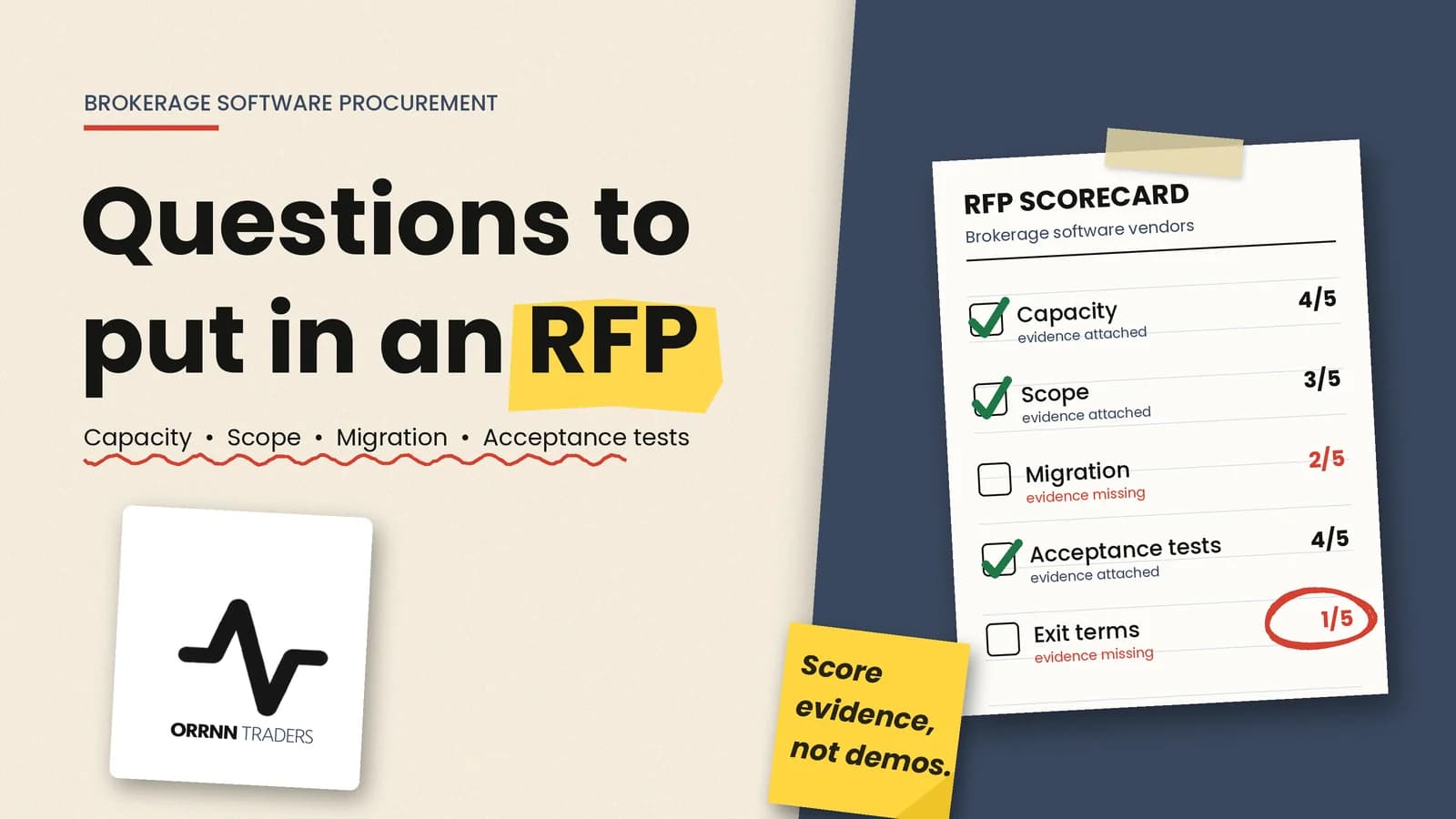
The RFP questions that matter when buying brokerage software: capacity, scope, scoring, migration, acceptance tests and exit terms, with a scoring model.
Brokerage Software Procurement: Questions to Put in an RFP
A weak RFP produces polished answers to the wrong questions. Buyers of brokerage software often send a long feature spreadsheet, receive "yes" in every cell, and discover the real differences during migration.
This guide is about writing the RFP itself: what to define before vendors respond, how to score answers against evidence, and which contract, acceptance and exit questions to settle before signing. For the due-diligence items on vendor due diligence, use our Trading Platform Procurement Checklist alongside this one. It covers scope: brokerage software selection only. Licensing, banking and managed launch are separate workstreams.
Business and asset requirements
Start with your own requirements, because vendors can only answer what you have defined.
Define the business case first
- Asset classes at launch and in 24 months
- Account models: netting, hedging, or both
- Client regions and the terminals and devices they use
- Operating model, such as A-book, B-book or hybrid execution
Put capacity in numbers
Vendors can't size a system for "a lot of traders". Supply figures for peak concurrent sessions, peak orders per second, number of symbols, and expected growth. Ask each vendor to state the test conditions behind any capacity figure, including message mix, hardware and duration.
Fix scope before pricing
Require a matrix that separates what the base licence includes from what is custom work. Custom matching logic, bespoke bridges and dedicated hosting are the usual sources of surprise cost.
| Requirement area | RFP question to ask |
|---|---|
| Capacity | At our stated peak, what sustained throughput did you measure, and under what conditions? |
| Scope | Which of our listed requirements are standard, configurable, or custom-built? |
| Integration | Which CRM, payment and liquidity integrations exist today, and which would be new work? |
| Risk controls | Which risk and margin rules can our team change without vendor involvement? |
| Reporting | What reports and raw data exports are available to us directly? |
Scored RFP and vendor evidence
Unscored RFPs get decided by the most persuasive demo. A scoring model forces the comparison onto evidence.
Here is an illustrative weighting. Adjust it to your priorities and agree it before responses arrive.
| Criterion | Weight |
|---|---|
| Functional fit | 25% |
| Capacity and resilience | 20% |
| Integration | 15% |
| Security and compliance evidence | 15% |
| Commercial terms and total cost | 10% |
| Migration and implementation | 10% |
| Exit terms | 5% |
Score each answer from 0 to 5, with one rule: a claim without evidence cannot score above 2.
Acceptable evidence includes:
- A load-test report showing the test setup and results, not only a headline figure
- Sandbox access where your own team runs scenarios
- Architecture documentation covering failover and data flows
- Independent security assessment summaries, where the vendor holds them
- Reference calls with firms of similar size and asset mix
Treat unexplained performance claims with caution. A figure that arrives without a test method is marketing.
For cost, compare over the full term. Our total cost of ownership guide covers licence, connectivity and customisation lines.
Contract, acceptance and exit questions
Acceptance tests
Write acceptance tests into the contract, and tie payment milestones to them. A practical set:
- Functional: your scripted scenarios run end to end, including account opening, funding, trading and closing.
- Load: performance at an agreed multiple of your stated peak.
- Failover: a witnessed drill with recovery time and data-consistency checks.
- Migration reconciliation: balances, open positions and history match the source system.
- Security: testing scope and remediation obligations agreed in advance.
- Rollback: a tested route back if a release fails health checks.
Migration questions
Moving from an existing platform, such as a legacy MetaTrader-based setup, is often where projects slip. Ask:
- How is data mapped, and who validates it?
- Is a parallel run possible before cutover?
- What is the cutover window, and what is the rollback plan?
- Which migration tasks are included, and which are chargeable?
Exit questions
Settle exit terms while you still have leverage:
- In what formats, and at what cost, can we export our data at any time?
- What transition assistance applies at termination, and for how long?
- Who owns custom algorithms, indicators and routing rules?
- What notice applies before an API version is deprecated?
Our guides on vendor lock-in and exit planning and change-control governance go deeper on the last two areas. Have your legal and compliance teams review the final terms against the outsourcing and operational resilience rules that apply to your licence in the US or UK.
Turning the RFP into a decision
Keep the process simple: define requirements, score against evidence, test in a sandbox, and put acceptance and exit terms in the contract. The best-scored vendor is the one whose claims survived your tests.
Want to run your shortlist through these questions? Request an architecture review and put our systems team through your RFP.