Trading Engine Architecture and Order Lifecycle | ORRNN
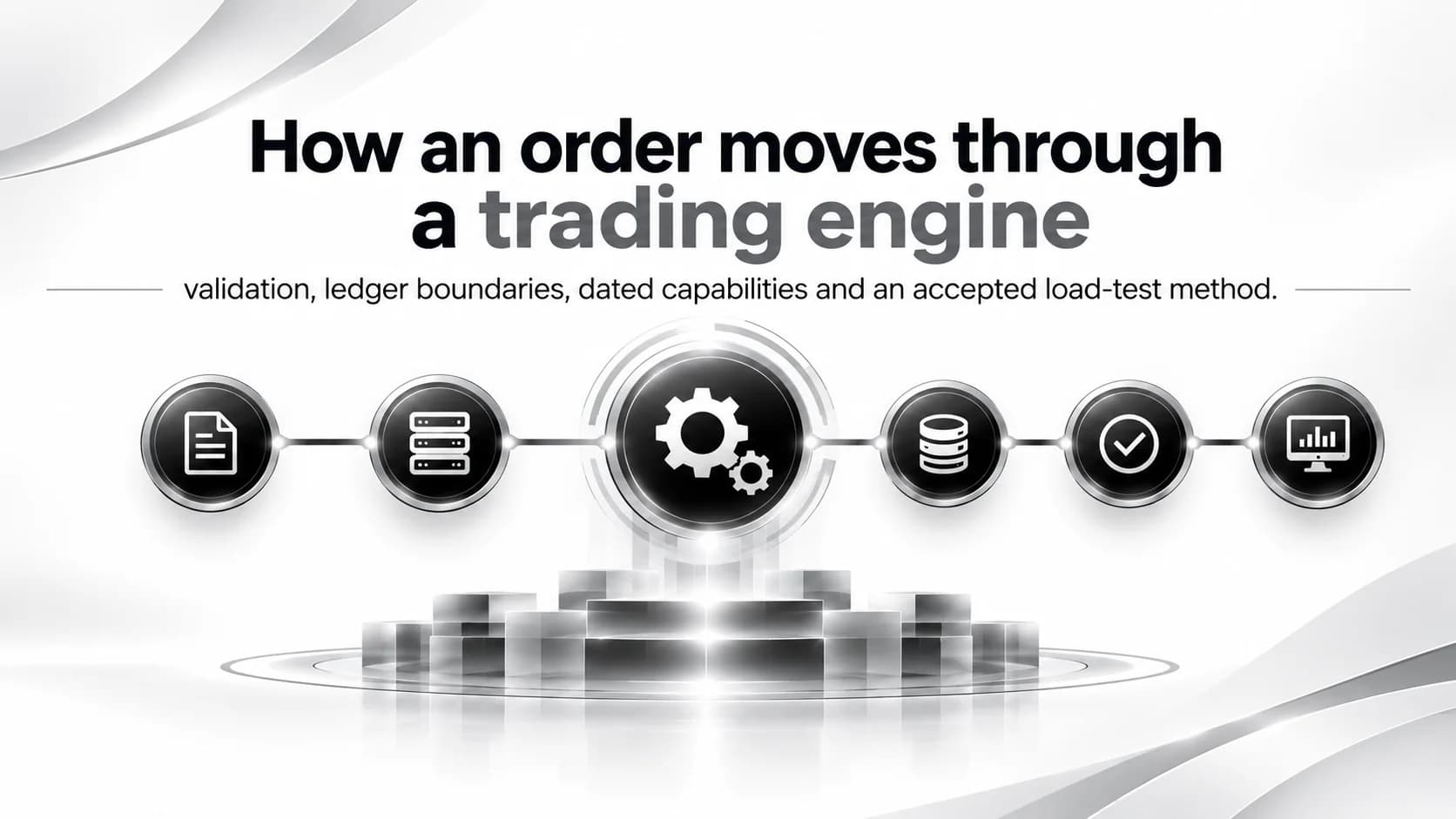
How an order moves through a trading engine: validation, ledger boundaries, dated capabilities and an accepted load-test method.
Every trading platform shows a clean architecture diagram. What buyers actually need to know is harder to see: where an order is checked, which component owns the record of what happened, and what has really been tested. This guide walks through the order lifecycle in the ORRNN Core Engine and sets out how to evaluate any trading engine architecture, including ours.
Order validation and ledger boundaries
An order in the Core Engine follows a six-stage path. The user's request enters through the RTX 5 gateway layer, reaches the Core Engine, goes out to the liquidity network, returns as a fill confirmation, and ends in a real-time reporting loop. Every handoff is a boundary, and boundaries are where production problems tend to hide.
Validation should happen early, before an order consumes downstream resources. A sound sequence checks session and permissions at the gateway, then instrument and order-type rules, then size, price and margin limits against the account's risk configuration. Only an order that passes every check should be routed. A failed order should return a specific rejection reason and never reach a liquidity provider.
The more important question is the ledger boundary: which component is the system of record? We recommend a single authoritative ledger written by the engine, recording every state change (accepted, routed, partially filled, filled, cancelled, rejected). Terminals, risk views and reports read from that record instead of keeping private copies. Reconciliation against liquidity provider confirmations then becomes a defined step rather than a forensic exercise.
When reviewing any engine, ask three things. Where does the ledger boundary sit? What happens to an in-flight order during failover? How is a duplicate message detected?
Architecture diagram and accepted load-test method
A load test is only accepted if its method is agreed before it runs. Our recommended method:
- Define the workload. Order mix (market, limit, cancel and replace), instruments, session count and message rates.
- Fix the environment. Record the build, hardware, region and liquidity simulator used.
- Ramp in steps. Increase load in stages, hold each stage, and measure at both client and engine boundaries.
- Report percentiles. Publish p50, p95 and p99 latency alongside rejection rate and any sequence gaps, never averages alone.
- Inject failures. Restart a node and drop a liquidity connection, then confirm the ledger reconciles with no unexplained differences.
- State the limit. Name the load at which latency or errors exceed agreed thresholds.
- Allow independent rerun. The buyer's team can witness or repeat the test.
A trading engine earns trust when its limits are published, not just its strengths.
Request an architecture review. Bring your order flow, risk rules and load targets, and our engineers will walk through validation, ledger boundaries and test method with you.