Forex Liquidity Providers: Selection and Due Diligence
Choosing forex liquidity providers means testing each candidate on your own symbols, order sizes and trading sessions, then getting depth, reject behavior, last-look and credit terms in writing. The headline spread is only one input. Confirm each provider’s contracting entity and its regulatory status on the regulator’s public register before you connect.
New to the term? Read what a liquidity provider is.
Updated
What to decide before you connect
- 01
The headline spread is one input. Depth at your order sizes, reject behavior and last-look terms decide what clients actually receive.
- 02
Test each LP on your own symbols, sessions and order sizes, then compare the measured results with the terms on paper.
- 03
Direct connections give tighter control of each venue. Aggregation adds reach and failover, but it also adds a routing layer you have to govern.
- 04
Get rejection and last-look terms in writing, together with the report that will show them in practice.
- 05
Confirm the contracting entity and its regulatory status on the regulator’s public register before you sign.
- 06
Orrnn helps define requirements and test connectivity. It does not supply liquidity, act as an LP or give regulatory advice.
How LPs fit into a broker’s flow
How much a broker relies on its LPs depends on how it handles client orders. Under an A-book model, client orders are passed to liquidity providers. Under a B-book model, the broker takes the other side of client trades and may hedge some or all of that exposure with LPs. Most brokers run a mix, and the mix changes with client behavior, symbols and risk limits.
The LP panel therefore has to support the broker’s real routing and hedging policy. A generic price feed is not enough. Each provider needs its own symbol list, size limits, session times, credit line and reporting. For the background, read forex liquidity explained. For the model choice, read A-book vs B-book vs hybrid. For the platform scope, see Orrnn for brokers.
Forex liquidity providers: selection criteria
Price is the first thing most buyers compare, but it is rarely the only thing that matters. The table sets out what an LP review should cover. Ask for each item in writing, because a verbal answer is hard to test later.
Swipe sideways to see all columns
| Criterion | What to ask | Evidence to request |
|---|---|---|
| Pricing | How are spreads, markups and commissions set? Do quotes widen during news or in thin markets? | Written price schedule, quote logs for your symbols, and the widening rules |
| Depth and size | How much size is quoted per symbol, and at which price levels? Are there size tiers or caps? | Depth snapshots at your typical order sizes and a sample of fills |
| Rejects and last look | Is last look applied? What is the hold window, and for which reasons are orders rejected? | Written policy, reject codes, and reject rates by symbol and session over an agreed period |
| Latency and session stability | Where is the connection hosted? How is round-trip time measured? How are dropped sessions recovered? | The measurement method, timestamp definitions, session logs and sequence-recovery behavior |
| Reporting and reconciliation | Which trade, quote and fee reports are provided, and how often? How are disputes raised and answered? | Sample reports, daily reconciliation files and the dispute-handling timetable |
| Credit, margin and settlement | What credit lines, margin and collateral are required? What are the close-out and settlement terms? | Term sheet reviewed by your counsel and finance team |
| Legal entity and regulation | Which entity contracts with the broker, in which jurisdiction, and under which permissions? | Entity details and a dated record of the register check on the regulator’s public register |
Latency figures depend on the measurement point, the network path and the test method. Compare providers only on the same basis.
Last look and rejects
In a last-look model, a provider can review an incoming order against its current price for a short window before it accepts or rejects the order. Practice varies by provider and product, so ask for the policy in writing. A low headline spread with frequent rejects can cost a broker more than a slightly wider spread that fills reliably. Measure rejects over real sessions, not only in a demo.
Direct LP connections or aggregation
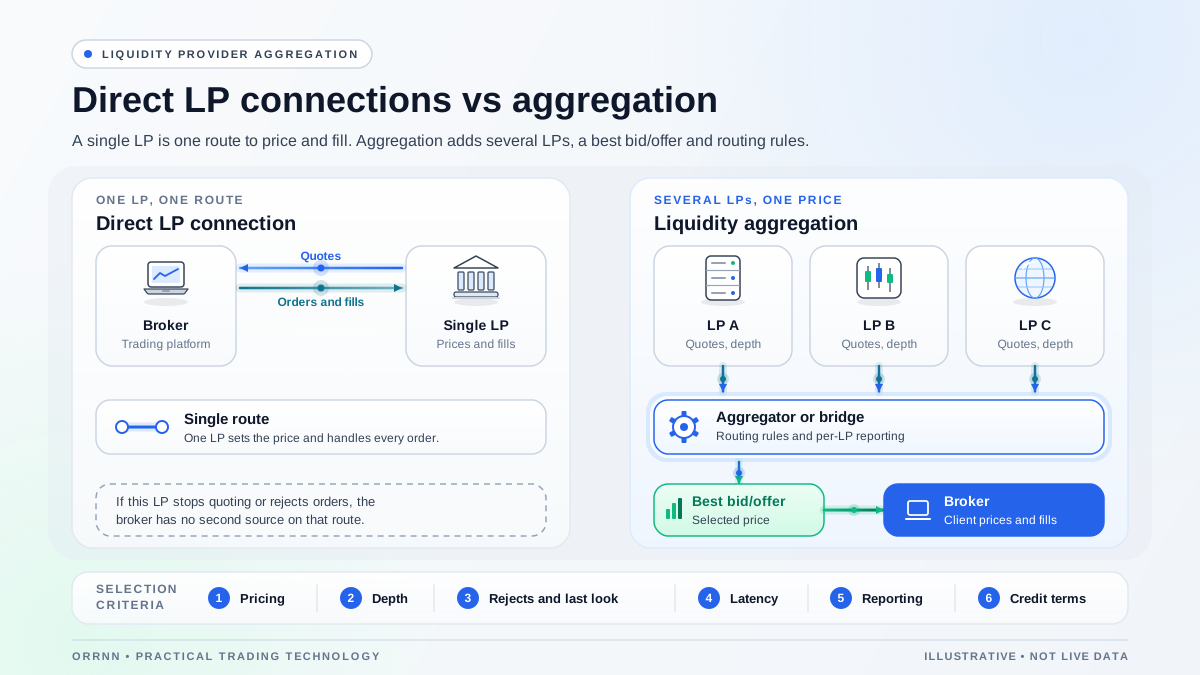
A broker can connect to each LP directly, with its own session, credit line and dialect. Or it can connect through an aggregator or bridge that combines several LP streams into one price and routing layer. Direct connections are simpler to audit, and each counterparty relationship stays clear.
Aggregation gives wider reach, easier failover and one integration point for the trading platform. The cost is governance. The broker has to decide how prices are selected, how markups are applied and which provider receives each order. Liquidity aggregation is a pricing and routing decision, not only a connectivity task.
The liquidity bridge evaluation guide covers routing, risk and the testing sequence in more detail.
Where Orrnn fits in LP selection
Orrnn does not supply liquidity. It is not a liquidity provider, prime broker or market maker, and it does not give regulatory or legal advice. Orrnn is a trading software architecture and engineering provider. Brokers contract directly with their liquidity venues.
In LP selection, Orrnn’s engineering team can help a broker:
- define connectivity and routing requirements for each LP, including FIX or API scope, symbols and session rules
- evaluate how an LP connection would fit the liquidity bridge and the order-routing design
- test integrations against agreed acceptance criteria, such as session recovery and reconciliation
RTX5’s roadmap lists its bridge and FIX 4.4/5.0 adapters as build not published (checked 9 November 2026), and its REST and WebSocket APIs are Planned. Each venue connection needs an agreed scope, a demonstration and acceptance tests before production use. Orrnn refers licensing and brokerage-launch enquiries to FxTrusts, a separate company with its own terms. You can read more on the broker page.
LP due-diligence checklist
Use this list for each provider on the shortlist, and keep the answers with the signed terms.
- 01
Get the price schedule in writing, including markups, commissions and any conditions tied to size or volume.
- 02
Get the last-look and rejection policy in writing: hold window, reject reasons and the report that shows reject rates.
- 03
Run a limited test on your own symbols, sessions and order sizes. Record quotes, fills and rejects with timestamps.
- 04
Confirm the connection method, FIX version or API scope, session limits, sequence recovery and maintenance windows.
- 05
Agree how latency is measured and reported, and which timestamps are the reference.
- 06
Agree reconciliation: daily trade and quote files, a fee report, and a dispute route with response times.
- 07
Review credit lines, margin, collateral, close-out and settlement terms with your finance and legal advisers.
- 08
Confirm the contracting entity and its permissions on the relevant public register, and keep a dated record of the check.
- 09
Ask for the failover arrangements and the procedure for open positions during an outage.
- 10
Record the decision in a scored shortlist with a review date, so the choice can be revisited.
Limitations of this guide
No liquidity provider is endorsed by Orrnn, and this page does not recommend any provider. Pricing, execution behavior, reject practice, credit terms and regulatory status vary by provider, product, client type and jurisdiction, and they change over time.
This page is general information. It is not investment advice, legal advice or regulatory advice. Verify each counterparty’s status yourself on the relevant public register, and have counsel review the contract. Leveraged FX and CFD trading carries a high risk of losing money quickly.
Sources
MetaQuotes describes connectivity to exchanges and liquidity providers in its MetaTrader 5 broker offer. That is the vendor’s description of its product, not evidence of any broker’s LP arrangements.
FIX is an open messaging standard. Check each LP’s FIX version and message scope against the FIX Trading Community standards.
Register checks: the FCA Financial Services Register (UK), NFA BASIC (US) and the ASIC registers (Australia).
Forex Liquidity Provider FAQ
Direct answers to the questions brokers ask when they compare liquidity providers.
A forex liquidity provider streams bid and ask prices for currency pairs and executes orders at those prices. The prices a broker’s clients see, and its hedging fills, depend on the LP. Pricing, depth and reject behavior therefore show up in spreads, slippage and client complaints.
Last look is a practice in which a liquidity provider can check an incoming order against its current price for a short window, then accept or reject it. It matters because a reject leaves a client’s order unfilled and can lead to slippage or disputes. Practices differ by provider, so ask for the policy in writing, the hold window, the reject reasons and the reject rate measured over a real trading period.
Direct connections give each LP its own session, credit line and reporting stream, which is simpler to audit. An aggregator adds reach and failover through one price and routing layer, but it needs clear rules for price selection, markups and routing. The right choice depends on the broker’s flow, risk limits and capacity to govern that layer.
No. Orrnn does not supply liquidity, is not a liquidity provider, prime broker or market maker, and does not give regulatory or legal advice. Orrnn is a trading software architecture and engineering provider. It can help a broker define LP connectivity and routing requirements, evaluate how an LP connection fits the bridge design, and test integrations. The broker contracts directly with each liquidity venue.
Not necessarily. A low headline spread can be offset by frequent rejects, thin depth at the broker’s order sizes, or unfavorable credit terms. Compare quoted spread at real size, fill rate, reject behavior, reporting and contract terms, then test the shortlist on the broker’s own symbols and sessions.
Start with the legal entity named in the contract, not the brand name. Check its authorization or registration on the public register of the relevant regulator, such as the FCA Financial Services Register in the UK, NFA BASIC in the US or the ASIC registers in Australia. Confirm that the permission covers the activity, keep a dated record of the check, and have counsel review the position.
Review your LP shortlist with our engineers
Send your flow profile, target symbols and the providers you are evaluating. We will help define connectivity and routing requirements and the acceptance tests to run before any production use. Scope, timing and fees are set in a written proposal.