Disaster Recovery in Capital Markets: Testing Cold vs. Hot Standby Infrastructures
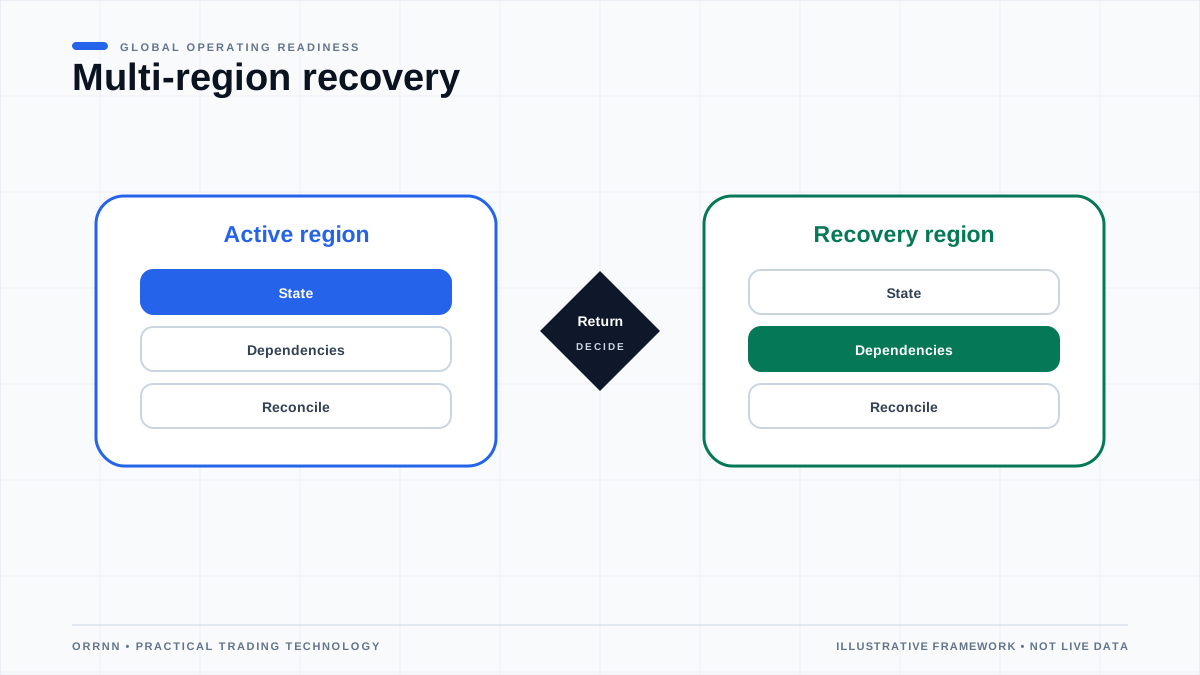
How tier-1 brokers organize quarterly failover drills, validate state deduplication, and satisfy regulatory continuity guidelines under MiFID II and CFTC.
Executive Technical Summary
How tier-1 brokers organize quarterly failover drills, validate state deduplication, and satisfy regulatory continuity guidelines under MiFID II and CFTC.
1. Problem Formulation & Scope of Analysis
Define the named environment, interfaces, workloads and evidence that would make this proposal acceptable. Architecture descriptions are evaluation context, not a substitute for an implemented and tested product.
Modern electronic trading platforms, matching engines, and institutional brokerages operate under unforgiving throughput and uptime constraints. Sub-optimal architectural design choices—such as unpinned CPU threads, non-deterministic network buffering, opaque vendor exit conditions, or unverified failover configurations—compound exponentially during peak volatility events like central bank rate decisions or macroeconomic announcements.
This guide provides evaluation questions for Disaster Recovery in Capital Markets: Testing Cold vs. Hot Standby Infrastructures. It is not an empirical benchmark, product acceptance report or evidence that a named RTX5 build has passed these checks. Confirm current product availability and the agreed deployment scope.
2. Requirements to Verify Before Procurement
Translate the proposed architecture into measurable acceptance criteria. The following questions are a procurement checklist, not measured performance results or claims of regulatory compliance:
| Specification Parameter | Evidence to Request | Verification Methodology |
|---|---|---|
| Vendor Due Diligence SLA | Request dated evidence with the assessor, scope and exceptions | Record the test method, conditions, sample and observed result |
| Data Portability & Exit SLA | Agree usable export formats, notice periods and exit assistance | Check the supported configuration and dependency inventory |
| Risk Pipeline Routing | Validate the proposed routing model and counterparty permissions | Verify the actual endpoint, permissions and connection behavior |
| Disaster Recovery Testing | Record recovery responsibilities, test frequency and observed results | Run a scoped failure/recovery test and retain its evidence |
3. Failure Modes & Operational Risk Controls
Every distributed financial system experiences unforeseen operating conditions. Mitigating operational and systemic risk requires layered defensive engineering:
- Capacity and Queue Saturation: Measure throughput and tail latency with a representative workload. Kernel bypass is one possible design choice, not a universal requirement or a guarantee against dropped messages.
- Resource Contention: Monitor CPU, memory, storage and connection stability during busy periods. Isolation controls can reduce interference; they do not eliminate every source of jitter or establish an execution guarantee.
- Recovery and Reconciliation: Test disconnection, restart and restore behavior. Document which records can be replayed, how duplicate actions are prevented and how discrepancies are resolved; replication alone does not prove zero data loss.
4. Production Engineering Checklist
Agree an acceptance checklist appropriate to the workload and jurisdiction before authorizing production traffic:
- Record the named build, environment, broker endpoints and supported dependencies.
- Enforce isolated user accounts with strict role-based access control (RBAC) and immutable audit log streams.
- Reconcile records against the agreed source of truth and retention requirements.
- Test backup restoration and service recovery, including any manual steps and limitations.
- Have qualified reviewers confirm applicable legal requirements; a software checklist is not a licence.
5. Conclusion & Verification Summary
Use dated test results and a written scope to choose the next step. No architecture can guarantee uninterrupted operation, execution speed or compliance in every circumstance. Compare the procurement checklist and broker technology scope before requesting a proposal.