Trading Technology for Brokers and Professional Firm
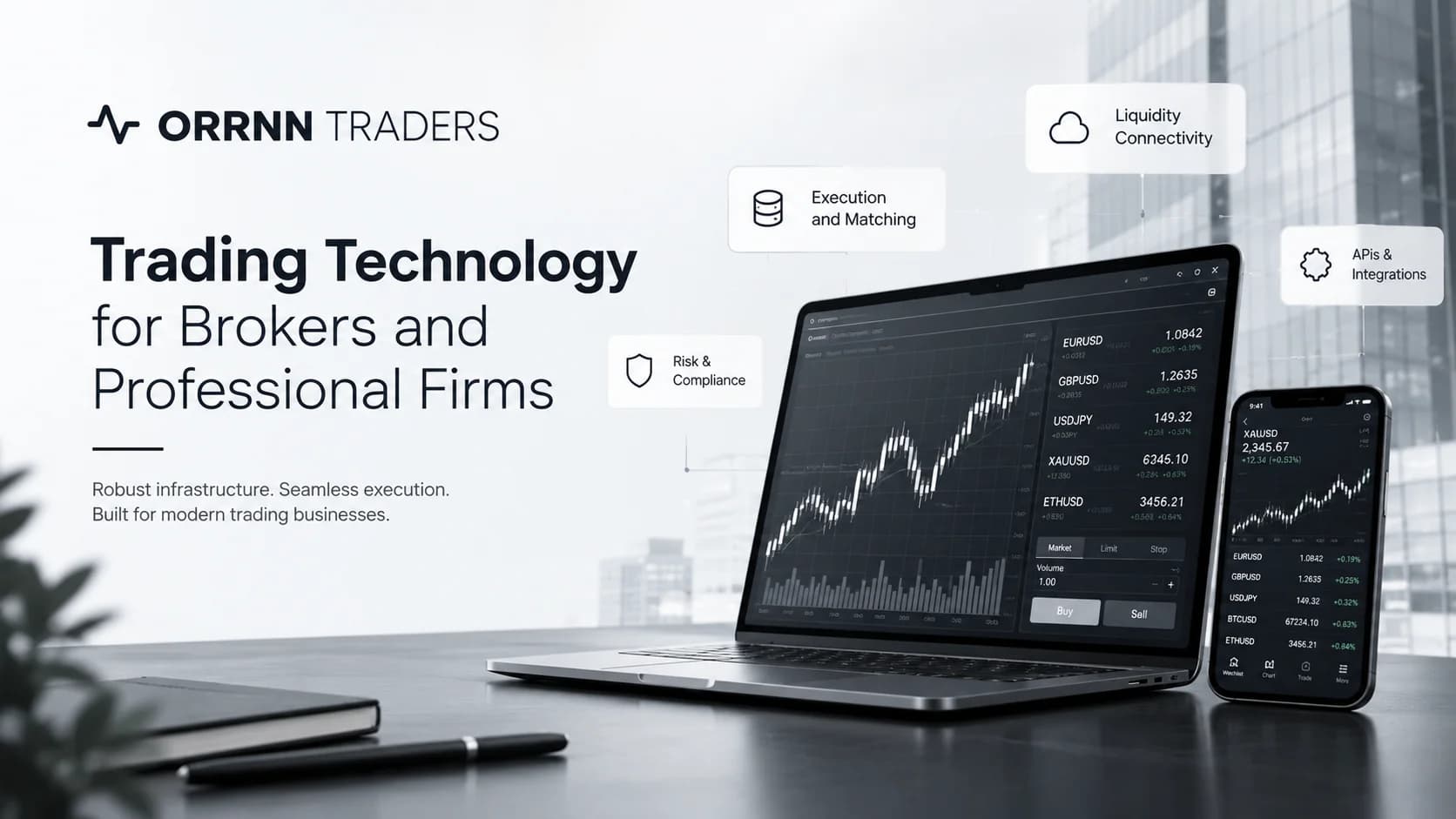
Explore trading technology for brokers and professional firms, from execution engines and APIs to liquidity, risk controls, security, and infrastructure.
Trading technology for brokers and professional firms combines trading platforms, execution systems, APIs, liquidity connectivity, risk controls, and infrastructure. These components help financial businesses manage trading workflows, integrate external services, and maintain operational visibility.
For forex brokers, hedge funds, proprietary trading firms, and institutional trading teams, choosing the right technology affects scalability, execution workflows, security, and operating costs. The objective is not simply to purchase software with more features. It is to build a technology stack that supports the firm's business model and long-term requirements.
What Is Trading Technology for Professional Firms?
Trading technology includes the software and infrastructure used to process orders, distribute market data, connect liquidity providers, manage accounts, and monitor trading operations.
A typical environment may include a trading terminal, execution engine, order-routing services, APIs, risk-management systems, and back-office integrations. The configuration depends on the organization: a forex broker has different requirements from a hedge fund managing multiple portfolios.
Explore Orrnn's trading platform architecture, brokerage technology solutions, and hedge fund technology to understand the different requirements of professional trading environments.
1. Trading Platforms and Execution Infrastructure
The execution layer processes trading instructions and manages order states. Depending on the architecture, it may handle order validation, routing, matching, margin checks, position updates, and execution reporting.
When evaluating a platform, examine these essential capabilities:
Order processing: How are rejected orders, partial fills, cancellations, and duplicate requests handled?
Performance: How does the system behave under representative peak workloads?
Risk controls: Where are exposure limits and margin checks enforced?
Monitoring: Can operators trace orders and investigate unexpected events?
Scalability: Can the architecture accommodate additional users, instruments, and integrations?
A documented order lifecycle makes testing and troubleshooting easier. Firms should request demonstrations and acceptance tests rather than relying exclusively on vendor performance claims.
Review Orrnn's trading platform architecture and engineering services when investigating platform design, integration requirements, and deployment options.
2. Liquidity Connectivity and Trading APIs
Professional trading systems often connect with liquidity providers, market-data vendors, prime brokers, and external financial applications. Reliable connectivity requires consistent message handling, instrument mapping, session recovery, and reconciliation.
FIX is commonly used for standardized financial messaging, while REST and WebSocket APIs support different integration and real-time communication requirements.
Before selecting a connectivity solution, assess:
Supported protocols and message types.
Authentication, permissions, and rate limits.
Market-data normalization and instrument mapping.
Order acknowledgements and execution reports.
Session recovery, logging, and reconciliation.
Compatibility with existing providers and systems.
Explore Orrnn's brokerage technology solutions, broker technology guides, and engineering services for related architecture and integration considerations.
Remember that general API support does not guarantee compatibility with every provider. Confirm supported workflows, implementation scope, and testing requirements before deployment.
3. Algorithmic Trading and Automation
Algorithmic trading infrastructure supports automated strategies, order execution, and trading-related workflows. However, reliable automation requires more than an algorithm that generates signals.
Systems must account for rejected orders, disconnected sessions, duplicate submissions, excessive message rates, and unexpected resource consumption.
Key considerations include:
Separating strategy processes from critical execution services.
Applying account-level permissions and access controls.
Monitoring resource consumption and message rates.
Maintaining logs and failure notifications.
Testing with realistic market data and execution assumptions.
Establishing procedures to pause or disable automation.
Explore Orrnn's algorithmic trading infrastructure to investigate relevant requirements. Confirm the availability of individual features, integrations, and deployment configurations before relying on them in production.
4. Risk Management, Security, and Resilience
Trading technology must support operational control alongside execution. Even a well-functioning system can encounter problems during network interruptions, infrastructure outages, or unexpected workload spikes.
Risk-management capabilities may include pre-trade validation, margin monitoring, exposure limits, and emergency intervention procedures. Security requires appropriate authentication, least-privilege access, environment isolation, change management, and audit records.
During vendor evaluation, ask:
Which controls are implemented within the platform?
How are privileged actions recorded and reviewed?
What happens when a market-data feed becomes unavailable?
How are backups and recovery procedures tested?
What evidence supports security and performance claims?
Review Orrnn's engineering services and technical guides for further information about architecture and implementation planning.
5. Technology for Hedge Funds and Institutional Teams
Hedge funds and institutional trading teams may require portfolio-level visibility, account allocation, reporting, and clearly separated operational responsibilities.
For example, traders may need order-submission permissions, risk managers may require exposure monitoring, and finance teams may need reconciliation records. Separating these responsibilities can improve oversight and simplify investigations.
Evaluate multi-account workflows, execution records, reporting requirements, access permissions, and integration dependencies according to your operating model.
The Orrnn hedge fund technology page provides a starting point for researching institutional trading requirements. Confirm the availability and scope of specific capabilities before selecting a solution.
6. How to Choose the Right Trading Technology
A structured procurement process helps firms compare vendors against consistent business and technical requirements.
Step 1: Define requirements. Document your business model, instruments, expected volumes, execution workflows, and operational responsibilities.
Step 2: Map dependencies. Identify the trading terminal, execution engine, liquidity connections, APIs, risk controls, hosting, and external services.
Step 3: Compare solutions. Assess customization, licensing, maintenance, implementation timelines, and vendor dependency.
Step 4: Test real workflows. Evaluate normal trading, peak loads, rejected orders, connectivity interruptions, and recovery procedures.
Step 5: Review commercial terms. Consider integration costs, recurring fees, support commitments, data portability, and migration responsibilities.
Use Orrnn's broker guides and technical resources to support your evaluation and identify questions for prospective technology providers.
7. Integration, Deployment, and Total Cost
The cost of trading technology extends beyond the initial software licence. Infrastructure, market-data rights, liquidity connections, custom development, monitoring, maintenance, and support all influence total cost of ownership.
Cloud, dedicated, and colocated environments each have different cost, control, and connectivity considerations. The right choice depends on workload requirements, architecture, operational capabilities, and measured performance.
Before implementation, document system ownership, integration dependencies, acceptance criteria, rollback procedures, and ongoing support responsibilities.
Explore Orrnn's engineering services and technology ecosystem to investigate architecture, integration, and deployment considerations.
Conclusion
Trading technology for brokers and professional firms should be evaluated as an interconnected system rather than an isolated software purchase. Execution architecture, liquidity connectivity, automation, security, and deployment decisions all influence suitability.
Start with documented requirements, test representative workflows, verify vendor claims, and clarify ongoing responsibilities.
For organizations assessing trading infrastructure, Orrnn's engineering services provide a starting point for exploring architecture, integrations, and implementation requirements. A focused technical review can help identify essential capabilities, dependencies, and deployment priorities.