Decision guide
Broker Back-Office and Risk Controls: An Operational Checklist
A control-design guide for broker operations covering access, client data, cash, orders, exposure, configuration, reconciliation, incidents, and evidence.
Direct answer
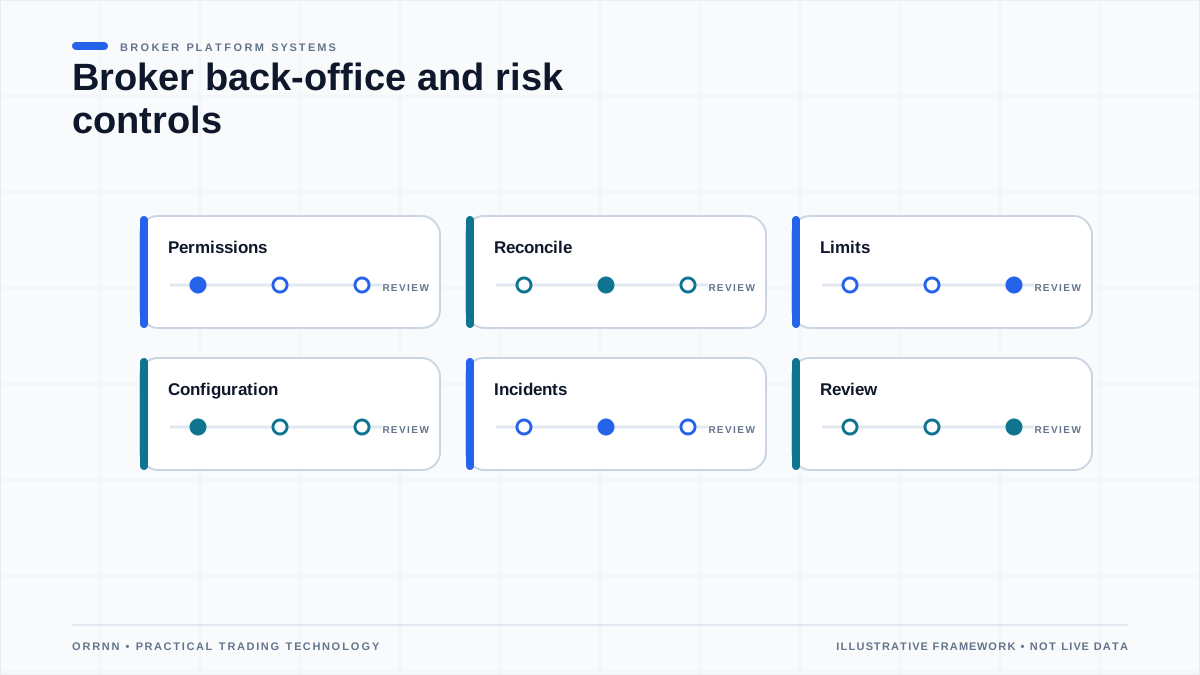
Effective broker back-office controls connect a clear risk objective to a preventive or detective activity, a named owner, timely evidence, escalation, and independent review. Start with the client and transaction lifecycle, protect privileged actions, reconcile independent records, set and monitor limits, control configuration changes, and rehearse incident decisions. Platform features help, but a screen or alert is not a control until people can operate and evidence it.
Begin with outcomes, obligations, and an operating model
A back office supports many different brokerage models, products, and jurisdictions. Before selecting controls, document the legal entities, permissions, client categories, products, dealing or agency model, custody and payment arrangements, counterparties, outsourced services, and records in scope. Map which organization owns onboarding, client money or assets where applicable, trade capture, confirmations, reconciliations, reporting, complaints, and incident response.
Convert risk statements into control objectives. "Monitor risk" is too vague. A useful objective might require unauthorized users to be prevented from changing account leverage, unexplained cash breaks to be detected before a defined cut-off, or orders above an approved exposure threshold to be blocked or escalated under a documented policy. The acceptable thresholds and timing must come from the actual business and its advisers.
Laws and regulatory expectations differ. The SEC market-access rule, European requirements for algorithmic trading, and supervisory rules in other jurisdictions can inform questions, but they are not interchangeable. A broker should obtain jurisdiction-specific legal and compliance advice and document how obligations map to its controls. This guide supplies an operational framework, not a universal compliance program.
Build a control inventory that can be tested
For each control, record the risk, objective, scope, type, frequency or trigger, performer, reviewer, input, procedure, output evidence, system dependency, threshold, escalation, exception process, and retention. Identify whether the control is preventive, detective, or corrective and whether it is manual, automated, or dependent on both. A control labelled automated may still rely on a person to maintain rules, review alerts, or handle failure.
Assess design separately from operation. A reconciliation may be well designed but ineffective if source files arrive late, breaks are closed without evidence, or the reviewer cannot challenge adjustments. Conversely, frequent manual effort can indicate a poor interface or data-quality problem rather than a need to hire more reviewers. Track root causes and improve the process.
Use stable control identifiers and map them to policies, procedures, systems, reports, and tests. Version the inventory when products or platforms change. This creates an evidence chain for internal assurance and helps migration teams identify controls that must be recreated rather than assuming a similar screen provides equivalent coverage.
| Field | Question it should answer | Example evidence type |
|---|---|---|
| Objective | What undesirable outcome is prevented or detected? | Approved risk-to-control mapping |
| Scope | Which entities, accounts, products, channels, and systems are covered? | Inventory or population report |
| Operation | Who does what, when, and using which inputs? | System event, signed checklist, case record |
| Exception | What happens when the control fails or finds a break? | Ticket, investigation, approval, retest |
| Review | Who independently verifies completeness and quality? | Review record and sampled evidence |
Protect identity, permissions, and privileged actions
Use individual identities, strong authentication, least privilege, and role design tied to job responsibilities. Joiner, mover, and leaver workflows should change access promptly and preserve approval evidence. Review privileged and dormant access more frequently where risk warrants it. Shared administrative accounts weaken attribution and should be avoided or tightly controlled where a system cannot eliminate them.
Apply segregation to actions that can alter money, positions, client restrictions, prices, limits, permissions, or audit evidence. Four-eyes approval is useful only when the reviewer sees enough context, is independent, and cannot approve their own action through another role. Emergency access needs a defined trigger, time limit, enhanced logging, and post-use review.
Log successful and denied administrative actions with the actor, time, affected object, previous and new value where appropriate, reason or ticket, approval, and source. Protect logs from routine alteration and synchronize time. Monitoring should focus on meaningful patterns such as unusual time, volume, target account, repeated denials, bulk exports, or disabled controls—not merely collect events.
Checklist
- Current role-to-permission matrix approved by business and security owners
- Individual administrative identities and strong authentication
- Joiner, mover, leaver, periodic review, and dormant-account processes
- Independent approval for defined high-impact actions
- Emergency access expires and receives retrospective review
- Administrative activity is searchable, protected, retained, and monitored
Control client and account master data
Identify authoritative sources for identity, classification, agreements, tax status, permissions, restrictions, communication preferences, and account hierarchy. Validate mandatory attributes and incompatible status combinations. Downstream systems should receive controlled changes with a traceable version or event rather than rely on periodic manual re-entry.
Sensitive changes—such as payment instructions, contact details used for authentication, account ownership, trading permissions, risk category, leverage, or restrictions—need risk-based verification. The process should address social engineering, compromised sessions, unusual requests, and callbacks or additional evidence where appropriate. Avoid publishing a fixed authentication recipe that attackers can exploit; define the principle and keep operational details protected.
Monitor records that remain incomplete or in a transitional state beyond an expected period. A status such as "pending" can conceal an account that is active in one system and blocked in another. Reconcile master-data propagation and ensure client communications match the effective status. Changes to suitability, appropriateness, or eligibility controls require specialist review where those concepts apply.
Reconcile cash, positions, orders, and external records
Reconciliation compares independent records to detect missing, duplicated, delayed, or incorrect activity. Define the records, frequency, cut-off, matching keys, tolerance, aging, owner, and escalation. A zero net difference can hide offsetting breaks, so use transaction-level matching and control totals at appropriate levels such as entity, account, currency, product, or counterparty.
Cash controls may compare platform ledgers, banking or payment records, custodial records, and general-ledger postings. Position and trade controls may compare order management, execution or drop-copy feeds, clearing, custody, venue, and client records. The exact sources depend on the operating model. Document which source prevails for each attribute and how corrections are authorized.
Exceptions need durable cases with cause, age, amount or exposure, client impact, temporary control, owner, evidence, and approval. Escalation should depend on materiality and uncertainty as well as age. Trend recurring breaks by source and process; repeatedly clearing the same symptom without remediation is not an effective control environment.
Set pre-trade and ongoing risk controls deliberately
Controls may include permissions, product eligibility, price collars, maximum order size, message-rate limits, fat-finger checks, credit or exposure limits, position limits, margin rules, concentration limits, duplicate detection, and kill or suspension functions. Which are required and how they are calibrated depends on products, routing, clients, counterparties, and regulation. An arbitrary universal threshold can reject legitimate activity or fail to prevent harm.
Define the calculation source, included orders and positions, aggregation level, units, currency conversion, market data, update frequency, behavior during stale data, and action when a limit is reached. Test boundaries and simultaneous activity. If controls exist at several layers, understand whether they are complementary or can produce contradictory states.
Limit changes should require appropriate evidence and authorization. Monitor overrides, repeated near-limit behavior, disabled checks, stale inputs, and controls operating in warning-only mode. A kill function needs a clearly defined scope, activation authority, authentication path, effect on working orders, recovery procedure, and regular exercise. A button that has never been tested is not a dependable contingency.
Govern prices, symbols, margin, and configuration
Configuration can change client outcomes as directly as code. Maintain an inventory and approved baseline for instruments, trading sessions, precision, tick size, contract size, price sources, spreads or markups where applicable, margin parameters, fees, groups, routing, calendars, and permissions. Use maker-checker or controlled deployment for material changes and capture before-and-after values.
Validate changes in a representative environment and use scheduled activation when timing matters. Test daylight-saving transitions, holidays, corporate actions, contract rolls, symbol changes, negative or extreme prices where relevant, stale prices, and missing sources. Provide an immediate way to identify which configuration version affected an order or statement.
Monitor source health and divergence rather than assuming a connected feed is correct. Define stale, crossed, outlier, or inconsistent conditions and the safe behavior for each workflow. Price controls should consider the characteristics of the instrument and session. Any fallback source or manual price requires governance, visibility, and reconciliation.
Control payments, adjustments, and client communications
Separate request, verification, approval, release, and reconciliation where the payment or adjustment risk justifies it. Validate account ownership and permitted routes under an approved process. Protect changes to beneficiary details and do not allow a single support interaction to bypass controls. Track pending, failed, returned, reversed, and duplicated transactions through to resolution.
Manual balance, fee, trade, or position adjustments need a restricted reason taxonomy, supporting evidence, independent approval at defined thresholds, and a visible audit trail. Monitor users, accounts, amounts, timing, reversals, and repeated reasons for unusual patterns. Reconcile adjustments to financial records and ensure client-facing statements explain them appropriately.
Notices, confirmations, statements, margin communications, and incident messages should use approved templates and accurate data. Control template changes, translations, recipient selection, suppression, and delivery status. A successfully queued message is not necessarily received; define the evidence appropriate to the communication and a fallback for material failures.
Prepare for incidents and degraded operation
Create scenarios across market data, order routing, positions, payments, identity, cloud or network services, cyber events, data corruption, and supplier failure. For each, define detection, severity, command roles, decision authority, client protection, communications, evidence preservation, regulatory or counterparty escalation where applicable, recovery sequence, and reconciliation after restoration.
Run tabletop and technical exercises that include operations and business leaders, not only engineers. Test difficult choices such as restricting a product, rejecting new orders, cancelling working orders where possible, disabling withdrawals, using a secondary channel, or operating manually. The safe decision depends on current facts and obligations; runbooks should guide judgment rather than pretend every event follows a script.
Measure detection and decision quality as well as restoration time. Record false positives, missing telemetry, unclear ownership, unavailable contacts, unsafe workarounds, and client communication gaps. Remediate exercise findings with the same discipline as production incidents.
Monitor control health and review limitations
Useful indicators include overdue reconciliations, aged or material breaks, privileged-access exceptions, failed or bypassed approvals, stale market data, disabled limits, repeated overrides, unreviewed adjustments, failed client communications, delayed incident actions, and open audit findings. Pair counts with context and denominator; more alerts may reflect more activity or improved detection rather than greater risk.
Assign independent testing based on risk and change. Sample evidence, reperform calculations, inspect populations for omitted items, and follow exceptions to closure. Automated controls need input, logic, configuration, access, and change testing. Management review needs evidence that the reviewer challenged anomalies rather than merely opening a report.
This guide cannot prescribe controls for a specific broker, prove regulatory compliance, or determine acceptable limits. Products, permissions, client types, technologies, and jurisdictions materially change the design. Qualified compliance, risk, security, finance, operations, and legal owners should approve the actual framework and verify that the selected platform can produce reliable evidence.
Checklist
- Risk and obligation mapping reflects the current operating model
- Control inventory identifies owner, population, evidence, exception, and review
- Privileged actions and material configuration changes are segregated and logged
- Independent records are reconciled at appropriate frequency and granularity
- Limits have defined inputs, behavior, authority, monitoring, and tested recovery
- Payments and adjustments have traceable approval and reconciliation
- Degraded-operation and incident decisions are exercised
- Control health, recurring causes, and remediation are independently reviewed
Primary sources and further reading
These sources support the frameworks and definitions used in this guide. They do not endorse Orrnn or establish that any product complies with the referenced material.
- Risk Management Controls for Brokers or Dealers With Market Access — 17 CFR 240.15c3-5
U.S. Securities and Exchange Commission / eCFR
Primary U.S. rule text for entities in scope; applicability and implementation require qualified advice.
- Commission Delegated Regulation (EU) 2017/589 (RTS 6)
EUR-Lex
Primary EU legal text on organizational requirements for investment firms engaged in algorithmic trading; scope must be assessed professionally.
- Security and Privacy Controls for Information Systems (SP 800-53 Rev. 5)
National Institute of Standards and Technology
A broad primary control catalogue useful for security-control vocabulary and tailoring, not a broker compliance certificate.
- Digital Identity Guidelines (SP 800-63-4)
National Institute of Standards and Technology
Current NIST digital-identity guidance for risk-based identity and authentication design.
Related reading
Broker platform migration
Carry control ownership and evidence into a target platform and cutover plan.
Read →White-label platform RFP
Turn control objectives into comparable vendor requirements and acceptance tests.
Read →Broker solutions
Review Orrnn's broker overview separately from this jurisdiction-neutral control guide.
Read →