Decision guide
Broker Platform Migration Checklist: Plan, Rehearse, and Cut Over Safely
A detailed broker platform migration framework covering scope, data, integrations, controls, rehearsal, cutover, rollback, and stabilization.
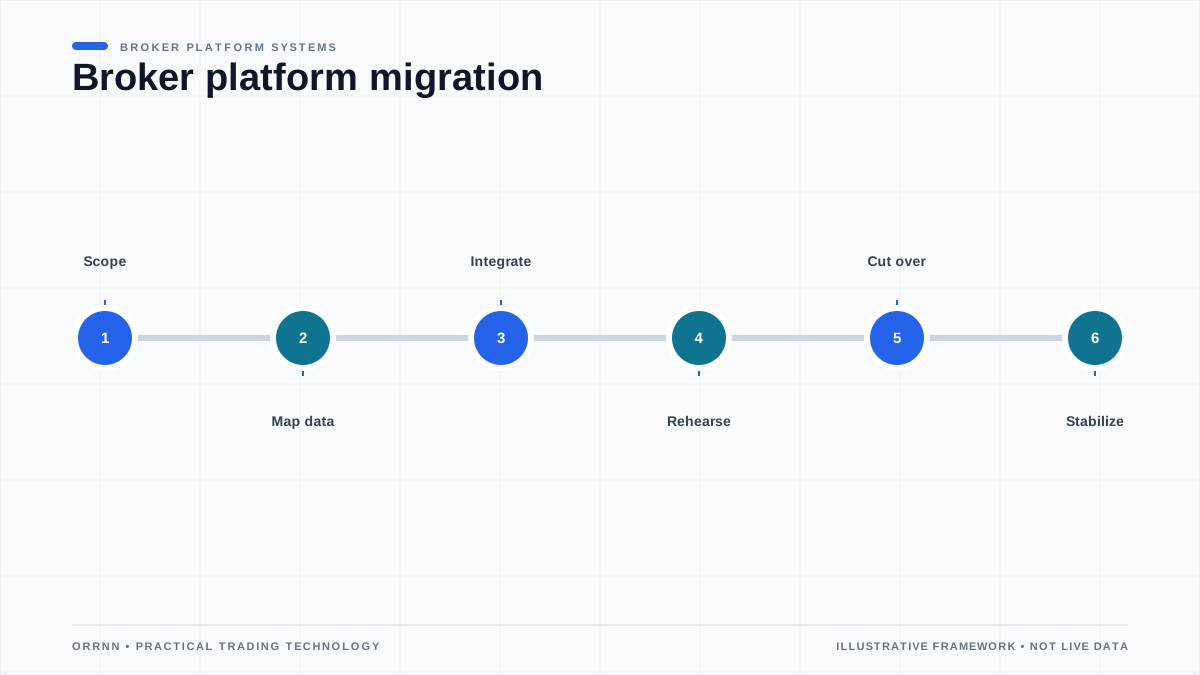
Direct answer
A safe broker platform migration is a controlled change to data, integrations, client journeys, operating procedures, and risk—not a weekend file transfer. Establish authoritative records, reconcile every transformation, test end-to-end failure paths, rehearse cutover with production-like volumes, define stop and rollback criteria, and keep accountable business, compliance, operations, engineering, and supplier owners in one command structure.
Define exactly what is migrating
Create a scope register before choosing a cutover date. Include client and account records, identity status, agreements and disclosures, balances, open orders, positions, tax lots where relevant, price and symbol configuration, permissions, leverage or margin settings, payment instructions, statements, documents, communications, audit history, reports, integration credentials, support cases, and retention archives. For each domain, name the current and future systems of record.
Separate data that must be active on the target at launch from history that can remain in a controlled archive. That decision should consider client service, investigations, dispute handling, reporting, retention, and legal obligations. An archive is useful only if authorized users can retrieve intelligible records within an acceptable time and the organization can preserve access throughout the required period. Qualified legal and compliance teams should approve retention and migration decisions for the relevant entities.
Record exclusions explicitly. If a product, dormant account, unsupported document, historical tick series, or custom report will not move, document how it will be handled and communicated. Unstated exclusions tend to surface late as defects. Create a traceable identifier strategy so records can be matched across old, migration, and target systems without relying on names or mutable account attributes.
Establish governance and independent challenge
A migration needs one accountable executive sponsor and named owners for business scope, data, integrations, infrastructure, security, compliance, operations, client communication, testing, suppliers, and cutover. Define decision rights before pressure rises: who can accept a defect, stop data movement, delay launch, invoke rollback, approve a manual workaround, or communicate an incident. The same supplier or team that performs a control should not be the only party judging its success.
Maintain a decision log, dependency register, risk register, assumptions register, and integrated plan. Link material requirements to test evidence and unresolved defects. Escalation should be based on agreed thresholds rather than confidence or seniority. Report readiness by evidence completed, not percent-complete estimates that can hide unfinished critical work.
Where multiple vendors are involved, use one service map and one incident model. A failure at an identity, payment, market-data, liquidity, messaging, or hosting supplier can appear as a platform defect. Agree how evidence will be shared, which service desk owns the client-facing ticket, and how cross-supplier diagnosis will work outside normal business hours.
Profile and clean source data before transformation
Do not wait for a test load to discover the source estate. Profile completeness, uniqueness, referential integrity, formats, encodings, time zones, currencies, precision, stale records, duplicate identities, invalid enumerations, and inconsistent status combinations. Quantify each issue and decide whether to correct it at source, transform it under an approved rule, reject it, or carry it with a documented exception.
Build a data dictionary that maps source fields to target fields, meanings, allowed values, ownership, transformation rules, and reconciliation method. Pay special attention to amounts, signs, rounding, instrument identifiers, time stamps, daylight-saving changes, account hierarchies, client consents, and statuses whose names look similar but have different business meaning. A technically successful import can still create incorrect client outcomes if semantics drift.
Use masked or synthetic test data unless production data is genuinely required and approved. Protect migration extracts with strict access, encryption, retention, and deletion controls. Record every extraction and load. Migration environments often receive broad datasets and temporary privileges, making them a security boundary that deserves the same scrutiny as the target platform.
Checklist
- Source and target systems of record agreed for every data domain
- Data dictionary and transformation rules approved by accountable owners
- Quality exceptions quantified and assigned a treatment
- Stable cross-system identifiers and duplicate-detection rules tested
- Migration files, credentials, environments, access, retention, and deletion controlled
Design reconciliation before writing migration code
Every migrated domain needs a reconciliation that can demonstrate completeness and correctness. Counts alone are insufficient: equal row counts can hide duplicated, omitted, or transformed values. Use control totals, hashes where appropriate, sums by currency and account state, key-field comparisons, relationship checks, exception reports, and business-level proofs. Define tolerances only where rounding or timing makes exact equality inappropriate, and explain why each tolerance is safe.
For positions, cash, margin, or other financially meaningful records, reconcile at multiple levels: overall, legal entity, product, currency, client, and account. Include open and pending activity whose state can change during the migration window. Agree a valuation time and price source when market movement could otherwise create apparent differences. Preserve source snapshots and reconciliation outputs as controlled evidence.
Design the exception workflow with the reconciliation. It should record the record identifier, difference, likely cause, materiality, owner, correction, approval, retest, and final disposition. Avoid undocumented direct database changes. If manual adjustments are unavoidable, require appropriate segregation and a durable audit trail.
| Domain | Completeness evidence | Correctness evidence |
|---|---|---|
| Clients/accounts | Counts by status and entity; missing and duplicate identifiers | Key attributes, status mappings, hierarchy, consents, restrictions |
| Cash | Accounts and currencies represented | Signed totals by currency and account; adjustment audit |
| Positions | Position counts by product and state | Quantity, cost basis where required, identifiers, valuation assumptions |
| Documents | Manifest versus target object count | Checksum, metadata, access control, representative retrieval |
| Configuration | Inventory of symbols, groups, roles, and rules | Approved value comparison plus workflow tests |
Migrate integrations and operational controls, not only data
Inventory inbound and outbound interfaces, schedules, certificates, credentials, IP rules, queues, file paths, schemas, rate limits, timeouts, retries, duplicate handling, monitoring, and support ownership. Test the target with every counterparty in the final topology where possible. A successful request from a developer workstation does not validate production networking, identity, capacity, sequence recovery, or failover.
For FIX connections, agree session identifiers, supported messages and tags, sequence handling, resend behavior, business-day boundaries, certification cases, and production activation. For REST and streaming interfaces, test authentication rotation, idempotency, pagination, ordering, reconnect recovery, throttling, and version compatibility. Include deliberately malformed, delayed, duplicated, and out-of-order inputs when the interface could encounter them.
Transfer control ownership deliberately. Reconciliation jobs, alerts, daily checks, access reviews, limits, reports, incident procedures, and approval workflows must have target-state owners, schedules, and evidence. A control that existed in the old platform does not automatically exist in the new one, even if the underlying feature appears similar.
Test complete journeys and adverse conditions
Organize acceptance around real roles and journeys: onboarding, account changes, deposits and withdrawals, instrument setup, quote receipt, order submission, rejection, partial fill, cancellation where supported, position updates, margin events, statements, reporting, support investigation, suspension, closure, and archive retrieval. Cover web, mobile, desktop, API, and operator channels that are actually in scope.
Exercise failure rather than assuming it. Disconnect a dependency, expire a credential, throttle an interface, duplicate an event, restart a component, use a stale version, fill a queue, delay market data, and restore from backup in a controlled environment. Verify client messaging, operator visibility, reconciliation, recovery ordering, and audit evidence. Not every destructive scenario belongs in a shared production-like environment, so security and platform owners should approve the test design.
Performance tests need a workload model grounded in expected behavior: concurrent sessions, subscriptions, order patterns, data rates, reports, batch jobs, and operational peaks. Record environment differences and avoid presenting laboratory latency as a production promise. Success criteria should include correctness and recovery, not only throughput.
Plan client, staff, and counterparty readiness
Identify every party whose action is required: clients, introducing partners, liquidity venues, data providers, banks or payment services, identity providers, regulators where applicable, support teams, and internal control functions. Track certificates, allowlists, user invitations, credentials, updated agreements, software distribution, training, and contact details. Give critical counterparties a named confirmation step rather than assuming silence means readiness.
Client communication should explain the practical impact without making unsupported assurances. Cover timing, unavailable functions, required actions, credential changes, order or withdrawal cut-offs, where to find records, support channels, and what happens if the schedule changes. Coordinate messages across website, email, applications, and support scripts. Accessibility and language needs should be included in the plan.
Train operators using migrated data and realistic cases. Provide runbooks for start-of-day, reconciliation, client investigation, access changes, common errors, degraded service, escalation, and rollback. Capture questions as gaps in tooling or documentation. A migration is not ready merely because the technology team can operate it.
Rehearse the cutover and measure the critical path
Run more than one rehearsal with production-like volumes and the same sequence, tools, access model, evidence capture, and decision checkpoints intended for launch. Measure extraction, transformation, load, reconciliation, integration activation, smoke testing, and business approval. Investigate variance between rehearsals; using the fastest run as the plan is unsafe.
Create a minute-by-minute runbook for the final window. Each step needs an owner, prerequisites, expected duration, evidence, success criterion, next step, and escalation. Mark the points after which rollback becomes slower, lossy, or impossible without additional reconciliation. Use a single authoritative status channel and an incident-style log.
Freeze only what must be frozen, and define how emergency changes will be approved. Capture the final delta after the main migration load, including transactions and configuration changes created during the preparation period. Confirm time synchronization across systems so event ordering can be reconstructed during investigation.
Checklist
- At least one end-to-end rehearsal uses representative volumes and final procedures
- Durations are measured and contingency fits inside the approved window
- Every step has an owner, evidence, success criterion, and escalation path
- Final-delta capture and reconciliation are proven
- Production access and credentials are tested without exposing secrets
- Business, operations, compliance, support, and supplier representatives join the rehearsal
Set go, stop, and rollback criteria before launch
Define objective go criteria such as reconciliations completed, zero unresolved critical defects, counterparties confirmed, operational staffing present, monitoring healthy, restore evidence current, client communications approved, and sufficient window remaining. Define stop criteria for missing records, unexplained balance or position differences, material security issues, unstable interfaces, failed recovery, or loss of necessary support coverage.
Rollback is a business process, not a database switch. Specify the last reversible point, how new activity will be captured, which system remains authoritative, how messages and duplicate orders are controlled, how clients are informed, and how data created on the target will be reconciled back or preserved. In some migrations, forward recovery is safer after a particular point. State that boundary explicitly and rehearse the relevant path.
The go decision should include named approvers from the accountable functions and a recorded rationale. Schedule pressure and sunk cost should not redefine acceptance criteria during the window. If an exception is accepted, document its client impact, control, owner, deadline, and review.
Stabilize, prove, and decommission carefully
Use a defined stabilization period with enhanced monitoring, frequent reconciliations, rapid triage, supplier coverage, and daily business review. Distinguish migration defects from ordinary incidents, but use the existing incident process for material impact. Track volumes, failed journeys, support demand, manual interventions, reconciliation breaks, performance, and control completion against a known baseline.
Do not decommission the old platform when the first trading session succeeds. Complete contractual, data-retention, archive-retrieval, audit, access-removal, infrastructure, license, and documentation tasks. Preserve the migration decision record and evidence. Remove temporary accounts, files, allowlists, elevated privileges, and environments under controlled change.
Run an independent lessons review after stabilization. Compare actual outcomes with assumptions, identify controls or documentation that should become permanent, and assign remediation. This guide cannot determine legal or regulatory obligations, acceptable downtime, migration tolerances, or suitability for a particular brokerage. Those decisions require evidence from the actual systems and review by qualified owners and advisers.
Primary sources and further reading
These sources support the frameworks and definitions used in this guide. They do not endorse Orrnn or establish that any product complies with the referenced material.
- Contingency Planning Guide for Federal Information Systems (SP 800-34 Rev. 1)
National Institute of Standards and Technology
A primary planning reference for contingency, recovery, testing, and plan maintenance; adapt it to the organization rather than treating it as a broker-specific rule.
- Guide for Security-Focused Configuration Management (SP 800-128)
National Institute of Standards and Technology
Primary guidance relevant to baselines, controlled changes, monitoring, and configuration evidence.
- FIX standards and technical resources
FIX Trading Community
Primary resources for planning FIX session, message, and certification migration details.
- OWASP Application Security Verification Standard
OWASP Foundation
An open verification source for application-security acceptance requirements.
Related reading
White-label platform RFP
Define evidence, responsibilities, and acceptance before selecting a migration target.
Read →Broker back-office controls
Design the operational controls that must survive and be retested during migration.
Read →FIX, REST, and WebSocket
Review protocol roles and recovery behavior when migrating interfaces.
Read →