Decision guide
Build vs Buy a Broker Trading Platform: A Decision Framework
A neutral framework for deciding whether to build, buy, white-label, or combine components for a broker trading platform.
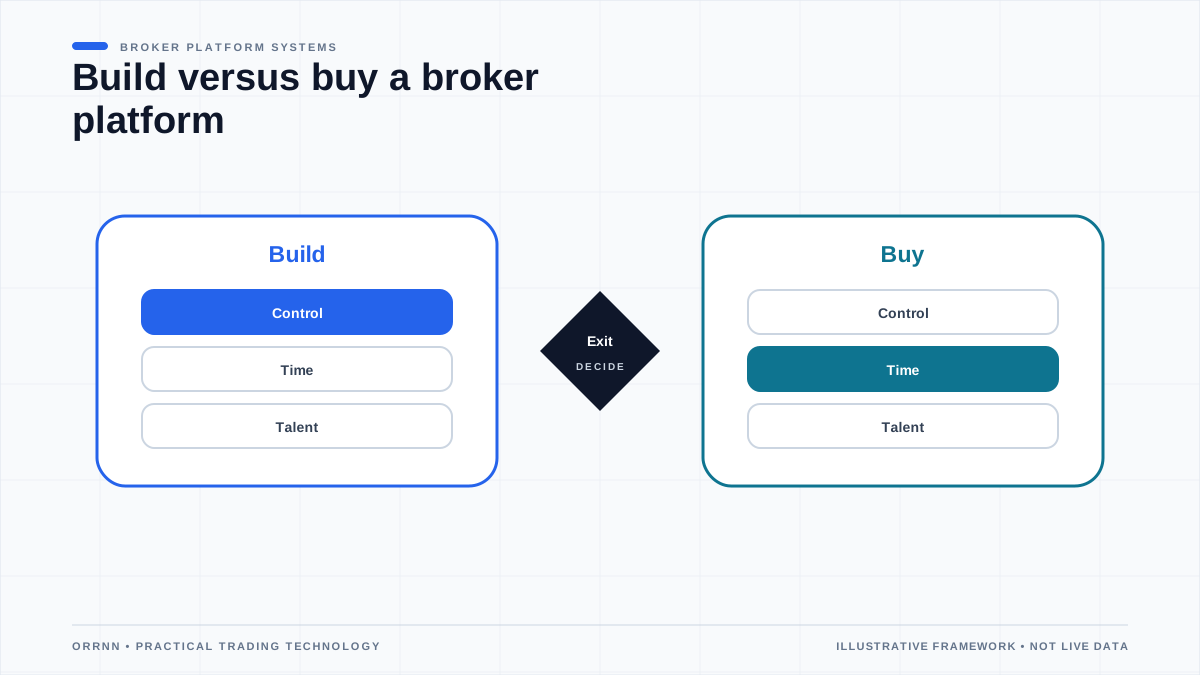
Direct answer
A brokerage should build only the capabilities that create durable differentiation or require control it cannot obtain from suppliers. Commodity functions with mature interfaces are usually candidates to buy; high-change, high-risk workflows may justify a hybrid model. The decision should compare whole-life cost, time to safe operation, talent, regulatory responsibility, integration risk, resilience, and exit—not license price against developer salaries.
Treat build versus buy as a portfolio decision
A trading platform is not one component. It can include client applications, identity and access, account services, pricing, market data, order management, execution connections, positions, margin, payments, reporting, surveillance, communications, analytics, content, and administrative tools. Choosing "build" or "buy" for the entire estate forces unlike problems into one answer. Decompose the target into capabilities and decide where ownership creates business value.
Most viable outcomes are hybrid. A brokerage might own its client experience and product rules while licensing execution connectivity, identity verification, market data, and commodity operations tooling. Another might license a complete platform initially and replace selected components when scale or differentiation supports the investment. The architecture must make boundaries explicit so a temporary shortcut does not silently become an irreversible dependency.
Start with a capability map and mark each element by strategic differentiation, change rate, operational criticality, regulatory sensitivity, data sensitivity, integration complexity, market maturity, and available internal expertise. This creates a reasoned sourcing conversation. It also exposes capabilities that should be simplified or removed rather than built or procured.
Define the four realistic sourcing models
None of these models removes responsibility. An in-house build still depends on cloud, network, market-data, security, and open-source suppliers. A purchased service still requires informed supervision, configuration control, reconciliation, incident handling, and customer support. A hybrid approach needs especially clear ownership when an order or balance crosses multiple services.
Do not confuse source-code access with operational control. Code is useful only when a team can understand, build, test, secure, deploy, observe, and maintain it along with its data and dependencies. Likewise, a managed service is not automatically low effort: integration, migration, assurance, vendor management, and operating-model changes may be substantial.
| Model | Potential advantage | Frequent constraint |
|---|---|---|
| Full in-house build | Maximum design and roadmap control | Largest talent, assurance, operations, and time commitment |
| Commercial platform | Faster access to an established product and support model | Vendor boundaries, configuration limits, and migration dependence |
| White-label service | Potentially shortest route to a configured customer proposition | Less control over differentiation, dependencies, and change timing |
| Composable hybrid | Control concentrated in differentiating capabilities | Integration, observability, data consistency, and multi-vendor accountability |
Identify what is genuinely differentiating
Ask which capabilities customers choose the brokerage for and which can be delivered in a way competitors cannot easily reproduce. Differentiation might lie in a specialized workflow, service model, product structure, risk logic, integration ecosystem, research experience, or distribution channel. A custom login screen or common chart type rarely creates durable advantage on its own.
Then ask whether ownership of the software is necessary to sustain that difference. Configuration, documented extension points, APIs, or a contractual roadmap may provide enough control. Conversely, if a critical rule changes frequently, is central to unit economics, or depends on proprietary data, an owned service may be justified even if an off-the-shelf approximation exists.
Document the hypothesis and a way to test it. Building a unique capability is not valuable merely because it is custom. Track whether it improves conversion, retention, risk outcomes, operator productivity, or another agreed result without creating unacceptable reliability or compliance cost. Capabilities without measurable value should face the same scrutiny as vendor features.
Compare time to safe operation, not time to first demo
Internal prototypes can appear quickly because they omit the difficult work: permissions, audit, recovery, reconciliation, observability, migration, documentation, support tooling, accessibility, security testing, and failure handling. Vendor demonstrations can create the same illusion by showing a mature happy path without proving fit for the brokerage's specific model. Compare the time until the organization can operate the capability safely under expected and stressed conditions.
For a build, estimate discovery, architecture, hiring, foundational services, functional increments, integration certification, assurance, data migration, operational readiness, and stabilization. Include the time needed to create environments, deployment controls, telemetry, test data, and support. For a purchase, include procurement, due diligence, contracting, configuration, custom work, third-party onboarding, integration, migration, and acceptance.
Use ranges and explicit dependencies instead of a single date. A plan that relies on an unfilled specialist role, an unconfirmed regulator interaction, or an external counterparty certification should display that uncertainty. Decision-makers can then compare a credible range with the economic value of earlier launch.
Model whole-life cost with comparable boundaries
A fair model covers at least implementation, run, change, assurance, incidents, and exit. The build case includes product management, engineering, design, quality, platform operations, security, compliance support, support tooling, infrastructure, market data, observability, licenses, recruitment, retention, on-call coverage, documentation, and opportunity cost. It also needs refresh work when operating systems, browsers, protocols, regulations, and dependencies change.
The buy case includes license and usage charges, implementation, configuration, integrations, data, hosting, vendor management, testing, training, professional services, minimum commitments, price escalation, custom changes, and parallel-run cost. Model the internal team needed to supervise the service and operate client outcomes. Include transition assistance and data export in the exit scenario.
Apply the same demand assumptions to each option and show low, base, and high cases. Record which costs are committed, volume-linked, uncertain, or deferrable. Avoid false precision: a range with named assumptions is more useful than a detailed spreadsheet built on unsupported adoption or staffing estimates. Review the model when scope or architecture changes.
Checklist
- Implementation and migration effort
- Product, engineering, security, operations, support, and vendor-management staffing
- Infrastructure, observability, market data, licenses, and third-party services
- Assurance, compliance support, penetration testing, and recovery exercises
- Change demand, compatibility maintenance, and technical-debt reduction
- Incident, parallel-run, transition, data-export, and exit costs
Evaluate architecture, data, and vendor concentration
Define boundaries through contracts and interfaces. For every capability, identify the system of record, data owner, consistency model, service-level objective, recovery behavior, version policy, and failure mode. A hybrid design with many synchronous dependencies may be less resilient than a coherent commercial platform. A monolithic vendor service may be operationally simple but make change and exit harder. The choice depends on evidence, not a preference for one architectural style.
Data portability deserves early testing. List the entities, history, documents, configuration, logs, and identifiers needed to continue operations elsewhere. Request formats, semantics, frequency, volume limits, fees, and sample exports. Determine how references remain consistent when data crosses systems and how historical records will be retained. An API that exposes current records is not necessarily a complete migration or regulatory archive.
Concentration risk includes more than the named platform vendor. Several services may depend on the same cloud region, identity provider, network, market-data source, or subcontractor. Map these common dependencies and assess whether a proposed contingency actually avoids them. Contractual substitution rights help only if technical interfaces, data, operating procedures, and staff readiness make substitution possible.
Assess talent and operating readiness honestly
A build decision is also a commitment to maintain a multidisciplinary organization. Beyond feature developers, the platform may need product management, architecture, quality engineering, security, site reliability, database and network expertise, client support, release management, technical writing, data operations, and domain specialists. The exact team depends on scope, but assuming that a small delivery team can permanently cover all functions is risky.
Consider recruitment market, onboarding time, key-person dependency, on-call sustainability, succession, documentation, and the ability to retain expertise through quieter product periods. A supplier may spread specialist costs across clients, while an internal team may learn the brokerage's needs more deeply. Both advantages are conditional: verify supplier staffing and escalation, and fund internal teams beyond initial delivery.
For purchased components, create a capable service-owner function. It should understand configuration, data, risk, releases, controls, commercial terms, and escalation well enough to challenge the supplier. Outsourcing execution of a control does not mean outsourcing accountability for the client or regulatory outcome.
Use security and software-supply-chain evidence
Compare how each option will satisfy the organization's security requirements. An internal build needs a secure development lifecycle, threat modeling, dependency management, code review, testing, secrets, artifact integrity, release controls, logging, vulnerability handling, and incident response. A supplier evaluation needs evidence about equivalent practices, the proposed service boundary, subcontractors, vulnerability disclosure, notifications, and customer responsibilities.
NIST's Secure Software Development Framework provides a useful set of practices for both internal and supplier conversations. OWASP ASVS can help teams turn application-security expectations into verification requirements. These frameworks do not select an architecture or certify a product; use them to ask consistent questions and record evidence.
Open-source components require governance in either model. Identify inventories, licenses, provenance, update processes, end-of-life exposure, and emergency remediation. A software bill of materials can support visibility, but it does not prove that vulnerabilities are exploitable or controlled. Define how the team assesses context and communicates material risk.
Design an exit before committing
Every option has an exit. A supplier may be replaced; an internal system may be rewritten, merged, or retired; a hybrid boundary may move. Describe the triggers, notice periods, data needed, knowledge transfer, parallel operation, client impact, regulatory steps, and archival obligations. Estimate exit cost in the original decision rather than treating it as a future surprise.
Test the most important portability assumptions before signing. Obtain representative exports, interface documentation, configuration definitions, and an inventory of proprietary identifiers. Confirm rights to continue accessing records after termination. For internally built components, preserve design decisions, runbooks, build pipelines, source, dependency records, and recovery procedures so ownership survives staff turnover.
Avoid a vague aspiration to be "vendor agnostic." Real portability has a price and can reduce access to valuable proprietary features. Decide where optionality is worth that cost and where a managed dependency is acceptable. The goal is an understood, governable dependency rather than the absence of all dependence.
Run a gated decision and record limitations
A useful decision process has gates: agree objectives and constraints; map capabilities; shortlist sourcing options; test decisive assumptions; complete architecture, security, compliance, operational, and commercial reviews; model scenarios; and record the recommendation with dissent and residual risk. Use a small number of weighted criteria, because an elaborate score can conceal weak evidence. Some requirements should be pass or fail rather than averaged away.
Revisit the decision when volume, geography, product scope, supplier performance, regulation, or internal capability changes. A sensible launch choice may not be the permanent target architecture. Design milestones that allow the brokerage to learn before making the next irreversible investment.
This framework is not a recommendation to build or buy a particular product, and it is not legal, regulatory, security, investment, or financial advice. Costs and obligations vary significantly. Validate the operating model with qualified specialists, test vendor statements directly, and avoid basing a strategic decision on generic market statistics or promised delivery times.
Checklist
- Capability map and differentiators approved
- Build, buy, white-label, and hybrid boundaries considered
- Time compared at safe operational readiness
- Whole-life cost uses the same demand and scope assumptions
- Data, integration, concentration, resilience, and exit risks tested
- Talent and service-owner capacity funded
- Security and regulatory reviews completed for the actual model
- Decision assumptions and review triggers recorded
Primary sources and further reading
These sources support the frameworks and definitions used in this guide. They do not endorse Orrnn or establish that any product complies with the referenced material.
- Secure Software Development Framework (SP 800-218)
National Institute of Standards and Technology
Primary secure-development guidance relevant to both internal builds and supplier assurance.
- Cybersecurity Supply Chain Risk Management Practices (SP 800-161 Rev. 1)
National Institute of Standards and Technology
A detailed source for identifying and governing technology supply-chain risk.
- OWASP Application Security Verification Standard
OWASP Foundation
An open basis for defining and testing application-security requirements.
- FIX standards and technical resources
FIX Trading Community
Primary protocol resources for evaluating boundaries around electronic-trading connectivity.
Related reading
White-label platform RFP
Translate a sourcing decision into comparable requirements and due diligence.
Read →Broker platform migration
Plan the data, integration, operational, and cutover work after selecting a target.
Read →Algorithmic trading overview
Review Orrnn's current algorithmic-trading overview separately from this neutral framework.
Read →