Trading Technology Consulting for Brokers and Funds
Trading technology consulting is advisory work that helps a broker, hedge fund or prop trading desk choose trading systems and test them before buying or building. The scope covers architecture review, RFP support, platform and liquidity evaluation, build versus buy, acceptance planning and migration planning. Orrnn builds RTX5, and any RTX5 recommendation is disclosed in the proposal.
Updated
What trading technology consulting settles
- 01
The consulting scope is advisory. It produces reviews, requirements, evaluations and test plans. Engineering delivery is a separate engagement with its own proposal.
- 02
Write requirements for order types, symbols, sessions, counterparties and reporting before an RFP goes out.
- 03
Compare platforms on the same scored criteria, and ask for evidence behind each claim. A demonstration is not production acceptance.
- 04
Treat build versus buy as a total cost question over a stated period, including licence, run and exit costs.
- 05
Orrnn builds RTX5. Any RTX5 recommendation is disclosed in the proposal and tested against the same criteria as the other options.
- 06
Orrnn does not supply liquidity, hold licences or give legal, regulatory or investment advice.
Who trading technology consulting is for
Trading technology consulting is for the people who decide what to buy, build or change before engineering starts. The same method applies to a small broker and to a fund with several venues.
Brokers
A broker replacing a platform needs written requirements for order types, symbols, sessions, risk checks and back-office reporting before an RFP goes out.
Hedge funds
A fund routing orders to execution venues needs clear connectivity scope, session rules and reconciliation. A review checks the execution path against its risk limits.
Prop trading desks
A prop desk depends on risk limits, account rules and trade reporting. A review helps define those rules and test how the platform applies them.
Trading technology teams
In-house teams often want an outside check on architecture, vendor claims or an acceptance plan, kept on file for the steering group.
What the trading technology consulting scope covers
The scope has six workstreams. A proposal can include one or several. Each one ends in a written output, and the table names the evidence the client receives.
Swipe sideways to see all columns
| Workstream | What is reviewed or produced | Evidence the client receives | Related reading |
|---|---|---|---|
| Architecture review | The order path, routing logic, pre-trade risk checks, isolation boundaries and data flows. | A findings list, a risk register and the open questions to close before any build. | Covered in the proposal |
| Requirements and RFP support | Requirement sets, scoring grids, vendor questions and demonstration scripts. | A written RFP pack and a scoring sheet the buying group can reuse. | White-label platform RFP guide |
| Vendor and platform evaluation | Side-by-side comparison of platforms against your requirements, with the stated status of each module. | A scored shortlist with evidence gaps marked and a review date. | Trading platform comparison framework |
| Liquidity and bridge connectivity evaluation | Counterparty list, FIX or API scope, session behavior and routing rules for each liquidity source. | A connectivity requirements note and the open questions for each counterparty. | Forex liquidity providers |
| Build versus buy and total cost of ownership | Licence, build, hosting, support and exit costs compared over the same stated period. | A cost model with every assumption listed, so the figures can be challenged. | Pricing and TCO in an RFP |
| Integration, acceptance and migration planning | Acceptance tests for order states, rejects, reconnects and reconciliation, plus cutover, parallel running and rollback. | An acceptance test plan and a migration runbook outline. | Covered in the proposal |
The table describes the advisory outputs only. It is not a list of product features, and it does not state that any module is available in a given build.
How the advisory workstreams fit together
The architecture review sets the boundaries, the requirements define what a platform must do, and the evaluation tests vendor answers against them. The cost model and acceptance plan then test whether a build is worth the risk.
Engineering delivery sits outside this service. If the client decides to build or integrate with Orrnn, that work is scoped in the separate engineering services proposal.
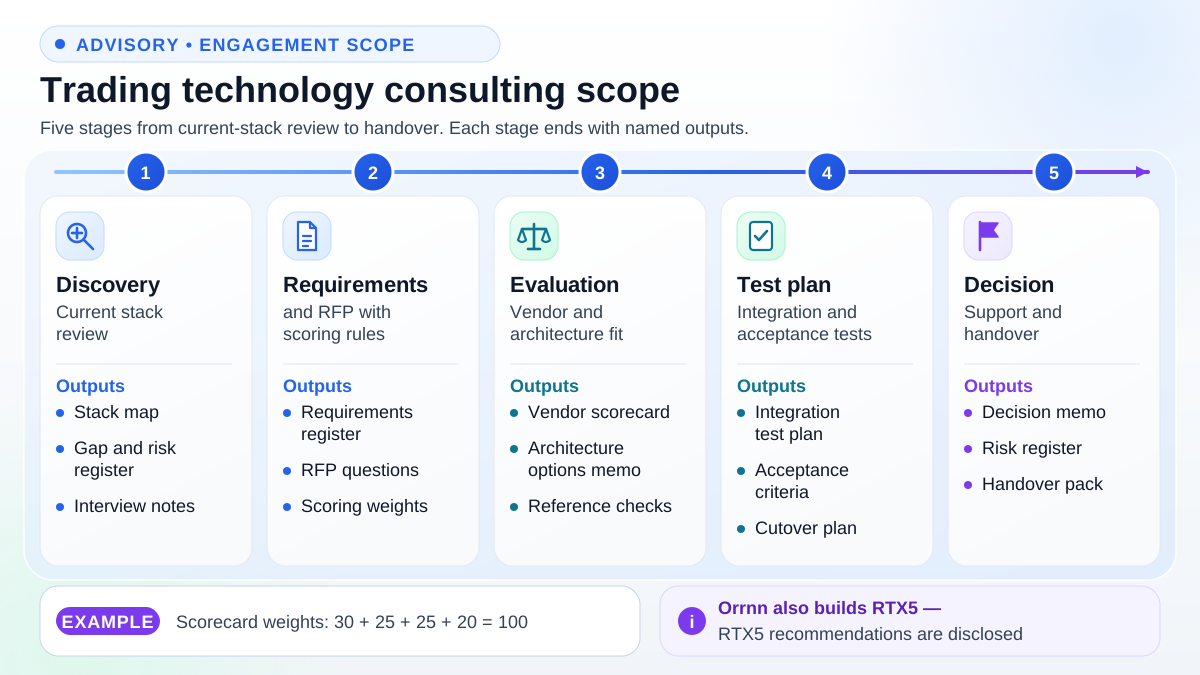
How an advisory engagement works
Every engagement is scoped per proposal. The proposal sets the deliverables, the review points, what the client must provide and what is excluded. Prices and durations are not published on this page.
- 01
Enquiry. You describe the current systems, the decision to be made, the instruments and the counterparties in scope.
- 02
Proposal. The scope, deliverables, dependencies and acceptance points are written into a proposal before work starts.
- 03
Delivery. The work follows the agreed proposal, and its outputs are reviewed with you.
- 04
Follow-on work. Any engineering delivery is scoped in a separate proposal.
What a first review usually settles
A first review is short and specific. Its job is to settle the questions that would otherwise be argued in the middle of a build: which order types are in scope, which counterparties must be connected on day one, where pre-trade checks run, and who owns the reporting data.
Example (hypothetical, no figures): a broker runs one platform with two liquidity providers and plans a third. The review maps each provider’s symbols and session rules and lists the acceptance tests needed before the new connection goes live.
What Orrnn does not do
- Orrnn does not supply liquidity. It is not a liquidity provider, prime broker or market maker.
- Orrnn is not a broker. It does not hold a brokerage licence, client funds or client orders.
- Orrnn does not give legal, regulatory, tax or investment advice.
- Brokerage-launch and licensing enquiries are referred to FxTrusts, a separate company with its own scope, jurisdiction and terms.
Orrnn builds and sells RTX5
That is a conflict of interest for any advice that involves RTX5, and this page does not present the service as neutral. When an RTX5 module is part of a recommendation, the proposal says so, states the module’s current status and compares it with the other options on the same written criteria.
The published RTX5 status, as checked on 10 November 2026, is as follows:
- The RTX5 roadmap (checked 10 November 2026) marks every module as build not published.
- Its Preview group includes the Desktop Trading Terminal, CRM, Bridge / Gateway and FIX 4.4 / 5.0.
- Its Planned group includes the Web Trading Terminal, Mobile Trading and the REST & WebSocket API.
The roadmap says Preview communicates an early demonstration or concept. Orrnn does not treat a Preview label as production acceptance. Confirm the exact build, supported counterparties and acceptance tests in writing before you rely on any module.
Limitations of this service
Advice is only as good as the information behind it. Vendor claims, module labels and counterparty behavior change over time, so each recommendation should carry a review date and be tested again before a contract is signed.
Consulting cannot make a platform meet a requirement that was never written down. If requirements change after the RFP is issued, reissue the scoring sheet and review the shortlist.
This page is general information. It is not investment, legal or regulatory advice. Leveraged FX and CFD trading carries a high risk of losing money quickly.
Sources
The FIX Trading Community describes FIX as open, technology-neutral specifications for electronic trading and trade processing (checked 9 November 2026). It is cited here for the FIX scope that a connectivity review checks.
Trading Technology Consulting FAQ
Direct answers to the questions brokers, funds and trading technology teams ask before they engage an advisor.
Trading technology consulting covers the decisions that come before a platform is bought or built. Orrnn’s advisory scope covers architecture review, requirements and RFP support, platform and liquidity evaluation, build versus buy with total cost of ownership, acceptance test planning and migration planning. Engineering delivery, such as building or integrating components, is a separate engagement.
It is for brokers choosing or replacing a trading platform, hedge funds that connect to execution venues, prop trading desks that run their own risk rules, and in-house trading technology teams that need an outside review. A firm without written requirements should start with an architecture review.
No, and this page does not claim otherwise. Orrnn builds and sells RTX5, so advice that involves RTX5 is a conflict of interest. The proposal discloses any RTX5 recommendation, states the module’s current status and compares it with other options on the same written criteria. Ask for that disclosure in writing before you rely on any recommendation.
No. Orrnn does not give legal, regulatory, tax or investment advice, and it does not hold a brokerage licence. Brokerage-launch and licensing enquiries are referred to FxTrusts, a separate company with its own scope, jurisdiction and terms. Your counsel and licensing advisers should review the regulatory position before any launch.
This page does not publish prices or durations. Cost and timing depend on the number of systems, counterparties, instruments and acceptance tests in scope. The proposal sets out the deliverables, dependencies, assumed dates and the review points. Be cautious of any fixed price or timeline offered before the scope is written down.
No. An advisory review supports your decision. It does not replace your internal risk, compliance or technology sign-off, and it does not move responsibility for your trading operations to Orrnn. Test each recommendation against your own order flow before you commit budget.
Talk through your advisory scope with our team
Send your current systems, the decision you need to make and your timeline. We will confirm whether an advisory review fits and what it would cover. Scope drives cost, so no prices appear on this page.