Broker Platform Pricing, Total Cost of Ownership, and RFP Guide
A procurement framework for comparing trading-platform proposals, hidden dependencies, pricing units, implementation, operational cost, risk, and exit without relying on price rumours.
Direct answer
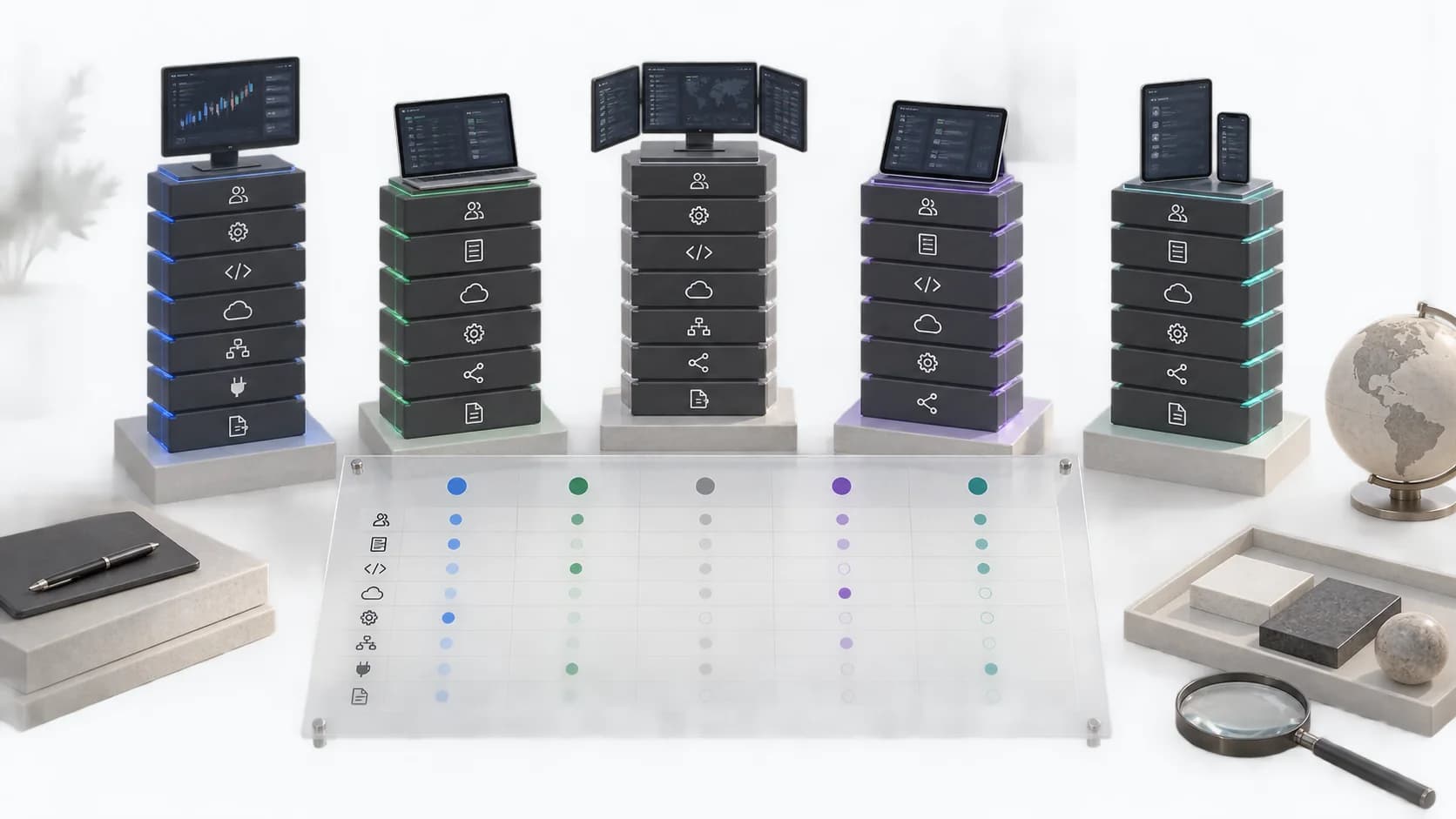
To compare broker platform pricing, give every supplier the same operating scope and volume scenarios, then model setup, licence, usage, infrastructure, data, bridge, liquidity connectivity, CRM, KYC, payments, applications, integrations, support, implementation, staffing, change, migration, downtime risk, and exit. Separate included, optional, third-party, custom, and roadmap items. Do not publish or rely on claims such as 'MT5 costs $10,000 a month' unless a current authoritative quote with identical scope supports them. RTX5 publishes plan-specific licence prices and module inclusions; confirm total cost, configuration and implementation terms in a written quote.
Apply this guide to RTX5
Get a quote for one clearly defined configuration
Start with the published RTX5 plans, then specify account capacity, CRM, adapters, environments and support. Request a line-item quote that separates licence charges from third-party and implementation costs.
Create a comparable commercial baseline
Describe the entities, countries, products, client types, account models, applications, languages, execution model, liquidity counterparties, integrations, data regions, support hours, environments, and implementation dates. Supply monthly and peak assumptions for registered users, active accounts, concurrent sessions, quotes, orders, executions, deposits, withdrawals, storage, messages, support cases, and reports.
Give each requirement an identifier, priority, response category, evidence request, and acceptance test. Require suppliers to mark included production function, configuration, custom work, third-party service, beta, roadmap, or unsupported. State whether pricing covers launch, steady state, growth, and migration. A quote is not comparable if the supplier solved a different scenario.
Request a detailed assumptions and exclusions schedule. Ask which legal entities, regions, asset classes, client applications, app-store accounts, integrations, connectors, environments, data retention, and service levels are included. Identify customer work, prerequisites, and third-party contracts. Treat silence as an unresolved scope question, not a free feature.
Decompose every price unit
Separate one-time fees for onboarding, setup, branding, environments, configuration, interfaces, certification, migration, training, security review, application publication, and launch support. Separate recurring licence, minimum commitment, active account, registered user, concurrent session, transaction, notional volume, message, instrument, connector, server, region, storage, log, market-data, and support charges.
Define the billing event precisely. An "active account" could mean logged in, funded, traded, open position, or not archived. Volume could mean requested, accepted, executed, one side, both sides, notional, lots, or revenue. Storage could include hot data only while archive and retrieval are separate. Ask how corrections, test accounts, dormant accounts, and internal users count.
Record currency, taxes, invoice timing, deposits, annual prepayment, minimum term, automatic renewal, indexation, tier thresholds, true-ups, pass-through costs, and late fees. Test threshold cliffs. A small increase in accounts or messages can change the unit price or trigger infrastructure and support requirements. Contract language should match the financial model.
| Category | Examples | Question |
|---|---|---|
| Core platform | Licence, accounts, volume, applications | What exact edition and capacity are included? |
| Broker operations | Back office, risk, dealer, reports, partner tools | Which roles and workflows need another module? |
| Connectivity | FIX, bridge, liquidity adapters, network, certification | Who owns counterparty onboarding and change? |
| Client lifecycle | CRM, portal, KYC, payments, communications | Are services native, third-party, or integration only? |
| Infrastructure | Cloud, servers, regions, databases, monitoring, backup | Who pays, operates, secures, and recovers it? |
| Change and exit | Custom work, upgrades, exports, migration, termination | What remains chargeable after the initial launch? |
Price dependencies outside the platform
Add CRM and client portal, identity verification, sanctions screening, document signing, payments, banking, market data, charts, news, bridge, liquidity, FIX connectivity, email, SMS, telephony, support desk, analytics, regulatory reporting, security monitoring, penetration testing, and audit. Determine whether the platform fee includes the service, only a connector, or neither.
For each integration, include vendor onboarding, legal and due diligence, sandbox, development, certification, recurring minimum, transactions, support, reconciliation, monitoring, maintenance, and replacement. A ready-made connector can reduce development but does not eliminate the counterparty contract, mapping, certification, production configuration, or incident coordination.
Model internal roles: product, project, architecture, integration, platform administration, dealing, risk, operations, reconciliation, compliance, financial crime, support, security, data, finance, and vendor management. Bundling can reduce some work, but the brokerage still needs accountable people capable of supervising the service and responding to incidents.
Model implementation and migration as cost and risk
Build a work breakdown with deliverables, dependencies, owners, estimates, environments, data, interfaces, applications, certification, training, procedures, acceptance, regulatory readiness, launch, and stabilization. Include customer effort and decision deadlines. Price delays caused by banking, liquidity, data, app stores, regulators, or incomplete requirements, not only vendor engineering.
For migration, inventory clients, agreements, accounts, balances, open positions and orders, history, statements, partners, commissions, configurations, instruments, identifiers, automation, integrations, and reports. Decide what migrates, remains accessible, or closes. Rehearse extraction, transformation, loading, reconciliation, client communication, parallel operation, rollback, and decommissioning.
Quantify operational risk rather than inventing a precise expected loss. Compare concentration, manual work, reconciliation complexity, change dependence, incident history, recovery evidence, security findings, data portability, and supplier financial or strategic risk. Use ranges and scenarios. A low recurring fee can be dominated by a delayed launch or failed migration.
Ask for evidence before scoring price
Script demonstrations around the workflows that create cost or risk. Have operational users configure products and permissions, investigate an order, reconcile cash and trades, export data, recover a failed integration, and produce a report. Note which tasks require vendor intervention or extra modules. Follow up every unanswered item in writing.
Use a proof of concept for a few decisive uncertainties with success criteria, representative data, topology, and test evidence. A trial does not establish production capacity, resilience, security, or support unless those are within scope. Record differences and price the work needed to close them.
Review security, privacy, business continuity, support, and regulatory cooperation with specialists. Ask for scoped assurance reports, responsibilities, incidents, recovery exercises, vulnerabilities, data locations, subprocessors, access, and deletion. A platform that cannot meet a mandatory control is not a bargain, regardless of feature points.
Build the total-cost model and decision record
Model at least low, expected, high-growth, stress, and exit scenarios over a realistic horizon. Show recurring and one-time cash flow, internal cost, pass-through cost, contingency, foreign exchange, tax assumptions, and when tier changes occur. Keep input cells traceable to proposal sections or internal estimates and show sensitivity where evidence is weak.
Separate cost from score but display both. Evaluate mandatory compliance, functional fit, operations, architecture, integration, data, security, resilience, implementation, support, commercials, and exit. State evidence, confidence, and residual risk. A single weighted number can hide a mandatory failure, so use gates before preferences.
Preserve the decision pack: business scope, requirements, responses, demonstrations, tests, reference calls, security and legal reviews, cost model, assumptions, risks, negotiation changes, approvals, and final contract mapping. This supports later vendor reviews and prevents a supplier change from being judged against a fictional memory of the original offer.
Decision checklist
- All suppliers price the same entities, products, integrations, regions, and volumes
- Every unit, minimum, tier, currency, index, tax, and billing event is defined
- Included, optional, third-party, custom, beta, and roadmap scope is separated
- Internal people, implementation, migration, operations, change, and exit are costed
- Claims are backed by documents, demonstrations, tests, and contract schedules
- Mandatory legal, security, record, and continuity requirements act as gates
- Low, expected, growth, stress, migration, and termination scenarios are compared
- The decision record links price and score to evidence and stated uncertainty
Negotiate the contract around outcomes and exit
Define the exact products, editions, versions, environments, applications, modules, integrations, regions, capacity, data, documentation, support, and third parties. Attach implementation deliverables, responsibilities, dates, assumptions, acceptance tests, defect severity, retest, launch criteria, and stabilization. Do not let the proposal disappear behind a generic order form.
Cover service levels, maintenance, support, incidents, security, privacy, audit cooperation, records, change control, price changes, subcontractors, business continuity, disaster recovery, regulatory assistance, intellectual property, confidentiality, liability, termination, transition, export, and deletion. Qualified counsel should tailor terms to the entities and jurisdictions.
RTX5 now publishes plan-specific pricing, including different CRM, bridge and FIX treatment. Use the linked matrix as a dated commercial input and request a written quote for the exact configuration. A universal MT5 monthly cost or an RTX5 savings claim is not established here; compare current, equivalent proposals including infrastructure, data, integration, support and exit costs.
Primary sources and evidence boundary
Sources are listed to support specific definitions, public vendor statements, and regulatory frameworks. They do not endorse Orrnn, prove that a product meets a requirement, or replace a current proposal, contract, legal opinion, technical test, or regulator decision.
The original source review was completed on 21 September 2026. RTX5 pricing and plan references were updated on 26 September 2026; the dated note below identifies that product source. Recheck time-sensitive requirements and commercial terms before relying on them.
- RTX5 broker pricing and plan inclusions
RTX5 / Orrnn
Product pricing reviewed 26 September 2026. Vendor-published commercial scope, not independent proof of performance, compatibility or regulatory approval. Inclusions vary by plan.
- MetaTrader 5 for Brokers
MetaQuotes
Official vendor page describing licence types and platform components without establishing a universal public monthly price.
- Trading Platform for Forex Brokers
Match-Trade Technologies
Official vendor material illustrating why standalone, white-label, server, CRM, and integration scope must be normalized.
- White Label Trading Platform
TradeLocker
Official vendor material; a current proposal is needed for exact account thresholds, package, region, and total cost.
- The NIST Cybersecurity Framework 2.0
National Institute of Standards and Technology
A general framework for evaluating security governance and supply-chain risk within procurement.
- FIX Protocol
FIX Trading Community
Primary technical reference showing why a connector must specify version, workflow, and implementation details.
Related reading and next steps
Trading platform comparison
Run the same evidence-led product and operational comparison before scoring cost.
ReadMetaTrader 5 alternatives
Create a shortlist without relying on unsupported price or equivalence claims.
ReadLiquidity bridge evaluation
Expose connectivity, certification, data, support, and counterparty costs hidden by a bridge label.
ReadYour next step
Explore an RTX5 configuration for your business.
Compare the published platform plans, then share the account capacity, client workflows and connectivity your business needs. A requirements discussion can establish the demonstration scope, quote and implementation dependencies. Module inclusions vary by plan.