Trading Platform Comparison Framework: MT5, cTrader, Match-Trader, TradeLocker, DXtrade, and RTX5
A neutral, evidence-led framework for comparing broker platform candidates by deployment, workflow, integrations, operations, security, cost, and exit rather than marketing claims.
Direct answer
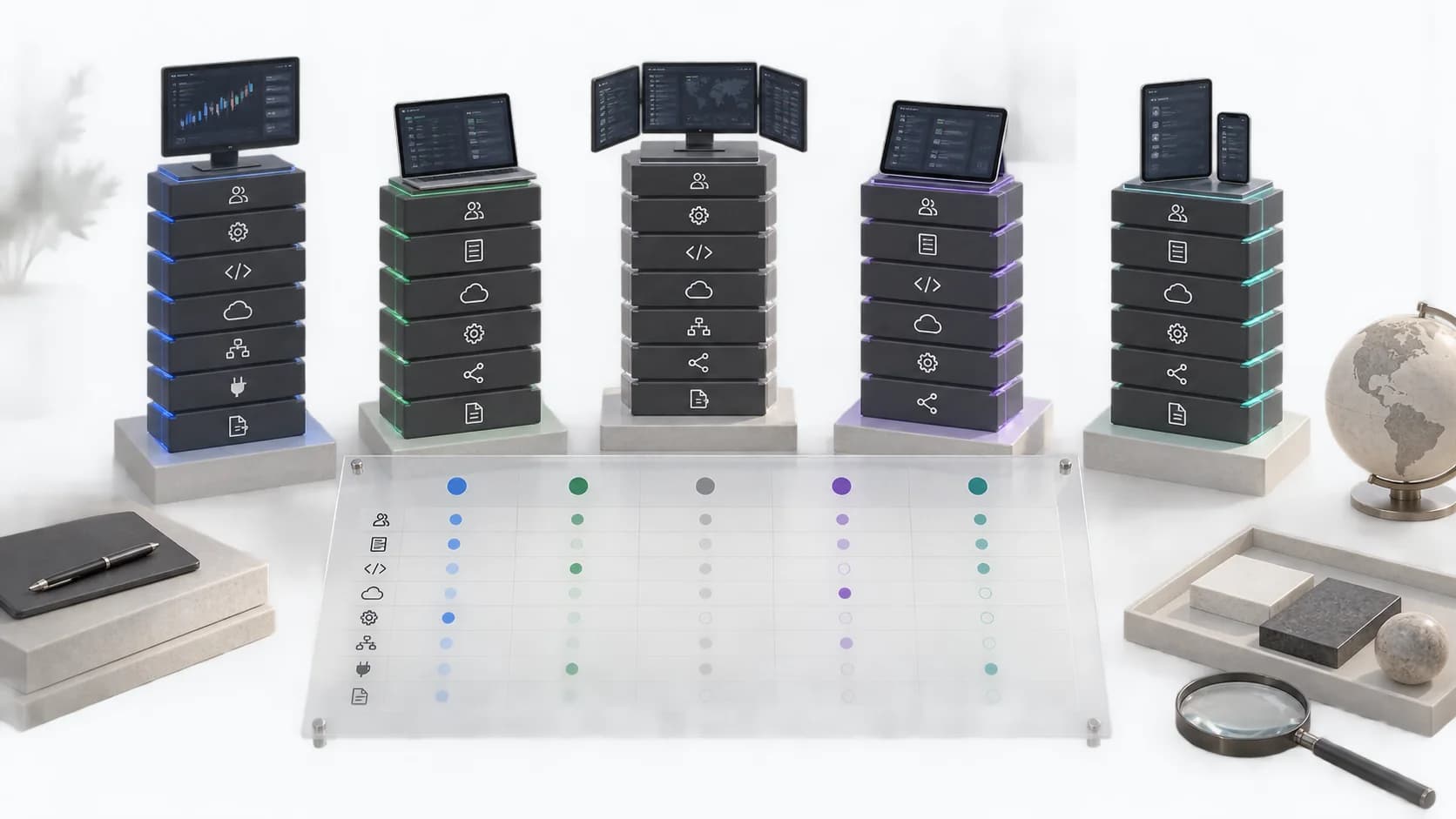
Compare MT5, cTrader, Match-Trader, TradeLocker, DXtrade, RTX5, and other platforms through one requirements matrix and scripted proof process. Official vendor pages can establish only what each vendor publicly describes; they do not prove your proposed edition, integrations, capacity, service levels, price, regulatory suitability, or implementation. Define the brokerage model first, request the same scope and evidence from every supplier, test full client and operator journeys, normalize total cost, and make contractual acceptance and exit measurable. RTX5 publishes a plan-specific licensing matrix; validate the proposed configuration through a demonstration and written acceptance criteria.
Separate public vendor statements from due-diligence evidence
A public product page is useful for creating questions and confirming how a vendor positions its product. MetaQuotes publicly describes MetaTrader 5 for brokers as a multi-asset platform with back-end functions, APIs, gateways, and broker-managed deployment. Match-Trader publicly describes standalone and combined configurations, including its own CRM option or APIs. TradeLocker markets a white-label platform. Devexperts describes DXtrade for FX and CFD brokers as a hosted, configurable offering.
Those statements come from the vendors and should be attributed as such. They do not independently prove security, uptime, capacity, suitability, successful integration, price, implementation duration, or the scope offered to a particular buyer. Products and commercial packages change. Request dated documentation and a proposal for the exact edition, entity, region, asset classes, client applications, and operating model.
RTX5 now publishes a broker licensing matrix with plan-specific account capacity, CRM, bridge and FIX treatment. Use the linked product source to build its comparison column, separating published commercial scope from tested functionality. Confirm the required builds, integrations, security, support, availability and migration terms for the proposed deployment. The matrix does not establish a universal price advantage over competitors.
| Candidate | Vendor publicly describes | Buyer must still verify |
|---|---|---|
| MetaTrader 5 | Broker platform, back-end, APIs, gateways, and broker-controlled deployment options | Exact licence, components, infrastructure, integrations, cost, support, and acceptance |
| cTrader | A platform ecosystem used through participating brokers and offered by a technology provider | Broker product scope, deployment, operations, data, integrations, price, and service levels |
| Match-Trader | Standalone or broader stack options, with vendor-described CRM/API paths | Exact included modules, external dependencies, regions, limits, cost, and support |
| TradeLocker | White-label trading platform and chart-centered trading workflows | Back end, account, risk, integration, data, deployment, commercial, and operational scope |
| DXtrade | Vendor-described hosted, configurable FX/CFD platform with back-office capabilities | Current edition, asset and region scope, integrations, support, evidence, and pricing |
| RTX5 | Published broker licensing with plan-specific CRM, bridge and FIX options | Every functional, technical, operational, commercial, security, and availability claim |
Freeze the operating model and comparison scope
State the legal entities, countries, client types, products, venues or liquidity counterparties, account structures, execution and risk model, currencies, languages, expected volumes, and launch phases. Identify which responsibilities remain with the brokerage and which could be outsourced. Without this baseline, two proposals that solve different problems will appear comparable.
Define mandatory launch functions, post-launch requirements, desirable features, and exclusions. Cover onboarding, identity, client portal, CRM, payments, accounts, ledger, trading interfaces, market data, instruments, order types, margin, risk, pricing, execution, bridge, reporting, communications, partners, surveillance, operations, security, and continuity. Mark every required integration and data owner.
Use stable requirement identifiers and response categories: generally available, configured, custom, third-party, beta, roadmap, or unsupported. Require document, demonstration, test, or contract evidence. A checkbox marked yes is not sufficient because a capability may exist only in another product edition, region, client app, or separately priced service.
Compare client and operator workflows end to end
Script the same client journeys for each candidate: application, verification state, account opening, funding, instrument discovery, price receipt, order entry, validation, partial fill, rejection, cancellation, margin event, statement, withdrawal, complaint, restriction, and closure. Include desktop, web, mobile, accessibility, languages, weak networks, session recovery, and negative paths relevant to the plan.
Evaluate brokerage operations with realistic roles. Ask staff to configure an instrument, session, margin, markup, commission, group, permission, partner, and notification; investigate a disputed execution; correct an approved error; export a report; reconcile a break; suspend an account; and trace an administrative change. Record which tasks require vendor support, deployment, restart, or database access.
Test consistency across surfaces. A setting visible in an administrator portal may not propagate immediately to risk, front ends, reports, and statements. Confirm effective time, cache and session behavior, audit logging, approvals, rollback, and existing-order treatment. A visually attractive trader application cannot compensate for weak operational control.
Interrogate architecture, integration, and data ownership
Request current deployment and data-flow diagrams for the proposed service. Identify tenant boundaries, regions, networks, environments, platform services, databases, broker systems, vendors, subprocessors, liquidity and market-data connections, monitoring, backups, and disaster recovery. Record who operates each component and who can access brokerage or client data.
Review APIs and connectors by protocol, purpose, version, schema, authentication, rate and volume limits, ordering, idempotency, error behavior, sandbox fidelity, certification, monitoring, change notice, and support. A logo in a marketplace or integration page is not proof of current interoperability with the buyer's account, workflow, configuration, and counterparties.
Contract for ownership and export of client, account, configuration, order, execution, position, cash, report, communication, partner, audit, and telemetry data as appropriate. Perform a representative export and confirm documented formats, identifiers, completeness, time, fees, and downstream usability. Assess how service continues during dispute, termination, migration, or supplier failure.
Demand security, resilience, and performance evidence
Use a responsibility matrix for identity, privileged access, secrets, encryption, tenant separation, secure development, vulnerabilities, penetration testing, logging, incident response, data protection, backup, and recovery. Review the scope and period of independent reports and unresolved findings under confidentiality. A certification logo does not prove every component or configuration proposed.
Set recovery objectives by business service and define the assumptions behind them. Ask for architecture, recent exercise evidence, data-loss behavior, failover authority, communication, and post-recovery reconciliation. Test platform, network, data, integration, and regional failure where proportional. Determine what remains manual and how duplicate or uncertain orders are controlled.
Define performance at the client and operational journey, not as an unattributed server number. Measure distributions under representative topology and load, including quotes, order acknowledgements, executions, account changes, reports, and recovery. State clocks, regions, test data, dependencies, and error rates. Do not repeat vendor latency or capacity claims without current, scoped evidence.
Normalize total cost and implementation risk
Model setup, licence, active account or user, volume, messages, instruments, environments, servers or cloud, region, storage, market data, liquidity connectivity, bridge, CRM, KYC, payments, applications, branding, APIs, reports, support, training, professional services, custom work, migration, upgrades, and exit. Include taxes, currency, minimums, tiers, indexation, and third-party contracts.
Run low, expected, growth, stress, and migration scenarios over several years. A lower base fee may exclude critical modules and implementation work; an all-in-one offer may include functions the brokerage does not need. Record assumptions and require suppliers to price the same scenario. There is no supported basis here for claiming any candidate costs a specific amount or that RTX5 saves a specific percentage.
Score implementation against dependencies and customer effort. Ask for named deliverables, environment dates, data, integrations, certification, application-store work, migration rehearsals, training, operational procedures, regulatory readiness, acceptance, launch, and stabilization. Treat an indicative sales timeline as an assumption until responsibilities and acceptance are contractually defined.
Use proof, weighted decisions, and contractual acceptance
Build demonstrations around decisive workflows and give suppliers the same scripts. Use a proof of concept only for material uncertainties such as a difficult integration, order lifecycle, permission model, export, or recovery behavior. Record differences between test and production. References should resemble the proposed scope and be treated as vendor-selected evidence, not a representative sample.
Score mandatory compliance separately from weighted preference. A supplier that fails a legal, security, record, or critical workflow requirement should not win through presentation or price points. Weight functional fit, operations, architecture, security, resilience, implementation, service, commercial terms, and exit. Publish evidence and residual risk beside each score.
Convert decisive requirements into contract schedules and acceptance cases. Define product and edition, environments, scope, dependencies, data, service levels, support, security, recovery, change, pricing, termination, and transition. Keep roadmap promises outside the launch baseline unless the agreement makes delivery and remedy clear. Final selection remains a business and regulated-risk decision, not a universal ranking of brands.
Decision checklist
- Every candidate receives the same operating model, volumes, and requirement identifiers
- Vendor public claims are attributed and separated from buyer-specific evidence
- Full client, operator, integration, reconciliation, and failure journeys are tested
- Architecture, data rights, security, recovery, and supplier access are reviewed
- Cost includes modules, third parties, implementation, change, growth, and exit
- Mandatory failures cannot be hidden by weighted feature or presentation scores
- Proposed RTX5 capabilities remain unclaimed until written and tested
- Contract schedules contain measurable scope and acceptance, not slogans
Primary sources and evidence boundary
Sources are listed to support specific definitions, public vendor statements, and regulatory frameworks. They do not endorse Orrnn, prove that a product meets a requirement, or replace a current proposal, contract, legal opinion, technical test, or regulator decision.
The original source review was completed on 21 September 2026. RTX5 pricing and plan references were updated on 26 September 2026; the dated note below identifies that product source. Recheck time-sensitive requirements and commercial terms before relying on them.
- RTX5 broker pricing and plan inclusions
RTX5 / Orrnn
Product pricing reviewed 26 September 2026. Vendor-published commercial scope, not independent proof of performance, compatibility or regulatory approval. Inclusions vary by plan.
- MetaTrader 5 for Brokers
MetaQuotes
Official vendor page describing the MetaTrader 5 broker product; statements are vendor claims and do not establish a buyer-specific package.
- cTrader Brokers
cTrader
Official cTrader page identifying cTrader as a platform/service provider and separating it from listed broker responsibility.
- Trading Platform for Forex Brokers
Match-Trade Technologies
Official vendor page describing Match-Trader configurations and features; verify current proposal scope and dependencies.
- White Label Trading Platform
TradeLocker
Official vendor page describing its white-label proposition; buyer-specific technical and commercial scope remains to be verified.
- DXtrade SaaS Trading Platform for FX/CFD Brokers
Devexperts
Official vendor release describing DXtrade's hosted and configurable positioning; obtain current product documentation.
Related reading and next steps
MetaTrader 5 alternatives
Create a requirements-led shortlist without treating 'alternative' as interchangeable.
ReadPlatform pricing and RFP
Turn the comparison into comparable scope, cost scenarios, and acceptance tests.
ReadBroker technology stack
Map every candidate to systems of record, controls, integrations, and responsibilities.
ReadYour next step
Explore an RTX5 configuration for your business.
Compare the published platform plans, then share the account capacity, client workflows and connectivity your business needs. A requirements discussion can establish the demonstration scope, quote and implementation dependencies. Module inclusions vary by plan.