Glossary term
What Is CFD Brokerage? How CFD Brokers Operate
CFD brokerage meaning: a CFD broker is the counterparty to a client's contract. Learn how quotes, margin, financing and close-out work on the broker side.
Definition
CFD brokerage is the business of offering contracts for difference (CFDs) to clients, where the broker is the counterparty to each client's contract. The broker quotes prices, holds margin, charges financing on open positions and closes out positions when margin runs short. Its revenue and market risk depend on how it fills and hedges those orders.
Also known as: CFD brokerage, CFD broker, CFD brokers, how CFD brokers work, CFD brokerage meaning
Key takeaways
- CFD brokerage is the business of offering CFDs, where the broker is the counterparty to each client's contract.
- From the broker's side, a CFD trade involves a quote, margin, financing charges and a possible close-out.
- In both the A-book and B-book models the broker is the counterparty. The difference is whether it hedges the risk or keeps it.
- UK and EU retail rules set leverage caps, a 50% margin close-out level and negative balance protection, but rules vary by jurisdiction.
- CFDs are leveraged and high-risk. Orrnn is not a broker and does not give licensing or investment advice.
What is CFD brokerage: the broker's role
The broker sells the client a contract that tracks a price, and it is the other party to that contract.
A contract for difference (CFD) pays the difference between the price when it is opened and the price when it is closed, on an underlying market such as a currency pair, index, commodity or share. The client does not own the underlying asset. A CFD brokerage offers these contracts, usually through an electronic platform, and it is the counterparty to each contract the client opens.
That counterparty role separates a CFD brokerage from a broker that only routes an order to an exchange for a commission. The client's contract is with the CFD broker, so the broker's pricing, margin and conduct obligations attach to that contract. What the broker does with the resulting risk is a separate choice, covered in the execution models section.
How a CFD trade works from the broker's side
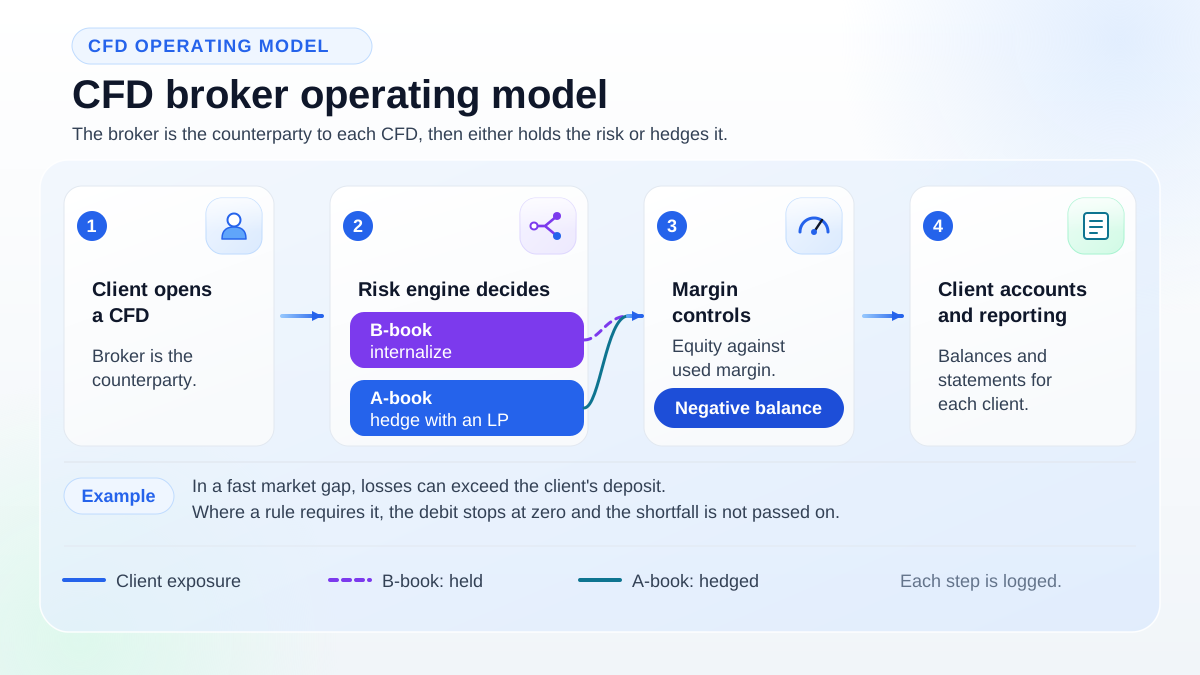
Four stages show what the broker's systems handle, from the first quote to the close.
Example (illustrative figures, not any broker's terms): a client opens a position of 10,000 units at a quoted price of 1.1000, a notional value of 11,000. With a 5% initial margin requirement, the client must hold 550 in equity to open it. The margin engine then recalculates the requirement as the price moves.
The broker's books carry a matching exposure that it either keeps or hedges. The quote and margin rules are the same either way.
- Quote: the platform streams bid and ask prices built from liquidity sources and the broker's markup rules. The client sees a price, and the broker sees the exposure that price creates.
- Margin: on opening, the system checks that the client has enough equity to meet the initial margin for the position's notional value.
- Financing: positions held past the daily rollover carry financing, often called a swap, based on interest rates and the broker's own rate schedule.
- Close-out: if equity falls below the required margin, the system closes positions at available prices to bring the account back within the rules.
Execution models in brief
The model decides what the broker does with the risk after it accepts a client order.
The full comparison, including hybrid models, is in the A-book vs B-book vs hybrid guide. This is only a short summary.
In both models the broker is the counterparty to the client's contract. The difference lies in hedging. An A-book broker lays off client exposure with liquidity providers. A B-book broker keeps some or all of it. The table shows the practical differences.
| Question | B-book (broker keeps the risk) | A-book (broker hedges with providers) |
|---|---|---|
| Legal counterparty to the client's CFD | The broker | The broker, because hedging does not change the client contract |
| Where market risk sits | With the broker, unless it hedges | Largely with the hedge provider once the broker has hedged |
| Conflict controls to check | Disclosed pricing and loss-handling policies, and monitoring of client results | Routing and best execution rules, disclosed markups and fill records |
| Main question for the client | Are the broker's prices and fills fair when it holds the other side? | Are routing, markups and provider choice documented? |
Regulation: where the CFD rules apply
Rules depend on jurisdiction. The EU and UK retail measures are the most specific published examples.
In 2018 ESMA adopted product intervention measures for CFDs sold to retail clients. They set leverage limits from 30:1 down to 2:1 by volatility of the underlying, a margin close-out at 50% of minimum required margin, per-account negative balance protection, an incentive restriction and a standardized risk warning. National regulators apply their own versions, and in February 2026 ESMA reminded firms to check whether newly offered derivatives, such as perpetual futures, fall within them.
In the UK, the FCA's rules for CFDs offered to retail clients are set out in COBS 22.5. The FCA released the final rules on 1 July 2019 in policy statement PS19/18. They set leverage between 30:1 and 2:1 depending on the underlying, a close-out at 50% of required margin, negative balance protection, a requirement to stop offering retail clients cash or other inducements, and a standardized risk warning. The FCA advises checking whether an overseas firm is involved, as it may offer fewer protections.
This page does not cover other countries. A broker serving several jurisdictions may place each client contract under a different regime, set by the regulator that supervises the contracting entity.
Technology a CFD broker needs
The platform has to price, check and record every position, then report it to the people responsible for it.
Connectivity to liquidity providers usually runs over FIX or a vendor API. The FIX Trading Community describes FIX standards as open, technology-neutral specifications for electronic trading and trade processing. The full stack is covered in the broker technology stack guide.
- Pricing: builds client quotes from liquidity inputs, applies markup and spread rules and logs the prices used for each fill.
- Risk engine: checks exposure, leverage and client limits before an order is accepted, and watches the book for concentration.
- Margin engine: recalculates required margin as prices move, applies the broker's margin rules and triggers warnings and close-outs in a defined order.
- Back office: posts trades, financing, fees and adjustments to client accounts, and reconciles them with liquidity providers and banks.
- Reporting: produces client statements, regulatory and internal reports and an audit trail of who changed which setting.
Risk and limitations
CFDs are leveraged, and many retail clients lose money. This page is general education, not advice.
CFDs are leveraged products. Losses can build quickly when prices move against a position, and margin calls or automatic close-outs can lock them in. The FCA says CFDs are "high-risk products, which are not suitable for all retail consumers." Read the regulator's risk warnings and the broker's disclosures before opening any account.
Many retail clients lose money trading CFDs. The standardized EU and UK warning states the share of losses on the firm's retail accounts. Check the warning the firm shows you.
Orrnn is a trading software architecture and engineering provider, and it builds the RTX5 platform. Orrnn is not a broker, does not hold a license, does not supply liquidity and does not give investment, legal or regulatory advice. Enquiries about launching or licensing a brokerage are referred to FxTrusts, a separate company.
The RTX5 roadmap, checked 10 November 2026, marks every module as build not published. Its Preview group includes the Desktop Trading Terminal, CRM, Bridge / Gateway and FIX 4.4 / 5.0. Scope and test each connection before relying on it.
Frequently asked questions
What is CFD brokerage?
CFD brokerage is the business of offering contracts for difference to clients, with the broker as the counterparty to each contract. The broker quotes prices, holds margin, charges financing and may close out positions. Whether it keeps or hedges the resulting risk is a separate decision, called the execution model.
How does a CFD broker earn money?
A CFD broker can earn from the spread or markup on its quotes, from commissions where it charges them and from financing on open positions. A broker that holds client risk also depends on client trading results. The fee schedule and the broker's disclosures show which sources apply to a given account.
What is the difference between an A-book and a B-book CFD broker?
In both models the broker is the counterparty to the client's contract. An A-book broker hedges client exposure with liquidity providers, while a B-book broker keeps some or all of that risk. A hybrid broker chooses between the two by client, product or order size. The A-book vs B-book guide sets out the trade-offs.
Are CFD brokers regulated the same way everywhere?
No. Rules depend on the jurisdiction and the legal entity the client contracts with. In the EU, national regulators apply product intervention measures based on ESMA's CFD measures. In the UK, FCA rules in COBS 22.5 cover CFDs offered to retail clients. Check the firm's regulator before opening an account.
Does Orrnn operate a CFD brokerage?
No. Orrnn builds trading software and infrastructure, including the RTX5 platform. It does not act as a broker, hold a license or supply liquidity. Launch and licensing enquiries go to FxTrusts, a separate company. The RTX5 liquidity bridge and FIX 4.4 and 5.0 modules have no published build yet.
Primary sources and further reading
These sources support the definitions used on this page. They do not endorse Orrnn or establish that any product complies with the referenced material.
- ESMA reminds firms of their obligations under CFD product intervention measures
European Securities and Markets Authority (ESMA)
Dated 24 February 2026. Cited for the list of measures (leverage limits, risk warning, margin close-out, negative balance protection, benefits ban) and the reminder on new derivatives. Checked 9 November 2026.
- ESMA adopts final product intervention measures on CFDs and binary options
European Securities and Markets Authority (ESMA)
Press release dated 1 June 2018. Cited for the leverage tiers, 50% close-out, per-account negative balance protection and incentive restriction. Checked 9 November 2026.
- Contracts for difference (CFDs)
Financial Conduct Authority (FCA), UK
UK scope only. Cited for the high-risk statement, the 30:1 to 2:1 leverage range, the 50% close-out, the requirement to stop offering retail clients cash or other inducements, the advice to check overseas firms, and the 1 July 2019 release of the final rules (PS19/18). Checked 9 November 2026.
- FIX Protocol standards
FIX Trading Community
Cited for the description of FIX standards as open, technology-neutral specifications for electronic trading and trade processing. Checked 9 November 2026.
Related reading
A-Book vs B-Book vs Hybrid
How brokers hedge client exposure, where the risk sits and the conflict controls to check.
Read →Broker Technology Stack
The systems a broker needs for pricing, risk, margin, back office and reporting.
Read →Order Routing for FX and CFD Brokers
Routing rules, risk gates and audit records for FX and CFD order flow.
Read →Broker Licensing and Regulatory Planning
Planning the licensing and regulatory steps before a brokerage launches.
Read →