Decision guide
Order Routing for FX and CFD Brokers: Rules, Architecture and Audit
Learn how FX and CFD brokers set order routing rules, design a router with risk gates and LP adapters, measure execution quality and keep audit records.
Direct answer
Order routing decides where a client order goes after risk checks: the internal book, a liquidity provider or a fallback path, and at what price, size and timing. For FX and CFD brokers, those choices follow written rules tied to the A-Book, B-Book or hybrid model, client groups and failover.
Key takeaways
- Order routing is a set of written rules that picks an internal book or a liquidity provider for each order, with a defined fallback.
- A risk gate should sit ahead of the router, so an order can be stopped while routing logic changes.
- Execution quality needs standard definitions for fill ratio, reject rate, slippage, last-look hold time and markouts.
- Best execution and market-access duties depend on the legal entity, client, product and jurisdiction. Confirm scope with counsel.
- No released smart order router product is evidenced for Orrnn. Routing requirements are scoped and tested per build.
What an order router decides in FX and CFD trading
Every client order that reaches a broker's execution layer raises the same questions. Should it be filled from the broker's own book, sent to a liquidity provider, or held for a fallback path? At what price and size may it trade, and how long can the path take before the quote goes stale? A router answers those questions from configured rules and live market state, and it records the answer.
In a retail FX or CFD brokerage, the first decision is usually internal versus external. Internal execution means the broker takes the other side on its own book, subject to its dealing model and risk limits. External execution passes the order, or a hedge of it, to one or more liquidity providers through a bridge or FIX session. Price, size, latency and provider availability feed each choice.
Order routing rules for liquidity providers, venues and books
Write routing rules as a table of conditions and actions, not as prose in a presentation. Each rule should name the account group, instrument, size band, session and failover path it covers, and the router should record which rule fired for each order. Overlapping rules need a priority order.
The A-Book, B-Book and hybrid model sets the baseline. In an A-Book flow, client orders go to the market, usually through a liquidity provider. In a B-Book flow, the broker takes the opposite side and manages the resulting risk. A hybrid model routes some flow each way, often by client group or trade size. Orrnn treats these models as routing requirements to define in the architecture review, not as a setting that switches on by default.
For CFD order flows in the EU, national product-intervention safeguards, including leverage limits and negative balance protection, can shape which rules are permitted. ESMA's reminder on those measures is a starting point for the compliance review.
Failover needs the most care. A router that switches provider mid-flow can create duplicate exposure, orphaned hedges or client confusion if order state is not reconciled. Define the timeout after which an order is treated as uncertain, the rule for querying the provider before any resubmission, and the maximum exposure allowed while a path is down.
Example routing rule dimensions for an FX or CFD book
| Dimension | Typical condition | What to verify |
|---|---|---|
| Account group | Client classification, account type or introducing partner | Group assignment follows the broker's configuration, and the client cannot change it |
| Instrument | Symbol, asset class or contract specification | Each symbol maps to the provider's symbol, tick size and lot size |
| Order size | Size band or maximum child quantity | Band limits match the liquidity agreement and the exposure limit |
| Session and time | Market hours, rollover windows or news periods | Behavior at session close and during rollover is documented and tested |
| Failover | Provider disconnect, reject rate above a threshold or stale quotes | Fallback destination, timeout and order-status recovery are defined |
Architecture from risk gate to audit store
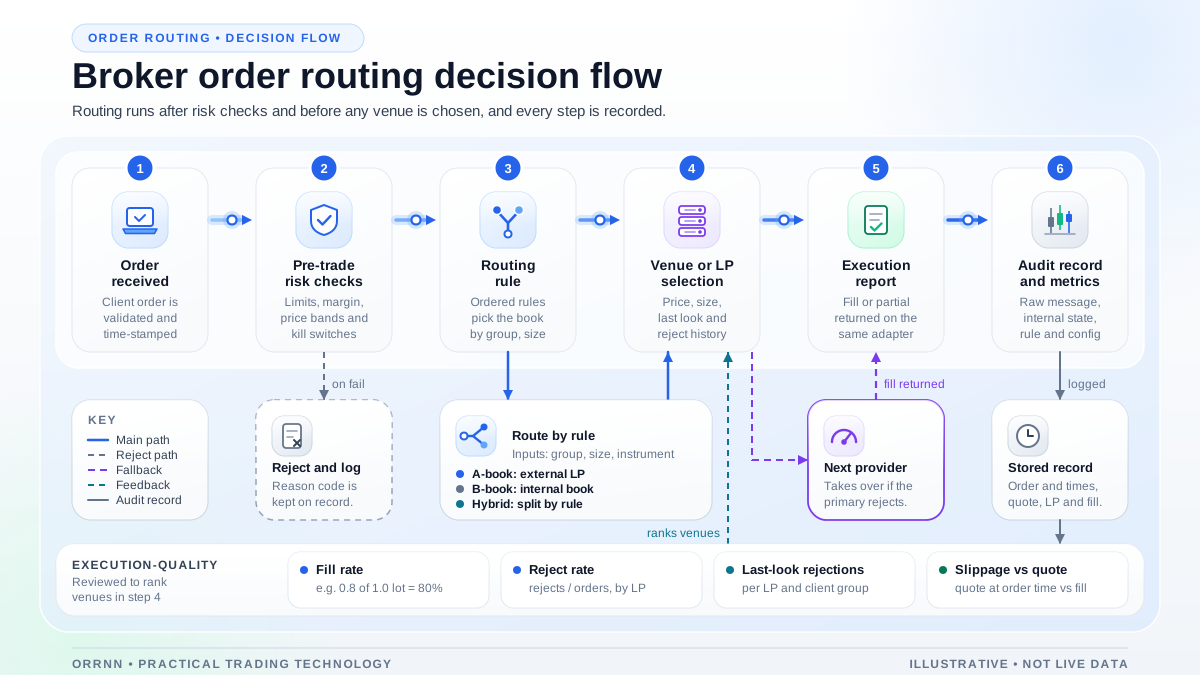
A practical design has six stages, and the diagram follows them in order. First, the client order is received and validated. Second, a risk gate checks it against account limits, margin, instrument permissions, price bands and kill switches, and rejects it with a reason code if a check fails. Third, the router applies the rule set. Fourth, the venue or liquidity provider is selected, and liquidity provider adapters or a bridge translate the order into that counterparty's protocol, whether FIX messages or a vendor API. Fifth, execution reports return through the same adapters and update the order state. Sixth, every event is written to a store that keeps the original message, the internal state and the rule that applied.
Keep the risk gate separate from the router, so the gate can stop an order while routing logic changes. Keep order states explicit, including an "uncertain" state for orders that cannot be resolved. Time stamps should come from synchronized clocks, and each record should carry the configuration version live at the time.
Measuring execution quality with standard definitions
Agree these definitions before comparing providers or reviewing a month of fills. Each measure should state its population, time window and reference price.
Report these by provider, instrument, account group, session and order size. Show medians and high percentiles together, because a single average can hide a poor tail during volatile periods.
Where a provider applies last look, it may hold an order before accepting or rejecting it. Whether that practice is permitted, and how it must be disclosed, depends on the venue, product and jurisdiction. Record the hold time, the decision and the price at decision.
Standard execution quality measures
| Measure | Definition | Caution |
|---|---|---|
| Fill ratio | Filled quantity divided by requested quantity, over a defined set of orders | Report full, partial and zero fills separately |
| Reject rate | Rejected orders divided by orders sent, grouped by provider and reason code | A low rate can hide requotes or cancellations that never reached the store |
| Slippage versus quoted | Difference between the executed price and the price seen at order time, signed by direction | Define the reference quote and the delay between quote and send |
| Last-look hold time | Time between an order reaching the provider and its accept or reject decision, where last look applies | Measure both ends on one clock and report distributions, not only an average |
| Markout | Price movement after a fill, measured at fixed horizons against a reference mid price | A markout is an analytical lens, not proof of intent or fault |
Compliance records and audit trail
Best execution duties are set by regulators, and their scope depends on the legal entity, client and product. In the EU, MiFID II Article 27 requires investment firms to take sufficient steps to obtain the best possible result for clients when executing orders, taking account of factors such as price, costs, speed and likelihood of execution. The ESMA Interactive Single Rulebook is the primary place to read that framework. The UK's FCA Handbook sets separate best execution rules for UK firms. For firms that trade algorithmically, Commission Delegated Regulation (EU) 2017/589 (RTS 6) adds organizational requirements, including pre-trade controls, and Delegated Regulation (EU) 2017/574 (RTS 25) set the clock-synchronization accuracy for business clocks used to timestamp reportable events until 1 March 2026, when Delegated Regulation (EU) 2025/1155 replaced it. None of these sources describes how to build a router.
MiFID II's technical standards also set requirements for clock synchronization and the traceability of business time. Those matter when a reviewer rebuilds the sequence of quotes, orders and fills. Compliance staff should confirm the exact requirements against the current official text, because this guide does not quote them.
In the United States, SEC Rule 15c3-5 applies to broker-dealers that provide market access. Broker-dealers with market access must have pre-trade controls that stop orders breaching credit or capital limits, or failing required regulatory checks, and must review those controls at least annually, with the CEO certifying the review. It is a market-access rule, not a best execution rule. Many US FX and CFD brokers fall under CFTC and NFA rules instead, so confirm the regime with counsel.
For the audit trail, store the client order as received, each pre-trade decision, the routing rule and configuration version used, every provider message, each state change and the clock source. Retention and access rules come from the firm's legal obligations.
Checklist
- Routing rule set versioned, with approver and effective time recorded
- Pre-trade decisions and rejections retained with reason codes
- Every provider message stored in original form alongside internal state
- Clock source and synchronization evidence available for review
- Periodic best execution review uses the same measures and sample definitions
Testing routing rules before go-live
Test routing as a contract, not as a demonstration. Cover each condition, fallback and boundary: a size at the edge of a band, an instrument at session close, a provider that rejects, one that times out after accepting, and one that disconnects during a fill. Write the expected outcome before each test runs.
Repeat the tests in the target environment with connected providers. A sandbox can differ in liquidity, latency and reject behavior, so record what it cannot prove. Keep a dated record naming the build, rule-set version, providers and sign-off owner.
Where Orrnn fits and what it does not provide
Orrnn is a trading software architecture and engineering provider. Its engineering work can evaluate routing requirements, design a layered architecture of the kind described above, and scope the bridge and FIX work a build needs. Orrnn does not supply liquidity, hold licenses or give legal or regulatory advice. Brokers contract directly with their liquidity venues. Orrnn refers brokerage-launch and licensing enquiries to FxTrusts, a separate company with its own terms; confirm the provider, jurisdiction and scope in writing.
The RTX5 roadmap lists the bridge and FIX 4.4 and 5.0 adapters as build not published (checked 9 November 2026), and the mobile, web and REST or WebSocket APIs are labeled Planned. A proposal should state which modules, providers, routing rules and acceptance tests a chosen build actually supplies. Treat any architecture diagram as design intent until a demonstration and acceptance test confirm the behavior.
Frequently asked questions
Is order routing the same as smart order routing?
Not quite, although the terms overlap. Smart order routing usually describes splitting orders across many fragmented venues, which is common in equities. FX and CFD brokers more often choose between an internal book and a few liquidity providers under configured rules. Define in the specification what the router decides, so buyers and auditors read the same meaning.
Does Orrnn sell a smart order router?
Not as a released product that this guide can evidence. Orrnn's engineering work can evaluate routing requirements, design the architecture and scope the RTX5 bridge and FIX adapters, which have no published build yet. A proposal should name the modules, providers, rules and acceptance tests a specific build includes. Orrnn does not supply liquidity.
How do A-Book and B-Book models change routing rules?
They change where flow goes first. In an A-Book model, client orders go to the market through a liquidity provider. In a B-Book model, the broker takes the other side and manages the resulting risk. Hybrid models route flow by group, size or other criteria. Each choice needs its own rules, exposure controls and reconciliation, so settle the model before specifying the router.
What should an FX or CFD broker keep in its order audit trail?
Keep the client order as received, each pre-trade decision, the routing rule and configuration version that chose the destination, every provider message, each state change, and the clock source for each time stamp. Retention and access rules come from the firm's legal obligations. Records should be searchable by order identifier and by provider.
Does best execution apply to CFD brokers?
It can, depending on the legal entity, client type, product and jurisdiction. In the EU, MiFID II Article 27 sets best execution duties for investment firms, and the UK's FCA Handbook sets separate rules for UK firms. Whether a particular broker is in scope is a legal question for qualified counsel or compliance specialists.
Primary sources and further reading
These sources support the frameworks and definitions used in this guide. They do not endorse Orrnn or establish that any product complies with the referenced material.
- MiFID II, Interactive Single Rulebook
European Securities and Markets Authority
Entry point to the MiFID II framework, including Article 27 on best execution.
- Small Entity Compliance Guide: Rule 15c3-5
U.S. Securities and Exchange Commission
Pre-trade risk controls for broker-dealers with market access. A US analogue, not a retail FX rule.
- FIX standards and technical resources
FIX Trading Community
Primary source for the FIX family. Counterparty dialects still need confirmation.
- ESMA reminder on CFD product-intervention measures
European Securities and Markets Authority
Product-intervention safeguards for CFD-like derivatives in the EU.
Related reading
Deterministic order routing architecture
The design reasoning behind repeatable routing decisions and state handling.
Read →A-Book vs B-Book vs hybrid
The dealing models that set the baseline for routing rules and exposure.
Read →Liquidity bridge evaluation
Scope the bridge, counterparties, recovery tests and reconciliation.
Read →Core engine architecture
How Orrnn approaches order lifecycle and engine design, with availability labels.
Read →Pre-Trade Risk Checks Without Adding Latency
Where inline and asynchronous risk checks sit in the order path, and how to test them.
Read →