Glossary term
What Is FIX Protocol? Financial Information eXchange
What is FIX protocol? It is the Financial Information eXchange standard for trade messages, sessions and versions. Learn the basics and how brokers use it.
Definition
FIX protocol, short for Financial Information eXchange, is an open messaging standard for electronic trading. The FIX Trading Community maintains it. Trading firms use FIX messages to send orders, receive execution reports and manage a session with a counterparty, so each side can connect without building a custom interface for every counterparty.
Also known as: FIX, FIX protocol, Financial Information eXchange
Key takeaways
- FIX protocol is an open message standard for electronic trading, maintained by the FIX Trading Community.
- A FIX session follows its own rules: logon, heartbeats, sequence numbers and resend requests keep the link reliable.
- The FIX Trading Community says firms are strongly recommended to use FIX Latest. FIX 4.2 and 4.4 remain supported for legacy implementations.
- Each counterparty has its own dialect, so every FIX connection needs conformance and acceptance tests.
- Orrnn's own RTX5 FIX modules have no published build (RTX5 roadmap, checked 9 November 2026).
What is FIX protocol and who maintains it
FIX is a shared message standard for electronic trading, maintained by one body and used across many counterparties.
FIX protocol is a message standard, not a product or a network. It defines the messages two trading systems exchange: an order, an acknowledgement, a fill, a cancel or a price request. Each message is a set of tag and value pairs. Tag 55, for example, carries the instrument symbol. Because both sides read the same tags, an order management system can talk to a dealer's gateway without a custom interface for that dealer.
The FIX Trading Community develops and maintains the standard. Its FIX Protocol page describes FIX as an application-layer protocol, meaning it defines what business information means. The session layer does not fix a transport. TCP/IP is the most common choice, and the session layer calls it the de facto standard transport for FIX sessions.
Session layer and application layer in FIX
FIX separates business messages from the session that carries them. The session rules decide whether a link can be trusted.
The application layer carries business messages. NewOrderSingle (35=D) sends an order, ExecutionReport (35=8) reports what happened to it, and OrderCancelRequest (35=F) asks for the remaining quantity to be cancelled.
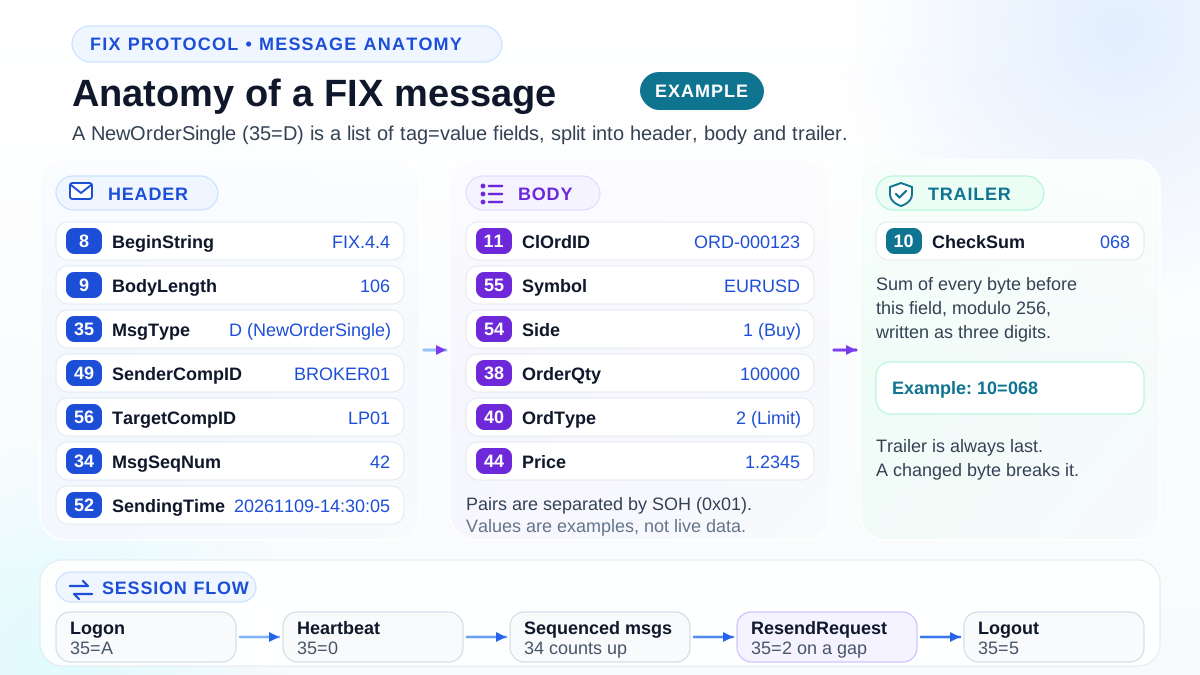
The session layer keeps the link reliable. A session opens with a Logon (35=A), which must carry the heartbeat interval in HeartBtInt (tag 108) and EncryptMethod (tag 98). Heartbeats (35=0) at that interval show each side the link is alive. A TestRequest (35=1) carries a TestReqID (tag 112), and the heartbeat that answers it must echo that ID. Every message carries a sequence number in tag 34. When a receiver sees a gap, it sends a ResendRequest (35=2) with BeginSeqNo (tag 7) and EndSeqNo (tag 16). Setting EndSeqNo to 0 asks for every message from BeginSeqNo onward, a convention the session layer specification recommends. Test this path before any live order flows.
Sessions built on the FIX 5.0 family use the FIXT session layer. Their BeginString (tag 8) reads FIXT.1.1, and the application version is declared at logon in DefaultApplVerID (tag 1137). Older sessions carried the version name in tag 8, such as FIX.4.4.
FIX message anatomy: tags and example values
Every FIX message has a header, a body and a trailer. Header tags do the session work, and body tags carry the trade.
A message opens with BeginString (8), BodyLength (9) and MsgType (35), in that order, then the sender, target and sequence fields. CheckSum (10) closes it. The values below match the example diagram at the top of this page. They are invented for illustration and come from no live counterparty.
| Tag | Name | Example value | Purpose |
|---|---|---|---|
| 8 | BeginString | FIX.4.4 | Identifies the protocol version for the session. First field. |
| 9 | BodyLength | 106 | Byte count of the body, checked by the receiver. Second field. |
| 35 | MsgType | D | Message type, such as D for NewOrderSingle. Third field. |
| 49 | SenderCompID | BROKER01 | Session ID of the sending firm, agreed at setup. |
| 56 | TargetCompID | LP01 | Session ID of the receiving firm, agreed at setup. |
| 34 | MsgSeqNum | 42 | Sequence number that detects gaps and duplicates. |
| 52 | SendingTime | 20261109-14:30:05 | UTC time the message was sent. |
| 11 | ClOrdID | ORD-000123 | Client order ID, required on NewOrderSingle. |
| 55 | Symbol | EURUSD | Instrument. Symbology is agreed with each counterparty. |
| 54 | Side | 1 (Buy) | Buy or sell. 1 is Buy, 2 is Sell. |
| 38 | OrderQty | 100000 | Order size, in the unit the counterparty defines. |
| 40 | OrdType | 2 (Limit) | Order type. 2 is Limit. |
| 44 | Price | 1.2345 | Limit price, required for limit orders. |
| 10 | CheckSum | 068 | Three-digit sum of all bytes before this field, modulo 256. |
Common FIX message types
A small set of message types covers most order flow. These six are a practical starting set for an order-flow integration.
| Code | Message | What it does |
|---|---|---|
| A | Logon | Opens a session and sets the heartbeat interval in tag 108. |
| 0 | Heartbeat | Confirms the link is alive. Answers a TestRequest with TestReqID (tag 112). |
| D | NewOrderSingle | Submits a new order for execution. |
| 8 | ExecutionReport | Reports acknowledgements, fills, rejects and status. |
| F | OrderCancelRequest | Requests cancellation of the remaining quantity. |
| V | MarketDataRequest | Requests market data. MDReqID (tag 262) ties it to its updates. |
FIX versions in use
FIX Latest is the recommended version, but older versions still run in many links. The counterparty's version sets your build.
Confirm the application version and extension pack in writing. On FIXT sessions, the logon message declares DefaultApplVerID (tag 1137), so check what each side sends before you test.
| Version | Status or scope | Note |
|---|---|---|
| FIX Latest | Firms strongly recommended to use it (FIX Trading Community) | Extended by numbered extension packs. The FIXLatest value was added to ApplVerID (tag 1128) in Extension Pack EP260. |
| FIX 5.0 SP2 | Application layer moved to FIX Latest, announced 17 May 2021 | Sessions in this family use the FIXT session layer. |
| FIX 4.4 | Supported for legacy implementations | Tags and codes in this guide follow FIX 4.4. |
| FIX 4.2 | Supported for legacy implementations | Confirm support with each counterparty. |
Counterparty dialects and certification
Two firms can both say FIX 4.4 and still need changes before an order flows between them.
Each counterparty chooses which messages, tags, enumerations and session settings it accepts, and some add custom tags. Those choices are the dialect, and they explain why one connection can reject orders another accepts. The FIX protocol conformance guide on this site covers how to test a connection before go-live.
Where Orrnn fits: FIX integration engineering
Orrnn is a trading software architecture and engineering provider. It builds RTX5, so weigh its product statements with that in mind.
Orrnn does not supply liquidity, act as a dealer, hold a license or give legal advice. Its own RTX5 FIX modules have no published build (RTX5 roadmap, checked 9 November 2026). Orrnn's services include FIX integration engineering, scoped per proposal, so the version, message set and acceptance tests for each connection are agreed in that proposal.
Limitations
This page explains FIX protocol in general terms. It is not legal, regulatory or investment advice, and it does not assess any broker, dealer, venue or counterparty.
FIXT is covered only in outline here. For the session rules, read the FIX Session Layer Technical Standard, which is the primary source. Field tags follow the FIX 4.4 specification, and extension packs can change how fields are used, so check the version your counterparty supports.
Version statuses reflect the FIX Trading Community pages as checked on 9 November 2026. Check the current list before you commit to a version. No latency, throughput or uptime figure is given, because none is stated in these sources.
Frequently asked questions
What is FIX API?
FIX API usually means a trading connection that uses the FIX protocol instead of a proprietary vendor API. The client sends messages such as NewOrderSingle and receives ExecutionReport messages back. The term is loose, so check the message set, version and session rules in each specification.
How does FIX compare with REST and WebSocket?
FIX is a session-based standard with defined message types, sequence numbers and resend rules. REST is request and response over HTTP, suited to account and reference calls. WebSocket keeps a connection open for pushed updates. The FIX vs REST vs WebSocket guide in the related links sets out the trade-offs.
Which FIX version should a broker use?
The FIX Trading Community says firms are strongly recommended to use FIX Latest, and FIX 4.2 and 4.4 remain supported for legacy implementations. In practice, the version your counterparty supports sets the choice. Confirm the version and extension pack in writing, then test against it.
Does using FIX guarantee that two firms can connect?
No. FIX sets a shared message format, but each counterparty decides which messages, tags and session settings it accepts. Two firms that both say FIX 4.4 can still need changes. Test logon, resend, reject and cancel behavior before any order is sent live.
Does Orrnn provide a FIX gateway?
Orrnn is a trading software architecture and engineering provider. Its RTX5 FIX 4.4 and 5.0 modules have no published build (RTX5 roadmap, checked 9 November 2026). Its services include FIX integration engineering, scoped per proposal. Orrnn does not supply liquidity or hold a license.
Primary sources and further reading
These sources support the definitions used on this page. They do not endorse Orrnn or establish that any product complies with the referenced material.
- FIX Protocol
FIX Trading Community
Maintainer, application-layer scope, the recommendation to use FIX Latest, FIX 4.2 and 4.4 legacy support, and numeric tags for fields.
- Transition from FIX 5.0 SP2 to FIX Latest completed
FIX Trading Community
Posted 17 May 2021. Covers the application-layer move to FIX Latest and the FIXLatest value added to ApplVerID in EP260.
- FIX Transport (FIXT) family of standards
FIX Trading Community
Identifies the FIXT 1.1 transport specification. The page does not list transports.
- FIX Session Layer, Technical Standard (June 2020)
FIX Trading Community
Session rules: TCP/IP as the de facto transport, HeartBtInt (108) and EncryptMethod (98) at logon, TestRequest with TestReqID (112), ResendRequest with EndSeqNo (16) where 0 means all messages, FIXT profiles, and DefaultApplVerID (1137).
- FIX 4.4 Orchestra Repository
FIX Trading Community
The Trading Community's FIX 4.4 download, the place to check field names and tag numbers. The page lists the FIX 4.4 Orchestra package.
Related reading
FIX 4.4 vs FIX Latest
Application versions, session behavior, dialects and certification for FIX 4.4 and FIX Latest.
Read →FIX Protocol Conformance Guide
How to test a FIX connection against a counterparty before order flow goes live.
Read →FIX vs REST vs WebSocket Trading APIs
Protocol roles, trade-offs and integration patterns for FIX, REST and WebSocket.
Read →Execution Management System
The trader-side system that sends and tracks orders, often over FIX.
Read →