Glossary term
Execution Management System (EMS): Definition and Criteria
An execution management system (EMS) is trading software that works a firm's orders across venues. See its functions, OMS differences and buyer criteria.
Definition
An execution management system (EMS) is trading software that manages how a firm's electronic orders are worked in the market. It chooses venues, runs execution algorithms, splits parent orders into child orders, routes them over FIX or APIs and tracks fills. It sits beside the order management system, which keeps the order record.
Also known as: EMS, execution management system, EMS trading, execution management software
Key takeaways
- An EMS controls how an order is worked in the market: venue choice, algorithms, child orders and routing.
- An order management system (OMS) keeps the order record. The two often overlap, and vendors bundle them differently.
- Ask every vendor for test evidence with your own liquidity providers and for the place where pre-trade checks run.
- Build or buy depends on venue count, algorithm needs, staffing and how much routing control the firm needs.
- Orrnn builds RTX5, so this page comes from a vendor. It does not rank EMS products or supply liquidity.
What an execution management system does
An EMS manages the execution stage of an order, after the order is accepted and before the fill is booked.
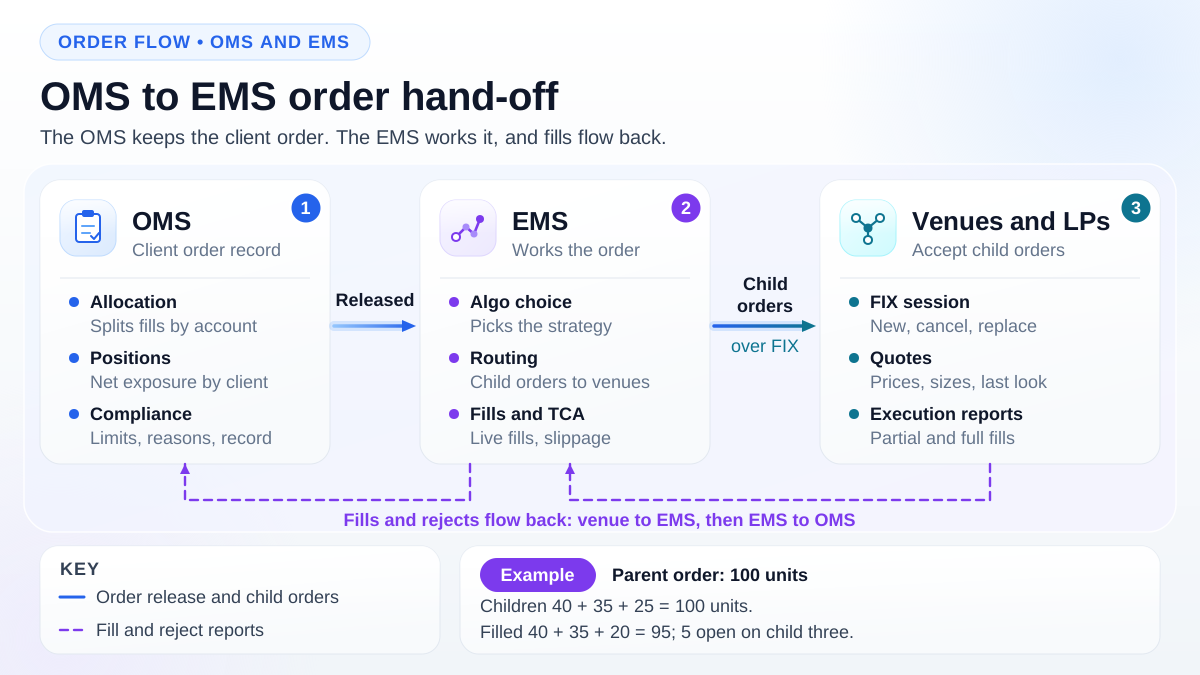
The core job is execution. A trader or an automated strategy sends a parent order, which may be large or spread over time. The EMS decides how to work it. It may split the parent into child orders, send each child to a venue or liquidity provider, and change the plan as prices and fills come in. Each step is recorded.
This page groups EMS work into five areas: execution algorithms such as VWAP or TWAP, smart order routing under firm-set rules, real-time monitoring of fills and rejects, transaction cost analysis (TCA) against benchmarks, and connectivity, usually over FIX.
The EMS does not replace the risk system. Pre-trade checks can sit inside the EMS or in a separate gateway. Placement matters, because a check that runs after an order has left the firm limits nothing.
How an EMS relates to an OMS
The OMS owns the order record and compliance state. The EMS owns the work done to fill that order in the market.
An order management system keeps the order record, allocations, positions and compliance state. An execution management system works the order in the market. The two can overlap, so write down where each record is kept. The OMS vs EMS guide on this site compares the two systems function by function and lists what to check when buying.
How an EMS fits a broker and a fund
The same function serves different goals. A broker needs routing evidence for its clients, while a fund needs control over its own execution.
A broker may run an EMS to route client flow to its own book, to outside liquidity providers, or to both. It must be able to show how each order was routed. Brokers that act as counterparty on some flow also need the EMS to separate internal fills from external ones.
A fund may run an EMS to work large orders with limited market impact. Its concerns are algorithm choice, participation rates, allocation to the right funds and TCA against its own benchmarks. A fund's EMS may connect to more than one broker, depending on its counterparties.
Buyer criteria: what to ask each vendor
Ask every vendor for the same evidence. Vague answers at this stage usually cost more later.
Use this execution management system buying checklist as a scoring sheet. Record the evidence each vendor provides, the build or version it refers to and the date you checked. A capability is not confirmed until a demonstration or test shows it on the build you would buy.
| Criterion | What to ask each vendor | Evidence to request |
|---|---|---|
| Asset and venue coverage | Which asset classes, venues and liquidity providers are supported today | Supported list with build number and date |
| Algorithm suite | Which algorithms ship, which can be customised, and who maintains the logic | Parameter list, test results and change log |
| FIX certification with your LPs | Which counterparties and FIX versions have been tested with your liquidity providers | Conformance results naming each counterparty, version and message scope |
| Pre-trade risk placement | Where size, price and credit checks run, and whether any order path bypasses them | Architecture diagram and a rejection test |
| TCA data | Which execution data is captured, how benchmarks are set and whether data can be exported | Sample report and data dictionary |
| Resilience and failover | How sessions recover after a disconnect and what happens to working orders | Recorded failover test and recovery procedure |
| Integration with your OMS | Which message types and fields pass between systems, and who owns the mapping | Interface specification and a reconciliation example |
| Exit and data ownership | How order, fill and audit data can be exported, and the time and cost to leave | Contract clause on data export and a sample export file |
Build vs buy: the decision points
Buying shortens time to first order. Building gives control over routing logic and data, at the cost of ongoing engineering.
| Question | Points toward buying | Points toward building |
|---|---|---|
| Venue and provider count | A standard set of venues and providers | Unusual connectivity or a counterparty list that changes often |
| Algorithm needs | Standard algorithms cover the flow | Proprietary logic that is central to the business |
| Staffing | No in-house team for FIX, market access and TCA | A team that can own FIX, risk and TCA over time |
| Control of routing rules | Vendor configuration is enough | Routing decisions must be fully explained and changed in-house |
| Time to first order | Usually shorter, depending on integration scope | Usually longer, with testing before live use |
Regulatory and control context
Rules set the standard for pre-trade controls and algorithm testing. They do not name products.
In the United States, Exchange Act Rule 15c3-5, the market access rule, requires broker-dealers with market access to maintain risk controls. The SEC staff FAQ says the controls must limit financial exposure from market access and help ensure regulatory compliance. An EMS is often where such checks run, but the broker-dealer remains responsible for them.
In the EU, MiFID II Article 17 requires firms that engage in algorithmic trading to have effective systems and risk controls. ESMA points to Commission Delegated Regulation (EU) 2017/589, known as RTS 6, for the detailed requirements, which include testing algorithms before deployment.
Some FX and CFD brokers fall under other regimes, such as CFTC and NFA rules. Confirm which rules apply with qualified counsel.
Limitations
This page is not legal, regulatory or investment advice, and it does not rank or endorse any EMS product.
Orrnn builds RTX5, a trading platform, so this page comes from a vendor. Orrnn does not supply liquidity, is not a broker and does not hold licences. The RTX5 roadmap, checked on 10 November 2026, marks every module as build not published. Its Preview group includes the Desktop Trading Terminal, CRM, Bridge / Gateway and FIX 4.4 / 5.0. None of them should be read as an available EMS function.
Frequently asked questions
What is an execution management system?
An execution management system is trading software that manages how a firm's orders are worked in the market. It selects venues and liquidity providers, runs execution algorithms, splits parent orders into child orders, routes them and tracks fills and costs in real time. It usually connects to counterparties through FIX or an API.
What is the difference between an EMS and an OMS?
The OMS keeps the order record, and the EMS works the order in the market. The OMS vs EMS guide on this site compares the two systems function by function.
Does a broker need an execution management system?
Not always. A broker that routes all orders to one counterparty may need only a simple bridge or gateway. A broker with several liquidity providers, routing rules and execution policy obligations usually needs routing control, pre-trade checks and TCA. Decide from order flow, counterparties and regulatory scope.
What should I ask an EMS vendor first?
Start with evidence. Ask which venues and liquidity providers are supported on the build you would buy, which FIX versions have been tested with your counterparties, where pre-trade checks run and what data you can export. Ask for test results rather than a feature list.
Is an EMS the same as a smart order router?
No, although they overlap. Smart order routing chooses a venue for each order based on rules. An EMS includes routing, and also algorithms, real-time monitoring, connectivity and transaction cost analysis, so it covers more of the order's life. Compare the scope each vendor actually includes.
Primary sources and further reading
These sources support the definitions used on this page. They do not endorse Orrnn or establish that any product complies with the referenced material.
- FIX Protocol
FIX Trading Community
Describes FIX as a global, open standard for trade messages. Cited for connectivity. Checked 9 November 2026.
- Supported Versions of the FIX Protocol
FIX Trading Community
Lists the numbered FIX versions, of which 5.0 SP2 was the last before FIX Latest, so buyers should name the version used in each counterparty test. Checked 9 November 2026.
- Responses to Frequently Asked Questions Concerning Risk Management Controls for Brokers or Dealers with Market Access
U.S. Securities and Exchange Commission, Division of Trading and Markets
Explains the financial and regulatory controls under Rule 15c3-5. Checked 9 November 2026.
- Article 17: Algorithmic trading
European Securities and Markets Authority, Interactive Single Rulebook
MiFID II Article 17 requires effective systems and risk controls for algorithmic trading. The page links to Delegated Regulation (EU) 2017/589 (RTS 6) for the detailed rules. Checked 9 November 2026.
Related reading
Order Management System for Brokers and Funds
Order lifecycle, allocation, positions and audit trail, the functions this page contrasts with an EMS.
Read →What Is an Institutional Trading Platform
How institutional platforms combine order, execution and risk functions, and where an EMS fits.
Read →Order Routing for FX and CFD Brokers
Routing rules, risk gates and audit records for FX and CFD order flow.
Read →FIX Protocol
What FIX is, the message types used for orders and fills, and why protocol versions matter.
Read →Build vs Buy for a Broker Trading Platform
A decision framework for building or buying a broker trading platform, including the EMS layer.
Read →OMS vs EMS for Brokers
A function-by-function comparison of the two systems and the criteria for choosing.
Read →