Glossary term
What Is a MAM Account? MAM vs PAMM for Brokers
What is a MAM account? It is a master account whose block trades a platform copies into linked client accounts. Compare MAM with PAMM for broker setup.
Definition
A MAM account (multi-account manager) is a master trading account that a money manager uses to place block trades, which the platform copies into many linked client accounts in set proportions. Each client keeps its own account and its own funds. PAMM is different: it pools client money into one account.
Also known as: MAM account, multi-account manager, multi account manager, MAM vs PAMM
Key takeaways
- A MAM account is a master account whose trades the platform copies into linked client accounts by an allocation rule.
- Equity lot ratio splits a block by each account's share of total equity. Equal volume gives every account the same lot size.
- Lot rounding can leave a residual, so the allocation rule must say how leftover lots are handled.
- PAMM pools client money into one account, and each investor holds units whose value moves with the pool.
- Managing client money or trading for clients may need authorisation in many markets. Check the regulator first.
- Orrnn builds RTX5 but does not run MAM or PAMM accounts, hold licences or give regulatory advice.
What is a MAM account?
A MAM account is a master account controlled by a manager. Each client keeps a separate account that receives the copied trades.
This entry covers how a broker and a money manager set up MAM and PAMM structures. Retail copy-trading services are out of scope.
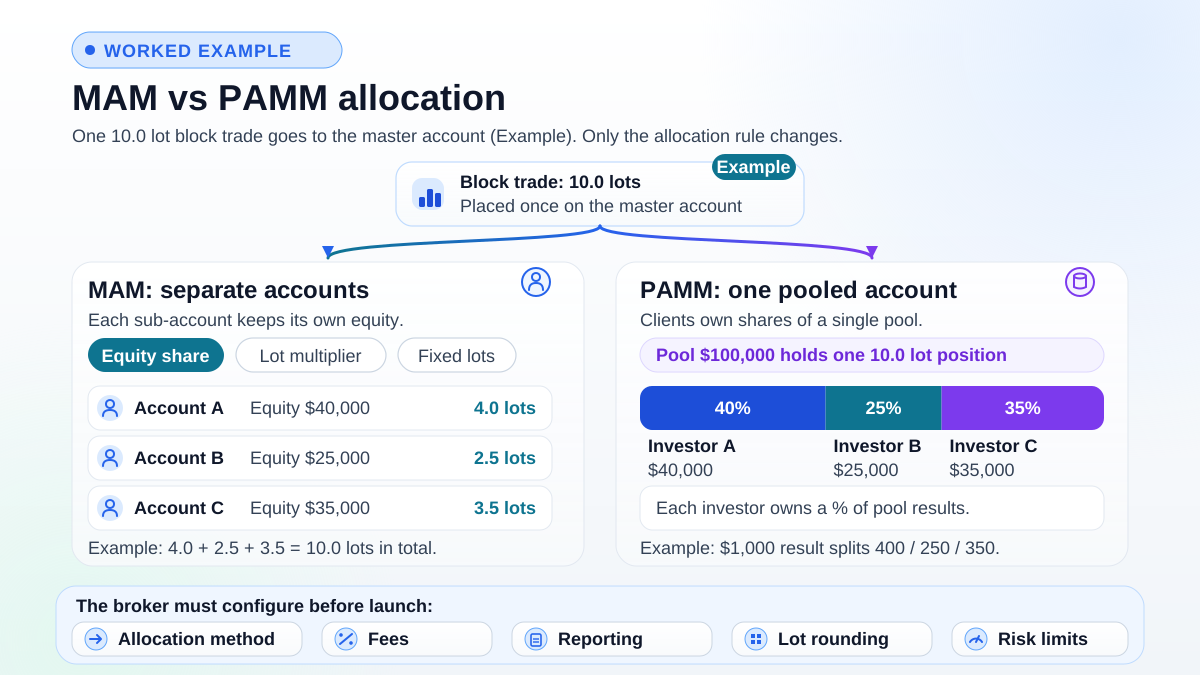
A MAM account is a master account controlled by a money manager. The manager places orders in the master account. The platform copies each order into the client accounts linked to it, in proportions set by the allocation rule. Each client account stays separate on the broker's books, with its own balance, equity and open positions.
The model is a block-trade tool. One decision reaches many accounts without a separate order in each. For a broker, the work is to make the copying reliable, the allocation auditable and the manager's authority documented.
How a MAM allocates a block order
Allocation turns one master fill into client fills. The method sets the shares, and the rounding rule decides whether they add up.
MetaQuotes' news item on its MAMM plugin for MetaTrader 5, dated 13 October 2016, names three schemes: Equity Lot Ratio (MAM), Equity Cash Ratio (PAMM) and Equal Volume. The item describes a server-side plugin, so check current support before you plan around it.
Lot-ratio allocation gives each account a share of the master lots equal to its share of total equity, which keeps exposure in proportion to capital. Equal volume gives every account the same lot size whatever its equity, so a small account can carry a position that is large for its balance.
Example: a master account places a 0.50 lot buy. Three linked accounts hold $30,000, $25,000 and $35,000, so total equity is $90,000. Each raw lot size is 0.50 multiplied by the account's share of equity, then rounded to a 0.01 lot step.
| Account (Example) | Equity (Example) | Share of total equity | Raw lots (0.50 × share) | Rounded lots (0.01 step) |
|---|---|---|---|---|
| Account A | $30,000 | 33.3% | 0.1667 | 0.17 |
| Account B | $25,000 | 27.8% | 0.1389 | 0.14 |
| Account C | $35,000 | 38.9% | 0.1944 | 0.19 |
| Total | $90,000 | 100.0% | 0.5000 | 0.50 |
Rounding and residual lots
Rounding often does not cancel out, so the rule needs a written answer for leftover lots.
The Example above adds up by chance. Under equal volume, a 1.00 lot master order split three ways gives 0.33 lots each after rounding to 0.01. The three fills total 0.99 lots, which leaves 0.01 lot unallocated.
The rule must say where that residual goes: it can stay in the master account, go to one account in a fixed order, or carry forward. Rounding down keeps every account at or below its calculated size but leaves more residual. If one linked account rejects its share, for example for margin, log that child order so each client's size can be explained later.
What is PAMM?
PAMM pools client money into one trading account. Each investor holds units in that pool, not a separate position.
In PAMM, investor money goes into one pooled account. The manager trades the pool, and each investor holds units. Units are issued at the current unit value, which rises or falls with the pool's equity.
Example: a pool with $200,000 of equity and 200,000 units has a unit value of $1.00. An investor who adds $20,000 receives 20,000 units. The pool now holds $220,000 of equity and 220,000 units. If pool equity later falls to $198,000, the unit value is $0.90 and that holding is worth $18,000. The Example is illustrative and shows that losses are shared as well as gains.
MAM vs PAMM: comparison table
The main differences are who allocates capital, who sets risk, who owns the account and how profit and loss reach each client.
| Feature | MAM account | PAMM |
|---|---|---|
| Who allocates capital | Each client keeps its own funds; the allocation rule sets each block share | Investor money goes into one pool; each investor's units set its share |
| Who sets risk | The manager trades within the agreement; the broker can apply account-level limits | The manager trades the pool within the agreement; investors share the result |
| Account ownership | Each client account is separate, with its own balance and positions | One pool account; investors hold units, not positions |
| How P&L is attributed | Each linked account carries the P&L of its own fills | Pool P&L is shared by unit; unit value reflects pool equity |
| Fees | Set in the manager agreement, separate from broker fees | Set in the agreement; may be tied to pool results, depending on terms |
| What the broker must configure | Linked accounts, allocation rule, lot step, rounding, residual handling, audit log, manager authority | Pool account, unit valuation timing, subscription and redemption records, per-investor statements |
Broker setup and controls
Most of the setup work is governance: who can trade, how each fill is allocated and what each client can see.
Checklist
- Manager authorisation: a signed agreement setting trading authority, limits, withdrawal rules and termination. Where a power of attorney is used, record its scope, duration and how it is revoked.
- Allocation audit trail: for each master order, log the time, master fill, allocation rule, each account's calculated and rounded size, and any residual.
- Rounding and partial fills: a written rule for lot step, rounding direction, residual handling and rejected child orders.
- Client reporting: each client sees its own fills, P&L, fees and allocation method, and no other client's data.
- Pool accounting (PAMM only): unit valuation time, subscriptions, redemptions and a per-investor statement each period.
- Change control: changes to linked accounts, allocation rules and manager details are logged and approved first.
Regulatory note: managing client money
Running a MAM or PAMM can bring a firm within commodity or investment-management rules, depending on the market and the facts.
In the United States, the CFTC describes commodity pool operators (CPOs), which operate a pool and solicit funds for it, and commodity trading advisors (CTAs), which advise others on trading futures. Intermediaries are generally required to register, and the National Futures Association's registration pages cover both.
In the United Kingdom, the FCA describes an investment manager as one that manages portfolios under client mandates, and lists managing investments among the typical permissions an applicant needs. Check the regulator where each client lives. Authorisation depends on who holds the money, who decides the trades and what the agreement says, so take legal advice on your own position.
Limitations
This page explains terms for broker teams. It is not legal, regulatory or investment advice, and it does not assess any manager, pool or platform or state that a platform supports MAM or PAMM.
The MetaQuotes source is a 2016 news item about a plugin, not a current specification. Confirm rounding and allocation behaviour in a test environment. Orrnn builds RTX5 and sells it. Orrnn does not run MAM or PAMM accounts, hold licences, supply liquidity or give regulatory advice.
Frequently asked questions
What is a MAM account?
A MAM account is a master trading account that a money manager uses to place block trades. The platform copies each trade into linked client accounts using an allocation rule, such as equity lot ratio or equal volume. Each client keeps its own account, balance and positions.
What is the difference between MAM and PAMM?
In a MAM, each client keeps a separate account, and the allocation rule sets each block share. In a PAMM, investor money goes into one pooled account, and investors hold units whose value moves with the pool. The main differences are account ownership, profit and loss attribution and what the broker must record.
What is PAMM in broker software?
PAMM is a pooled account model. A manager trades one pool, and each investor holds units rather than a separate position. When pool equity rises or falls, unit value moves with it. The broker needs per-investor valuation, subscription and redemption records, and statements.
Does a MAM account need a licence?
It depends on the market and the agreement. In the United States, commodity pool operators and commodity trading advisors are generally required to register with the CFTC. In the United Kingdom, the FCA lists managing investments among the typical permissions an investment manager needs. Check local rules and take legal advice before launch.
Does Orrnn run MAM or PAMM accounts?
No. Orrnn is a trading software architecture and engineering provider, and it builds RTX5. It does not operate MAM or PAMM accounts, hold licences, supply liquidity or give regulatory advice. A broker should confirm each platform's support and its own permissions before planning a structure.
Which rounding rule should a MAM use?
There is no single correct rule. Write down the lot step, the rounding direction and how residual lots are handled. Test the rule with the minimum lot size and a partial fill before go-live, and show each client how its own size was calculated.
Primary sources and further reading
These sources support the definitions used on this page. They do not endorse Orrnn or establish that any product complies with the referenced material.
- Intermediaries
U.S. Commodity Futures Trading Commission
Defines commodity pool operator and commodity trading advisor and says intermediaries are generally required to register. Checked 9 November 2026.
- Registration and Membership
National Futures Association
Covers CPO and CTA firm registration at a high level. Used for the registration point only. Checked 9 November 2026.
- Investment managers
Financial Conduct Authority
Describes managing portfolios under client mandates and managing investments as a typical permission. Checked 9 November 2026.
- MAMM plugin for MetaTrader 5 (news item 1383)
MetaQuotes, metatrader5.com
Dated 13 October 2016. Names the Equity Lot Ratio (MAM), Equity Cash Ratio (PAMM) and Equal Volume schemes. Plugin announcement, not a specification. Checked 9 November 2026.
Related reading
Broker Licensing and Regulatory Planning
Regulatory planning steps for a broker before launch.
Read →Broker Back-Office Risk Controls
Back-office controls for records, reconciliation and exceptions.
Read →Broker CRM Requirements
What a broker CRM needs for client records and reporting.
Read →A-Book vs B-Book vs Hybrid
How a broker chooses between passing orders to the market and taking the risk.
Read →