Glossary term
Trade Aggregation Explained: Bundling Client Orders for Execution
Trade aggregation bundles several client orders into one execution, then allocates the fills back to each client. Read the worked example, rules and risks.
Definition
Trade aggregation, also called client-order bundling, is the practice of combining several client orders for the same instrument into one larger order for execution. The firm then allocates the fills back to each client under a stated allocation policy, so each client gets its share of the result.
Also known as: trade aggregation, client-order bundling, order aggregation, aggregating client orders
Key takeaways
- Trade aggregation combines several client orders for the same instrument into one order sent for execution.
- Fills are allocated back to each client under a stated policy, and the policy must be applied the same way every time.
- Partial fills make allocation harder, so decide in advance how each partial fill is split.
- Fairness depends on a written policy, applied to every client and recorded before the trade.
- Trade aggregation is not liquidity aggregation. The first bundles client orders; the second combines prices from several sources.
Trade aggregation meaning: bundling client orders for one execution
Trade aggregation is about client orders, not about combining prices from several sources.
Trade aggregation, also called order aggregation, means grouping client orders for the same instrument into one larger order. The firm sends that order to a liquidity provider or venue once, instead of sending each client order separately. Fewer messages can result, but the fills must then be allocated back.
Aggregation changes who holds the position before allocation. Until the fills are split, the firm holds the aggregate exposure, not the clients. That is why the allocation policy matters as much as the execution.
Worked example: three client orders in one execution
The figures are illustrative and chosen so that every total adds up.
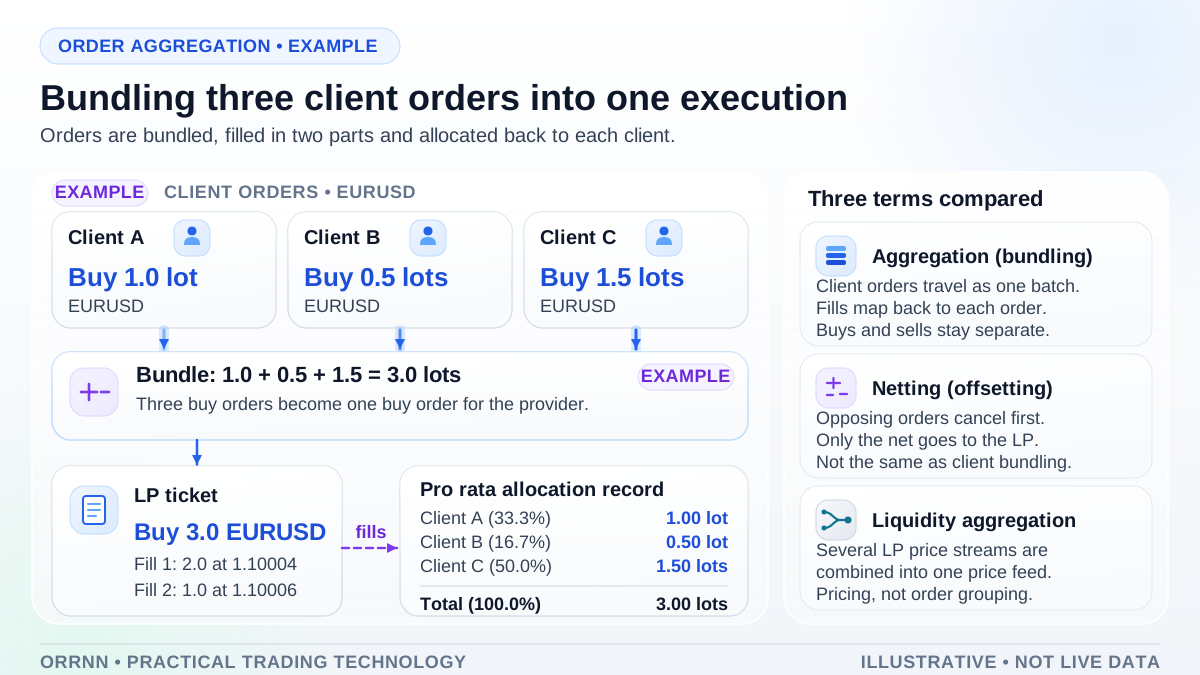
Example: at 09:30:00, three clients send market orders to buy EUR/USD. Client A buys 1.0 lot, Client B buys 0.5 lots and Client C buys 1.5 lots. The firm bundles them into one buy order for 3.0 lots and sends it to its liquidity provider.
Example: the provider fills 2.0 lots at 1.10004 and then 1.0 lot at 1.10006. The fills total 3.0 lots, which matches the bundle. The average fill price is (2.0 × 1.10004 + 1.0 × 1.10006) ÷ 3.0 = 1.10005, rounded to five decimal places.
Example: under a pro rata policy, each fill is split by each client's share of the bundle: 33.3 percent for Client A, 16.7 percent for Client B and 50.0 percent for Client C. The 2.0-lot fill splits into 0.67, 0.33 and 1.00 lots, and the 1.0-lot fill splits into 0.33, 0.17 and 0.50 lots.
Example: every client receives the 1.10005 average. Rounding leaves a small difference against the exact fills, so the policy should say how it is booked.
| Client | Order size (lots) | Share of bundle | From 2.0-lot fill | From 1.0-lot fill | Total allocated (lots) |
|---|---|---|---|---|---|
| Client A | 1.0 | 33.3% | 0.67 | 0.33 | 1.00 |
| Client B | 0.5 | 16.7% | 0.33 | 0.17 | 0.50 |
| Client C | 1.5 | 50.0% | 1.00 | 0.50 | 1.50 |
| Total | 3.0 | 100.0% | 2.00 | 1.00 | 3.00 |
Aggregation vs netting vs liquidity aggregation
Three terms share some words but describe different things. The table separates them.
In MetaTrader 5, netting is an account system. MetaQuotes documents one common position per symbol in a netting system, and several positions of one symbol, including opposite ones, in a hedging system.
Liquidity aggregation combines prices from several providers into one view and routes orders by rules. This page covers only client-order bundling.
| Feature | Trade aggregation (client-order bundling) | Netting | Liquidity aggregation |
|---|---|---|---|
| What is combined | Several client orders for one instrument | Opposing orders or positions, so only the net is held or sent | Prices and depth from several liquidity sources |
| Result | Fills that must be allocated to each client | One common position per symbol in a MetaTrader 5 netting system | One routed order, filled at one source |
| Records needed | Parent and child order links, allocation time and policy | Position and offset history | Source, price, timestamp and routing rule |
Allocation back to clients and fairness
The allocation policy decides which client gets which fill, and when. Fairness depends on that policy being stated, applied and disclosed.
An allocation policy should say how fills are split, when allocation happens, and how partial fills and rounding are handled. It should also say who approves exceptions. A policy written this way can be tested against any bundle.
Timing matters. A late allocation leaves client exposure without a recorded split, so the policy should set a deadline.
Fairness is the central test. A policy that lets the firm's own orders, or a favored account, take better fills than clients is a conflict of interest. It should be removed or disclosed.
- Partial fills: state whether fills are split pro rata, by order time or by another fixed method, and apply it to every client in the bundle.
- Price averaging: state whether clients receive the average price or the price of their own fills, and how rounding is handled.
- Own accounts: if the firm's orders can join a bundle, state how they rank against client shares.
- Exceptions: record who approved any change to a stated rule, and why.
Regulatory points: MiFID II and US record-keeping rules
The rules differ by jurisdiction, product and registration. These are general pointers, not a compliance opinion.
In the EU, MiFID II rules set conditions for aggregating client orders and require an order allocation policy. The detailed rules sit in Article 68 of Commission Delegated Regulation (EU) 2017/565. It allows aggregation only when it is unlikely to work overall to the disadvantage of any client whose order is aggregated, and it requires an order allocation policy. Read the current text before applying it.
In the US, the position depends on product and registrant. This page does not state a single rule for aggregating spot FX orders.
For futures and other commodity interest orders, 17 CFR 1.35 requires a written record, made right away, when a customer order cannot be entered into a trade matching engine immediately. The record must include the account identification and be timestamped to the nearest minute of receipt. The rule has an exception for certain bunched orders. Confirm which rules apply to your products.
Records and audit trail for aggregated orders
Each bundle should leave a trail from client orders to fills and allocations.
Without that trail, a firm cannot show that an allocation followed its policy. Keep the time each client order was received, the time the bundle was sent, each fill's price and time, and the allocation result with the rule that applied.
Checklist
- Link every client order to its bundle ID, and each bundle to its fills
- Timestamp client order receipt, bundle submission, each fill and each allocation
- Store the allocation rule that applied on the trade date
- Record manual changes, the approver and the reason
When not to aggregate
Aggregation saves handling only when allocation can be run cleanly. Some orders should go out alone.
- A client instruction requires its order to be sent alone, such as a different price limit or time condition.
- The bundled order would breach a mandate or risk limit that applies to one client.
- The allocation cannot be run before the policy deadline, so a client's share would be booked late.
- The bundle cannot be traced through the audit trail, or its records do not reconcile.
Limitations
The figures are examples and do not show a result for any broker, provider or market. Fills and allocation outcomes depend on the venue, instrument, order size and market conditions.
The regulatory points are general. Check the current rule text and which rules apply to your entity, jurisdiction and products. This page is not legal, regulatory or investment advice.
Orrnn is a trading software architecture and engineering provider, and it builds the RTX5 trading platform. It does not supply liquidity, act as a broker or dealer, or give investment, legal or regulatory advice. Allocation logic in any deployment is set by the operating firm's policy and contract.
Frequently asked questions
What is trade aggregation?
Trade aggregation is the practice of combining several client orders for the same instrument into one order sent for execution. The fills are then allocated back to each client under a stated policy. It is also called client-order bundling, and it differs from liquidity aggregation.
What is the difference between trade aggregation and netting?
Trade aggregation bundles client orders for one execution, then allocates the fills. Netting offsets opposing orders or positions so only the net amount is held or sent. In MetaTrader 5, netting is an account system with one common position per symbol, as MetaQuotes documents.
Is trade aggregation the same as liquidity aggregation?
No. Trade aggregation combines client orders into one execution. Liquidity aggregation combines prices and depth from several sources into one view, then routes orders by rules. A firm can use both, and each keeps its own records. This page covers only client-order bundling.
How are partial fills allocated to clients?
The allocation policy should say how. One approach is pro rata allocation by order size, where each client receives its share of every fill. The rule should be the same for every client in the bundle and recorded before the trade, so the split can be checked later.
Does trade aggregation guarantee a better price?
No. Aggregation can reduce the number of orders a firm sends, but it does not guarantee a better price or fill for any client. A bundled order can fill worse than a client would have received alone, and results depend on the venue, the size and market conditions.
Primary sources and further reading
These sources support the definitions used on this page. They do not endorse Orrnn or establish that any product complies with the referenced material.
- 17 CFR 1.35: Records of commodity interest and related cash or forward transactions
Cornell Law School Legal Information Institute (text of 17 CFR)
Checked 9 November 2026. Cited for the written record of a customer order that cannot be entered into a trade matching engine right away, with account identification and a timestamp to the nearest minute of receipt. The text also has an exception for certain bunched orders. Covers commodity interest products, not necessarily spot FX.
- MetaTrader 5 build 1325: Hedging option and testing on real ticks
MetaQuotes, MetaTrader 5 release notes
Checked 9 November 2026. Cited for MetaQuotes' description of the netting system (one common position per symbol) and the hedging system. The note is dated 22 April 2016, so check current MetaTrader 5 help before relying on it.
- MiFID II single rulebook
European Securities and Markets Authority (ESMA)
Checked 9 November 2026. Cited only as the entry point to the MiFID II rulebook. The page does not name Commission Delegated Regulation (EU) 2017/565, so use the current EUR-Lex text for the detailed rules.
- Commission Delegated Regulation (EU) 2017/565, Article 68
EUR-Lex, Publications Office of the European Union
Article 68 sets the conditions for aggregating client orders and for allocating aggregated orders; Article 69 covers transactions for own account. Checked 9 November 2026.
Related reading
Liquidity Aggregation vs Prime Brokers
How liquidity aggregation differs from prime brokerage. Read this for the liquidity sense of aggregation, not client-order bundling.
Read →Order Routing for FX and CFD Brokers
Routing rules, risk gates, LP adapters and audit records for FX and CFD order flow.
Read →Broker Back-Office Risk Controls
Back-office controls for positions, reconciliation and exceptions that a broker needs to run its book.
Read →MAM Account
How a multi-account manager allocates trades across client accounts, and where allocation policy matters.
Read →