Decision guide
Forex Trading Platforms for Brokers: Types Compared
Forex trading platforms for brokers compared by type: vendor-hosted, licensed, white label and proprietary, with control, data ownership and exit trade-offs.
Direct answer
A forex trading platform for brokers is software that takes client orders, routes them to liquidity and records accounts and trades. There are four common types: vendor-hosted, licensed on broker servers, white label, or proprietary. Each type sets who controls the roadmap, client data and exit route, so the choice is as much about control as technology.
Key takeaways
- Forex trading platform types differ mainly in who runs the servers, who owns the roadmap and who holds the data.
- White label is a license arrangement. Its terms, not its brand name, decide how much control the broker keeps.
- Vendor-hosted, licensed and proprietary options each trade operating load against control and exit flexibility.
- Test FIX and bridge connectivity for each counterparty and version rather than accepting a general FIX claim.
- Score platforms on data ownership and exit terms as well as on total cost over the contract term.
- Orrnn builds RTX5 and discloses its status. The RTX5 roadmap marks every module as build not published.
The four forex trading platform types a broker chooses between
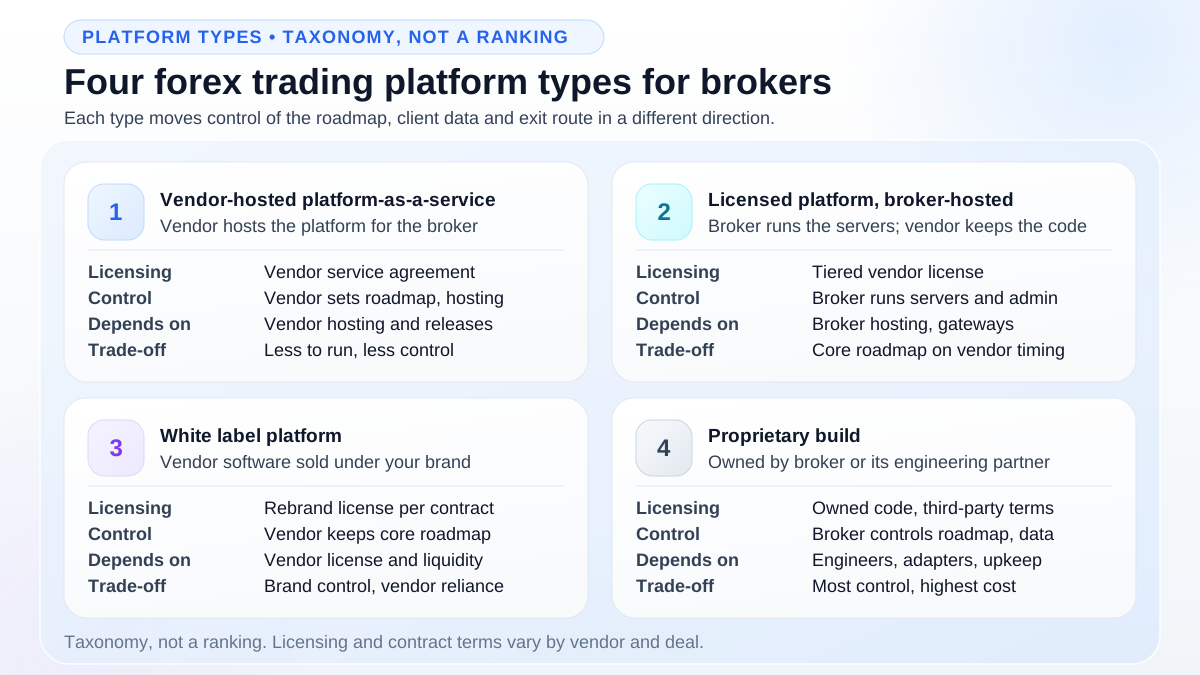
A broker comparing forex trading platforms is choosing between arrangements, not logos. The arrangement sets who runs the servers, who ships new features, who holds trade and client data, and what it costs to leave.
The table is a working taxonomy of common patterns, not a ranking. Confirm each row against the vendor's current terms and the signed contract, because license scope varies between vendors and between deals.
Forex trading platform types for brokers: licensing, control and trade-offs
| Platform type | How it is licensed | Who controls roadmap and data | Typical dependencies | Main trade-off |
|---|---|---|---|---|
| Vendor-hosted platform-as-a-service | Vendor service agreement; pricing and terms are not stated on the vendor page and need confirming | Vendor controls the roadmap and the infrastructure; data terms need confirming in writing | Vendor infrastructure, vendor release cycle, vendor-supplied connections | Less infrastructure to run, but less control over hosting, change timing and exit |
| Licensed platform, broker-hosted | Vendor license in tiers by account count and components, as MetaTrader 5 describes (checked 9 November 2026) | Broker controls its servers, administration and support; the vendor keeps the software roadmap | Broker hosting, licensed gateways or bridges, vendor client terminals | The broker runs operations, but the core product changes on the vendor's timetable |
| White label platform | Vendor software licensed for rebranding under the broker's name; terms set in the contract | Vendor usually keeps the core roadmap; data control depends on who hosts it | Vendor license, brand assets, bridge and liquidity arrangements | Brand control without owning the code, and the vendor dependency remains |
| Proprietary build | Owned by the broker or its engineering partner, with third-party components under their own licenses | The broker or its engineering partner controls the roadmap and data | Engineers, counterparty connections, FIX or API adapters, ongoing maintenance | Most control and exit flexibility, with the highest build and support cost |
White label versus full license and proprietary builds
White label is a commercial arrangement, not a technical category. The vendor's software is sold for the broker to present under its own name, and the license terms decide whether the broker can change the product, which servers it runs on and how it exits. MetaQuotes states that MetaTrader 5 "supports White Label licensing" (checked 9 November 2026). Its broker page does not state a price, so ask for it in the proposal.
A full license, as the term is used here, is a license to run the vendor's stack on the broker's own infrastructure. It usually gives more operational control than a white label arrangement, but the broker still does not own the code. Whether it includes source access or modification rights is a contract question, not a generic one.
A proprietary build reverses the question. The broker or its engineering partner owns the code, the roadmap and the data model. The gain is control and exit flexibility. The cost is that the broker carries engineering, security testing, counterparty connections and maintenance for as long as the platform runs.
Write down which parts the vendor owns and which the broker owns before signing, because that boundary sets the cost of leaving.
Decision criteria for choosing a forex trading platform
Use these criteria to narrow the list before any demonstration, and get a written answer from each vendor.
Checklist
- Operating model: whether the broker runs A-Book, B-Book or hybrid flow, and which platform features that model needs
- Asset classes: forex only, or also CFDs, metals, indices or crypto, and which instruments are supported at launch
- Client apps: desktop, web and mobile terminals, and which are available now rather than planned
- Bridge and liquidity connectivity: which providers and FIX or API versions are supported, and who builds and maintains each connection
- CRM and back office: onboarding, permissions, reporting and reconciliation, and whether they come from the platform vendor or another supplier
- Data ownership and exit: where trade and client data is hosted, who can export it, in what format, and on what notice
- Total cost: license or service fees, connection and maintenance charges, staff time and migration cost over the full term. The broker platform pricing, TCO and RFP guide sets out a whole-life cost model
Connectivity: bridges, liquidity providers and FIX
Connectivity decides whether the platform can reach the liquidity a broker needs. The FIX Trading Community describes its standards as open, technology-neutral specifications for electronic trading and trade processing. A platform that claims FIX support can still differ from a counterparty's dialect, so confirm the version and message set for each connection.
The two vendor sources in this guide show how the claim varies. cTrader's FIX documentation states that cTrader supports FIX version 4.4, and describes brokers using the FIX API to receive prices and execute their clients' orders (checked 9 November 2026). MetaQuotes describes dedicated gateways for direct connectivity to global exchanges. Neither page says how a specific broker's connection will behave, so test it.
Ask who owns each connector, which counterparties have been tested, and how the platform recovers after a disconnect.
Migrating between platform types
Changing platform type is usually harder than choosing one. Client accounts, open positions, history and permissions move together, and a poorly planned cutover can disrupt live client orders. Moving from a licensed server to a proprietary build, for example, needs data mapping, parallel running and a tested rollback path.
The broker platform migration checklist covers discovery, rehearsal, cutover, rollback and post-cutover checks. Before signing, confirm which data the current vendor will export and in which format, because that sets the exit cost.
Where RTX5 fits and what Orrnn does not provide
Orrnn builds RTX5, its own trading terminal, so this section is a disclosure from the vendor, not a neutral assessment. Orrnn is a trading software architecture and engineering provider. It is not a broker, does not supply liquidity, does not hold licenses and does not give investment, legal or regulatory advice. Enquiries about brokerage launch or licensing are referred to FxTrusts, a separate company.
The RTX5 roadmap, checked 10 November 2026, gives this status. Its Preview group includes the Desktop Trading Terminal, CRM, Bridge / Gateway and FIX 4.4 / 5.0. Its Planned group includes the Web Trading Terminal, Mobile Trading and the REST & WebSocket API. It marks every module in both groups as build not published. The roadmap says Preview communicates an early demonstration or concept. Orrnn does not treat a Preview label as production acceptance.
A broker evaluating RTX5 should ask whether it is offered under a white label arrangement, which modules a given proposal includes, and what the data-ownership and exit terms are. Those answers belong in a written proposal.
Limitations and risk notes
This guide is general information for brokers comparing platform types. It does not assess a specific jurisdiction, license, product or market, and it does not replace advice from qualified lawyers, compliance specialists or auditors.
Vendor descriptions are not evidence of fit, performance or availability. Confirm each claim against the current vendor page, a demonstration and the signed contract. Trading involves risk, including the loss of capital, and no platform type removes market or operational risk.
Frequently asked questions
What is a white label forex trading platform?
It is vendor software that a broker licenses and presents under its own name. The license terms decide what the broker can change, where the platform runs and how the broker can leave. Vendors describe white label offers in different ways, and the label alone does not show who owns the code, the roadmap or the client data. Confirm those points in the contract.
Is a white label platform the same as a proprietary platform?
No. A proprietary platform is built or commissioned and owned by the broker or its engineering partner, which controls the roadmap and data model. A white label platform is a vendor product sold under the broker's brand. A proprietary build gives more control but costs more to build and maintain. A white label platform starts sooner but depends on the vendor's roadmap.
Which forex trading platform type should a broker compare first?
Start with control questions: who runs the servers, who ships features, who holds trade and client data, and what leaving would cost. Then compare bridge and liquidity connectivity for each candidate, the client apps the broker needs and the total cost over the contract term.
Does Orrnn supply liquidity or hold a broker license?
No. Orrnn is a trading software architecture and engineering provider. It does not supply liquidity, hold licenses, act as a broker or give investment, legal or regulatory advice. Brokerage launch and licensing enquiries are referred to FxTrusts, a separate company. Confirm each service, provider and jurisdiction in a written proposal.
Which RTX5 modules are available now?
The RTX5 roadmap, checked on 10 November 2026, marks every module as build not published. Its Preview group includes the Desktop Trading Terminal, CRM, Bridge / Gateway and FIX 4.4 / 5.0, and its Planned group includes the Web Trading Terminal, Mobile Trading and the REST & WebSocket API. The roadmap says Preview communicates an early demonstration or concept, so confirm the build and its scope in a proposal.
Primary sources and further reading
These sources support the frameworks and definitions used in this guide. They do not endorse Orrnn or establish that any product complies with the referenced material.
- FIX standards and technical resources
FIX Trading Community
Primary source describing FIX as open, technology-neutral specifications. Checked 9 November 2026.
- MetaTrader 5 for Brokers
MetaQuotes Ltd
Vendor page stating that MetaTrader 5 supports White Label licensing, broker-run infrastructure and dedicated exchange gateways. Vendor claim, checked 9 November 2026.
- MetaTrader 5 for Brokers: license types
MetaQuotes Ltd
Vendor page naming Entry, Standard and Enterprise license types, which differ in account count and components. Vendor claim, checked 9 November 2026.
- cTrader for Brokers
Spotware Systems Ltd
Vendor page describing platform-as-a-service. It says the platform is powered, developed and supported by Spotware, including infrastructure. Hosting and data terms are not stated. Checked 9 November 2026.
- cTrader FIX API
Spotware Systems Ltd
Vendor documentation stating FIX 4.4 support. Other versions and counterparty dialects need confirming with the vendor.
Related reading
Trading platform comparison framework
A neutral method for comparing named platforms, including a cTrader and MT5 section for brokers.
Read →White-label platform RFP guide
Requirements and evidence requests for a white label platform proposal.
Read →Broker platform migration checklist
Discovery, rehearsal, cutover and rollback planning when changing platform.
Read →Broker platform pricing, TCO and RFP
A whole-life cost model and a comparable proposal format.
Read →RTX5 terminal
Orrnn's own terminal, with its current availability labels.
Read →