Decision guide
Trade Processing Software for Brokers: Post-Trade Functions and Integration
Trade processing software for brokers runs post-trade capture, matching, allocation, settlement and reporting. See the flow, owners and integration points.
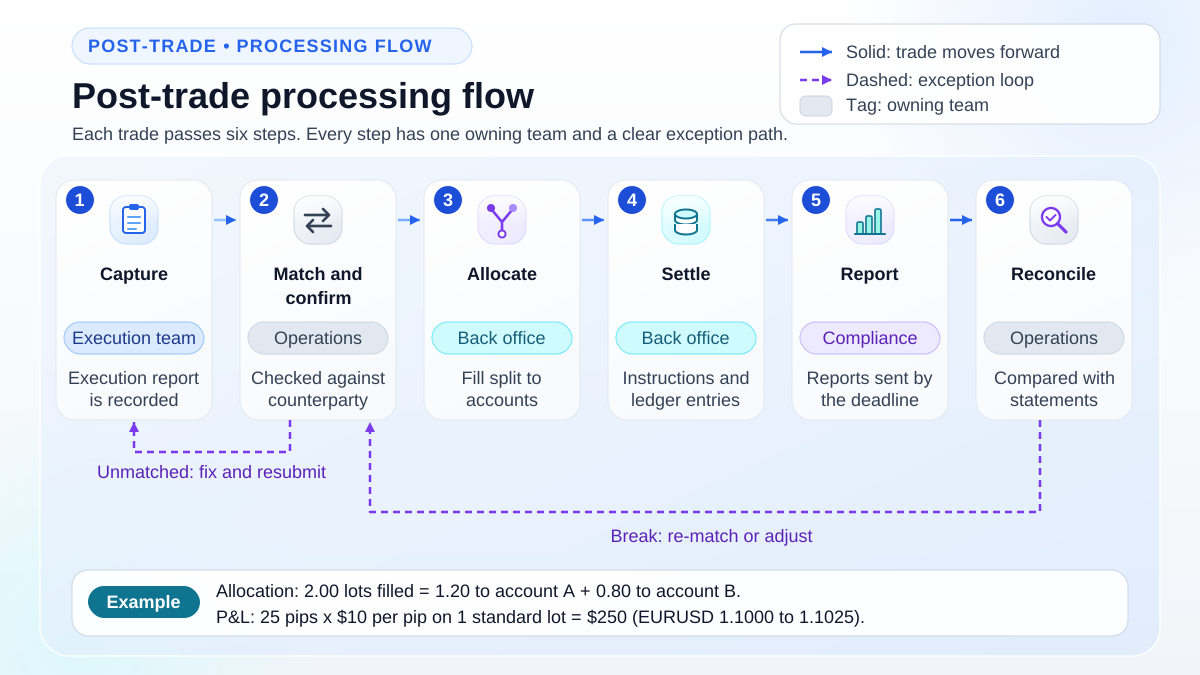
Direct answer
Trade processing software for brokers handles the post-trade work that follows an executed order: capturing the trade, matching and confirming it, allocating it, settling it, reporting it and reconciling it to counterparty records. It is broker operations software and does not cover trade finance. Quality depends on accurate execution data, controlled integration with the order path and daily reconciliation.
Key takeaways
- Trade processing software for brokers runs capture, matching, allocation, settlement, reporting and reconciliation.
- The subject is broker operations software, separate from trade finance and from pre-trade risk controls.
- Exchange-traded and OTC FX and CFD flows differ in reference records, settlement logic and reconciliation.
- The SEC's T+1 cycle applied from 28 May 2024 to most broker-dealer securities transactions.
- Drop copies, execution reports and reporting feeds each need a named owner and a tested message set.
Trade processing defined for brokers
Trade processing is the set of post-trade functions that turn an executed order into a settled, reported and reconciled record. For a broker, the work starts when a fill returns from a venue, a liquidity provider or the internal book, and it ends when every party holding a record agrees on the trade. The software runs those steps and keeps the records auditors request.
This guide covers broker software only. In trade finance, the same words describe letters of credit and import-export financing. That is a different market, so none of this guide applies to it. Pre-trade market-access controls, such as those in SEC Rule 15c3-5, are a risk question rather than a processing one. The back-office risk controls guide covers operational risk, and the order management guide covers the order record.
The post-trade flow, step by step
The table shows a typical post-trade flow for a broker, the function that usually owns each step, and the records it should produce.
Owners are typical, not fixed. A small broker may run all six steps in one back-office platform, while a larger one may split them across an order management system, a clearing link, a reporting service and a general ledger. Name one owner per step and document each hand-off.
Typical post-trade flow for a broker, with owners and records
| Step | What happens | System owner | Records produced |
|---|---|---|---|
| Capture | Execution reports are recorded against the parent order, with price, size, venue or counterparty and time | Execution team | Trade record with execution identifiers and time stamps |
| Match and confirm | The trade is checked against a counterparty confirmation or drop copy, and differences are flagged | Operations | Match status and break list |
| Allocate | Fills are split across client accounts, sub-accounts or funds under the agreed rule | Back office | Allocation records and average price calculations |
| Settle | Exchange-traded securities settle through instructions and cash movements. OTC FX and CFD positions update the ledger under product terms | Back office | Settlement instructions, ledger entries and a failed-settlement log |
| Report | Required transaction or position reports are generated and sent within the deadline | Compliance | Report files, acknowledgments and rejection logs |
| Reconcile | Internal records are compared with counterparty statements, clearing or custody records and the cash ledger | Operations | Reconciliation results, exceptions and sign-off evidence |
Exchange-traded and OTC FX and CFD brokers compared
Exchange-traded brokers process trades that a venue reports and that a central counterparty may guarantee. Records arrive through exchange and clearing feeds, and settlement follows a defined calendar.
OTC FX and CFD brokers usually deal directly with a counterparty, either from their own book or through a liquidity provider. The broker's execution path creates the record, so the broker must keep it complete itself. Settlement is mostly a ledger event: positions, margin and cash move under the contract terms.
The main difference is the reference record. For exchange-traded flow, the venue or clearing record is usually what the broker reconciles against. For OTC flow, the broker's own log and its counterparty statements can disagree, so the design must decide in advance which record governs.
Settlement cycles and what changed in the US
The U.S. standard settlement cycle moved from T+2 to T+1. The SEC adopted the change on 15 February 2023, with a compliance date of 28 May 2024 (SEC press release 2023-29, checked 9 November 2026). Settlement-date and cash-availability logic must reflect that date. Test it against your real calendar, including holidays and any exceptions that apply to your products.
The rule covers securities transactions. It does not set the settlement cycle for spot FX or CFD contracts, which follow product terms and counterparty arrangements. Confirm that with counsel before writing post-trade settlement logic for an FX or CFD book.
The CPMI and IOSCO Principles for financial market infrastructures set international standards for payment, clearing and settlement systems. A broker's software is not one of those infrastructures, but the principles are a useful reference for judging the settlement chain it depends on (BIS, checked 9 November 2026).
Integration: drop copies, execution reports, back office and reporting
Most trade processing depends on four feeds: execution reports from the venue or provider, drop copies of order and execution messages sent to a second system, back-office interfaces into the ledger, and regulatory reports sent to a supervisor.
On FIX connections, the execution report changes an order's state, and the drop-copy setup decides which other systems see that state. The FIX Trading Community publishes the open standards for these messages. Confirm the message set, session behavior and drop-copy scope for each counterparty, because versions and custom fields differ.
For EU investment firms, MiFIR Article 26 requires executed transaction details to reach the competent authority as quickly as possible, and no later than the close of the following working day (ESMA Interactive Single Rulebook, checked 9 November 2026). Scope and fields depend on the firm's license and products, so give the reporting engine a named compliance owner and a test pack.
Post-trade break handling
Exceptions decide whether trade processing works. A break is any difference between records that should agree, such as a fill quantity, an allocation that does not sum to the parent order, a failed settlement or a rejected report. Detect each break, assign an owner, record the cause and close it with evidence.
Post-trade breaks show up first in the drop copy, the allocation run and the settlement queue. Run intraday checks for missing execution reports and duplicate fills, and end-of-day checks against counterparty statements and clearing or custody records. The wider reconciliation of cash, positions and external records, with matching keys, tolerances and ageing, is covered in the broker back-office controls guide.
Checklist
- Every execution report has a matching internal order and trade record
- Allocations sum to the parent quantity and average price within a stated tolerance
- Failed settlements and rejected reports are queued with an owner and an age
- Breaks are closed with a recorded cause, reviewer and date
- Manual adjustments are logged with the approver and the reason
Buyer criteria for trade processing software
Ask for evidence rather than a feature list. A demonstration should use real message formats and include a failure case.
Checklist
- A documented data model for orders, executions, allocations, settlements and reports
- Supported FIX versions, message set and drop-copy scope for each counterparty, in writing
- A configurable settlement calendar, including holidays and product-specific cycles
- A break queue with ownership, ageing, audit history and role-based access
- Reporting outputs mapped to each regime in scope, with acknowledgment handling
- A recovery test for a missed execution report, a duplicate fill and a feed restart
Limitations and where RTX5 fits
This guide is general information, not legal, regulatory or financial advice. Settlement, reporting and client-money obligations depend on the firm's license, jurisdiction and products, and belong to qualified counsel and compliance specialists.
Orrnn is a trading software architecture and engineering provider. It builds RTX5, so it has a commercial interest in this topic. It does not supply liquidity, hold licenses or act as a broker, and it refers brokerage-launch and licensing enquiries to FxTrusts, a separate company. RTX5 module status, checked 10 November 2026 against the RTX5 roadmap: the Preview group includes the Desktop Trading Terminal, CRM, Bridge / Gateway and FIX 4.4 / 5.0; the Planned group includes the Web Trading Terminal, Mobile Trading and the REST & WebSocket API; every module in both groups is marked build not published.
An architecture diagram is not production acceptance. Acceptance depends on the build and tests in a signed proposal.
Frequently asked questions
Is trade processing the same as trade finance?
No. In broker software, trade processing means the post-trade steps after an executed order: capture, matching, allocation, settlement, reporting and reconciliation. Trade finance covers financing and documentary products such as letters of credit. The terms share words but not a market or a system. This guide covers only broker processing software.
What is post-trade processing for a broker?
Post-trade processing is the work after an order executes: recording the fill, matching it to a counterparty confirmation, allocating it to accounts, settling the obligations, reporting it where required and reconciling the result. Each step needs a named owner and records an auditor can follow.
Does the U.S. T+1 rule apply to FX and CFD brokers?
The SEC's T+1 rule covers most broker-dealer securities transactions, with a compliance date of 28 May 2024. It does not set the settlement cycle for spot FX or CFD contracts, which follow product terms and counterparty arrangements. Whether a given broker is in scope is a legal question for counsel.
What is a drop copy and why does a broker need one?
A drop copy is a copy of order and execution messages sent to a second system, such as a back office, a compliance archive or a risk monitor. That system sees the same order state without sitting in the trading path. Confirm the drop-copy scope, message types and session behavior for each counterparty, because implementations vary.
What should a broker check before buying trade processing software?
Check the data model, the supported FIX versions and drop-copy scope for each counterparty, the settlement calendar, the break queue and the reporting outputs for each regime in scope. Run a demonstration with a missed execution report and a duplicate fill, not only a clean file. Treat roadmap items as unsupported until they are released.
Primary sources and further reading
These sources support the frameworks and definitions used in this guide. They do not endorse Orrnn or establish that any product complies with the referenced material.
- SEC Finalizes Rules to Reduce Risks in Clearance and Settlement (press release 2023-29)
U.S. Securities and Exchange Commission
T+1 adoption date and 28 May 2024 compliance date. Cited for those dates only.
- Principles for financial market infrastructures
Bank for International Settlements (CPMI and IOSCO)
CPMI-IOSCO principles for payment, clearing and settlement systems, dated 16 April 2012. A reference, not a broker software standard.
- Article 26: Obligation to report transactions
European Securities and Markets Authority
MiFIR Article 26 reporting deadline for investment firms. Scope needs professional review.
- FIX standards and technical resources
FIX Trading Community
Primary source for the FIX family. Confirm version and message set per connection.
- Small Entity Compliance Guide: Rule 15c3-5
U.S. Securities and Exchange Commission
Pre-trade market-access controls. Cited only to separate pre-trade risk from post-trade processing.
Related reading
Broker back-office and risk controls
The operating and risk controls that sit beside post-trade processing.
Read →Order management system for brokers
How the order record that feeds post-trade processing is created and kept.
Read →Broker technology stack
Where the post-trade, risk and connectivity layers fit in a brokerage stack.
Read →What is an institutional trading platform?
The OMS, EMS, risk, market data and FIX layers that post-trade processing connects to.
Read →