Decision guide
Order Management System for Brokers and Funds: Functions and Buyer Criteria
Order management system trading explained: what an OMS does, its functions for brokers and funds, integration points and the buyer criteria to test.
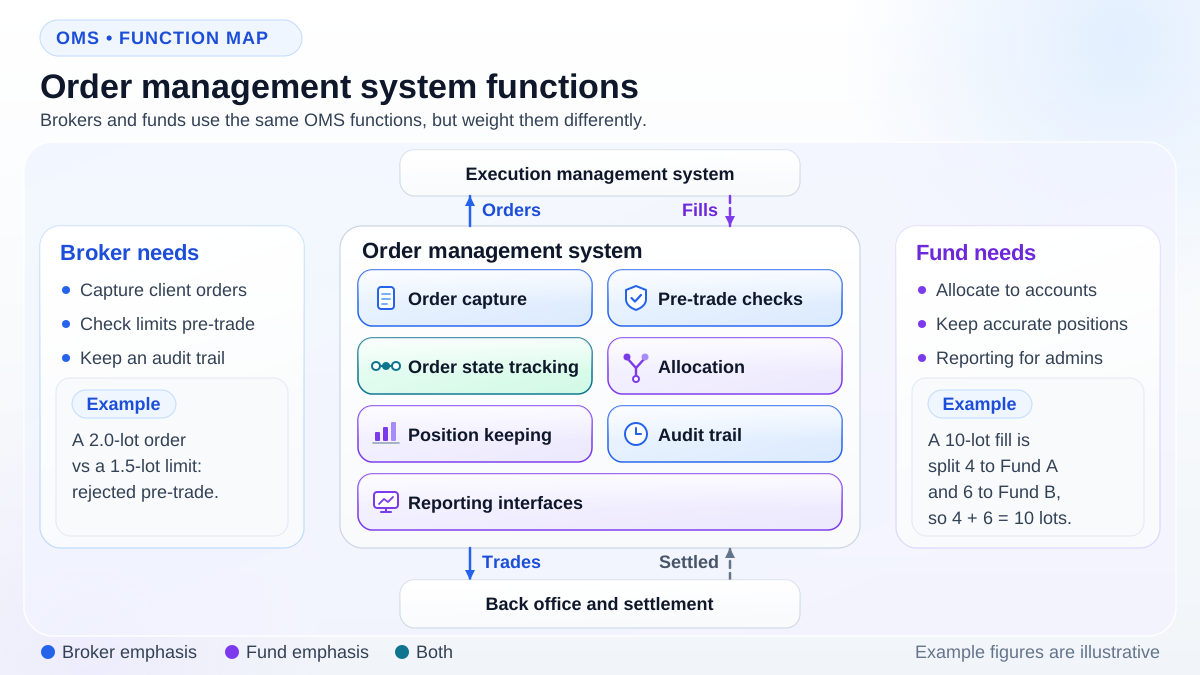
Direct answer
An order management system (OMS) is trading software that holds the authoritative record of each order from creation to completion. It tracks order lifecycle and status, allocates fills to accounts or funds, links them to positions, and writes an audit trail of every change.
Key takeaways
- An order management system holds the authoritative record of an order, from capture through allocation to audit.
- Brokers and funds use the same core functions with different emphasis: client rules for brokers, mandate and allocation for funds.
- The OMS and the execution management system are separate layers. Test the boundary between them.
- FIX sessions, back-office feeds and reconciliation decide whether the OMS record stays correct after launch.
- Ask for test evidence on your own order flows, and confirm record-keeping duties with counsel.
What an order management system trading platform does
Order management system trading means running client or fund orders through software that keeps one controlled record of each order. The order management system, or OMS, is where an order's state lives from creation until completion. Other systems around it must agree with that record.
A broker's OMS receives a client instruction, checks account and instrument rules, and creates the order. It then records each change in state, such as accepted, partly filled, filled, cancelled or rejected, with a timestamp and the user or system that caused it. For a fund, the same record carries allocations to portfolios and share classes. When a counterparty report disagrees with the internal record, the OMS is where the break is found and explained.
Core OMS functions for brokers and funds
The table lists the functions to expect and the emphasis that usually differs between a broker and a fund. Use it to plan the demonstration, not as proof that a product supplies them.
OMS functions and the emphasis for brokers and funds
| Function | What it does | Broker emphasis | Fund emphasis |
|---|---|---|---|
| Order capture and validation | Receives orders and checks permissions and instrument rules | Client account and margin rules before acceptance | Mandate limits and approved instruments |
| Order lifecycle | Tracks each state change, amendment and cancellation | Client status that matches the provider report | Trade status for portfolio managers and operations |
| Allocation | Splits a parent order or fill across accounts or funds | Rule-based split across client accounts | Documented policy, average-price rules and recorded exceptions |
| Positions and exposure | Links fills to positions and cash as they arrive | Client and house exposure by symbol and group | Position and sector exposure against the mandate |
| Audit trail and reporting | Stores events, user actions and configuration changes | Evidence for client disputes and regulatory extracts | Investor reporting and internal review evidence |
| Reconciliation | Compares internal state with counterparty and custodian records | Daily matching of fills and client balances | Matching with prime broker, custodian and administrator |
OMS and EMS in brief
The OMS holds the order record. The execution management system, or EMS, decides how the order reaches the market. The OMS vs EMS guide on this site compares the two systems function by function, and the EMS glossary entry covers the execution side in more depth. Where one product does both jobs, write down the boundary between them and test it.
Broker and fund requirements differ
A broker's OMS serves a client-facing business. It must handle many accounts and classifications, apply rules before acceptance, and show clients the same status the broker holds. The A-Book, B-Book or hybrid choice also changes what it tracks, because exposure may sit on the broker's own book.
A fund's OMS supports portfolio operations. It needs mandate checks, portfolio-level allocation, and close links to the administrator and custodian. Fund managers care most about timing, allocation fairness and explaining a trade afterwards.
- Broker priorities: client account hierarchy, pre-trade rule checks, status accuracy, exposure on the broker's own book, and dispute evidence.
- Fund priorities: mandate limits, allocation policy, custodian and administrator matching, investor reporting, and trade-level audit history.
Integration points: EMS, liquidity, back office, risk and CRM
Map each connection before the demonstration. The EMS and liquidity links carry child orders, fills and reject messages, often over FIX. The FIX Trading Community describes its standards as open, technology-neutral specifications for electronic trading and trade processing. Confirm the FIX version, message set and custom fields for each counterparty, because a shared protocol name does not prove two systems behave alike.
Risk checks may sit in the OMS, in a separate gate or in both, and the boundary should be written down so a stopped order can be explained. The CRM must match the client profile, account status and dispute history the OMS shows. Back-office feeds for settlement, custody and ledger postings need an owner and a schedule, because a late or mismatched feed can leave the OMS correct and the books wrong.
Buyer criteria and evidence to request
Put these items in the request for proposal. Each should produce a document, a test result or a live demonstration. A verbal yes is not evidence.
Checklist
- A written functional scope for your broker or fund flows, with each function mapped to a named owner
- A live demonstration of order entry, partial fill, amendment, cancellation and rejection, connected to your own counterparties in a test environment
- An allocation run on your own rules and data, including one exception case
- Change logs showing who can alter limits, groups and allocation rules, and how four-eyes approval is enforced
- A reconciliation output comparing OMS state with a counterparty or custodian file for the same day
- A sample audit export with user, timestamp, before and after values, and configuration version
- Recovery test evidence, including the state of uncertain orders after a restart, with scope and date
- The named product edition and version, with each capability labelled as generally available, configured, custom or roadmap
Build or buy the OMS
Few firms build an OMS from nothing. Buying gives a working core sooner but limits control over data models and release timing. Building gives that control and takes on security, testing and support for the life of the system. Ask who will change the allocation rules and limits after launch, and how quickly, under control. The build versus buy guide sets out a fuller framework.
Regulatory record-keeping and audit evidence
Record-keeping duties depend on the firm, its jurisdiction and its activity. In the United States, FINRA Rule 4511 is the general books-and-records requirement for FINRA members. Retention periods and formats for specific records sit in other rules, so counsel should confirm them for each firm. Firms with market access also face pre-trade controls under SEC Rule 15c3-5, which requires risk management controls and supervisory procedures reasonably designed to stop orders that exceed preset credit or capital thresholds or appear erroneous.
In the EU, the ESMA Interactive Single Rulebook is the entry point to MiFID II and its implementing rules. This guide does not quote MiFID II retention periods, which should come from the official legal text. Whatever the jurisdiction, the OMS should keep an audit record searchable by order identifier, account, user and time, and it should not allow silent edits to historical events.
Limitations and what this guide does not cover
This guide is a buyer framework. It does not rank products and is not legal, regulatory or investment advice. Orrnn builds RTX5, so read these criteria as one vendor's view, not a neutral comparison. Orrnn does not supply liquidity or hold licences; brokerage-launch enquiries go to FxTrusts, a separate company. The RTX5 roadmap, checked 10 November 2026, has a Preview group that includes the Desktop Trading Terminal, CRM, Bridge / Gateway and FIX 4.4 / 5.0, and a Planned group that includes the Web Trading Terminal, Mobile Trading and the REST & WebSocket API. It marks every module in both groups as build not published.
Frequently asked questions
What is an order management system in trading?
An order management system is software that records an order from creation until completion. It tracks status changes, amendments and cancellations, allocates fills to accounts or funds, links them to positions and keeps an audit trail. Brokers and funds both use one, though the rules they need differ. It is the record that the other systems must agree with.
How is an OMS different from an EMS?
The OMS keeps the order record. The execution management system decides how an order is worked in the market. The OMS vs EMS guide on this site compares the two systems function by function. Where one product does both, test the boundary between them: check partial fills, cancel-replace and rejected child orders across both layers.
Do brokers and fund managers need different OMS features?
Yes, mainly in emphasis. A broker needs client account hierarchies, pre-trade rule checks and status that matches client records. A fund needs mandate checks, fair allocation rules, custodian matching and trade-level audit. Many features overlap, so ask each supplier to demonstrate the flows your type of buyer actually runs.
What should a buyer ask an OMS vendor to prove?
Ask for a demonstration in a test environment connected to your own counterparties, covering a partial fill, amendment, cancellation and rejection. Ask for allocation rules run on your data, the configuration change log, a reconciliation output and a sample audit export. Also ask for the named version, with each capability labelled as generally available, configured, custom or roadmap.
Does an OMS replace pre-trade risk controls?
No. Pre-trade risk controls can sit in the OMS, in a separate gate or in both, but the boundary must be documented. A stopped order should show which control stopped it and why. Firms with market access should confirm their obligations under SEC Rule 15c3-5, or the equivalent rules where they operate, with counsel.
Primary sources and further reading
These sources support the frameworks and definitions used in this guide. They do not endorse Orrnn or establish that any product complies with the referenced material.
- FIX standards and technical resources
FIX Trading Community
Cited for FIX as open, technology-neutral specifications for electronic trading. Loaded 9 November 2026.
- FINRA Rule 4511 (General Requirements)
Financial Industry Regulatory Authority
Cited for the general books-and-records requirement. Loaded 9 November 2026. Sets a six-year default minimum for records with no period stated in another rule; record-specific periods come from other rules.
- Small Entity Compliance Guide: Rule 15c3-5
U.S. Securities and Exchange Commission
Cited for pre-trade risk control requirements for broker-dealers with market access. Loaded 9 November 2026.
- MiFID II, Interactive Single Rulebook
European Securities and Markets Authority
Cited as the entry point to MiFID II. Loaded 9 November 2026. Record-keeping periods are not stated on the page.
Related reading
Execution management system (EMS)
The order-working layer beside an OMS: venues, algorithms, child orders and routing.
Read →Broker CRM requirements
What a broker CRM must record and how it links to client and trading data.
Read →Broker back-office and risk controls
Back-office, reconciliation and pre-trade control design for brokers.
Read →Build vs buy for a broker trading platform
A decision framework for licensing a platform component or building it in-house.
Read →Order routing for FX and CFD brokers
Routing rules, risk gates and audit records for FX and CFD order flow.
Read →OMS vs EMS for Brokers: Which System Does What
Which functions belong to an order management system and which to an execution management system.
Read →