Decision guide
What Is an Institutional Trading Platform?
What an institutional trading platform does, the OMS, EMS, risk, market data and FIX layers it needs, and how it differs from a retail platform.
Direct answer
An institutional trading platform is the software and infrastructure a broker, fund or trading desk uses to receive, risk-check, route and record orders. It typically combines order and execution management, pre-trade risk limits, market data and FIX or API connectivity to liquidity providers. The term has no single regulatory definition, so judge the platform by its controls and connectivity.
Key takeaways
- An institutional trading platform is defined by its workflow and controls, not by a regulatory label.
- The core layers are the OMS, EMS, pre-trade risk, market data and FIX or API connectivity, each with a named owner.
- Retail and institutional platforms differ in users, account models, connectivity and audit.
- Pre-trade limits should be documented, tested and changed only through governed, recorded processes.
- Verify vendor claims through live demonstrations, reconciliation and failure tests, and confirm regulatory scope with qualified advisers.
What an institutional trading platform actually does
An institutional trading platform is best understood by its job rather than its brand. A retail app serves one account holder who places orders through a standard ticket. An institutional platform serves a firm that runs many accounts, strategies, traders and counterparties, and that must show who did what, under which limits, and through which route. Configuration and operating model matter as much as the product name.
In practice the platform sits between the firm's decision layer and the markets. Portfolio managers, dealers, algorithms or a broker's client flow send instructions in. The platform validates them, applies limits, routes them to venues or liquidity providers, and tracks every state change until the order is complete. It must also handle partial fills, rejections, cancellations and disagreements with a counterparty's records.
Vendors use the phrase "institutional trade" loosely, and it often refers to an order placed for a fund, company or other professional client. Define the term before comparing products. This guide uses the broader sense: the full chain from instruction to record, including the controls around it.
Institutional and retail platforms compared
The two differ mainly in who they serve and what they must be able to prove afterwards. Read the table as questions for a vendor, not as a verdict on any product.
A product label is not enough to settle the choice. MetaQuotes describes MetaTrader 5 for brokers as a multi-asset trading platform, and says it supports netting position accounting for exchange traders. A retail-familiar product can still be configured for professional use, so test whether its controls, connectivity and administration fit the specific build.
Typical design priorities for retail and institutional platforms
| Dimension | Typical retail platform | Typical institutional platform |
|---|---|---|
| Primary user | An individual account holder | Traders, portfolio managers, dealers, operations and risk staff |
| Account model | One login, usually one account | Many accounts, sub-accounts, fund structures and delegated permissions |
| Order handling | A standard ticket with a fixed set of order types | Configurable order types, algorithms, amendments and routing rules |
| Connectivity | A proprietary client interface to the provider | FIX sessions, REST or WebSocket APIs and counterparty adapters |
| Pre-trade controls | Margin and balance checks | Firm-set limits on size, price, exposure and order rate |
| Audit and reporting | Account statements and activity history | Event-level audit trail, reconciliation and exportable records |
| Administration | Largely managed by the provider | Role-based access, approval workflows and governed change control |
Core components: OMS, EMS, risk, market data and FIX
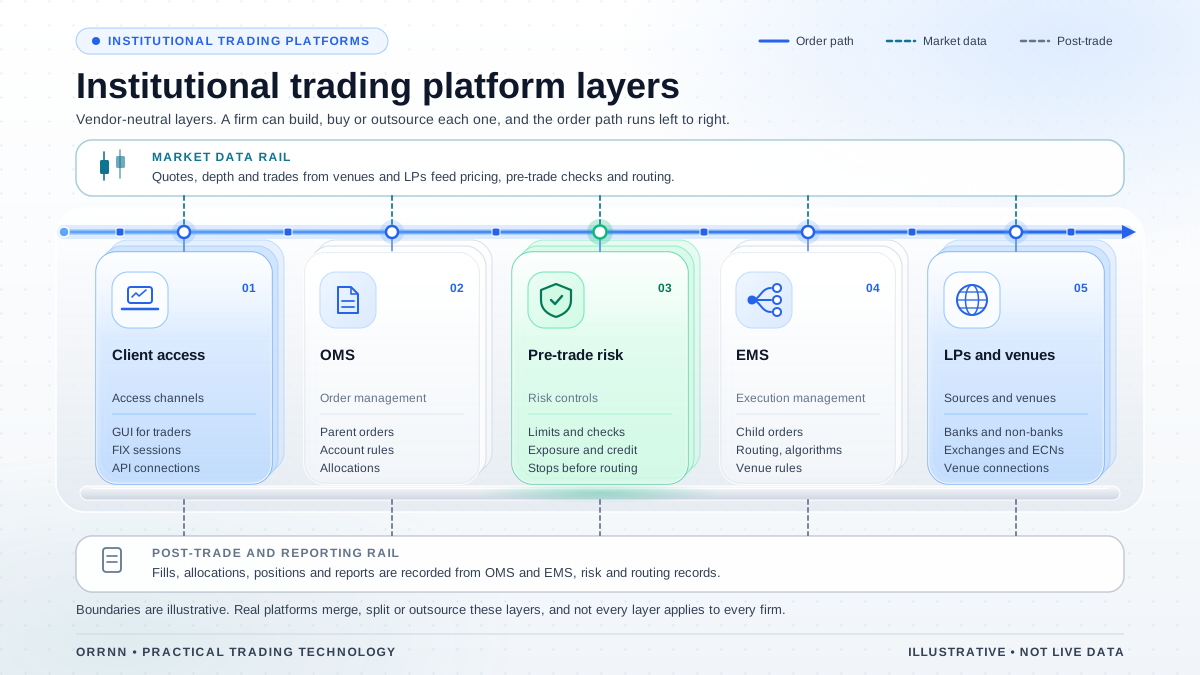
The order management system (OMS) holds the authoritative record of an order from creation to completion. It tracks parent orders, allocations to accounts or funds, status changes, amendments and the link to resulting positions. For a broker, it is also where client instructions are checked against account rules before they go further.
The execution management system (EMS) decides how an order reaches the market. It handles venue or broker selection, child orders for algorithms, routing rules and the handling of fills. Some firms run an OMS and EMS as one product; others combine a separate OMS and EMS. Either way, document the boundary, because status and fill information must agree across both systems.
Pre-trade risk checks run in the order path before anything leaves the firm. Typical checks include order size, notional value, price collars against a reference price, position and credit limits, and order-rate controls. The U.S. market access rule, Exchange Act Rule 15c3-5, requires broker-dealers with market access to maintain risk management controls and supervisory procedures reasonably designed to limit financial exposure and help prevent erroneous orders, applied before orders are routed to an exchange or alternative trading system. The rule applies only to firms in its scope, but it works as a checklist for order-entry questions.
Market data feeds prices, depth and reference data into the platform, and its quality shapes pricing, risk checks and reporting. The platform should record which feed, symbol mapping and timestamp it used for each decision that matters, so a dispute can be reconstructed later.
FIX connectivity links the platform to counterparties. The FIX Trading Community describes its standards as open, technology-neutral specifications for electronic trading and trade processing. Many electronic trading relationships use FIX for order routing and execution reporting, and some use it for market data. Versions and dialects differ between counterparties. Confirm the supported message set, session behavior and custom fields for each connection, rather than assuming that two systems which both say FIX will interoperate.
How the layers fit together
The components are easiest to assess as one flow.
- An instruction enters through a client interface, an API or a dealer blotter.
- The OMS checks account, permission and instrument rules, then creates the parent order.
- Pre-trade risk checks apply limits before any order is released.
- The EMS selects a route or algorithm and sends child orders over FIX or an API.
- Execution reports update order state, positions and cash, and feed reconciliation and the audit trail.
Controls that buyers should test
Controls are useful only when they have owners, thresholds, evidence and tests. Before accepting a design, ask for the configured values, the people who can change them, and the records created when they change. MiFID II Article 17 covers algorithmic trading, and ESMA's MiFID II rulebook lists the technical standards made under it, including Commission Delegated Regulation (EU) 2017/589 on organizational requirements for algorithmic trading. Its scope must be assessed professionally, but it points the same way as the U.S. rule.
Checklist
- Order size and notional limits by account, instrument and strategy
- Price collars and handling of stale or missing reference prices
- Duplicate-order and erroneous-order rejection rules
- A kill switch that halts new orders for a defined scope
- Intraday reconciliation of orders, fills, positions and cash against counterparty records
- Audit records for configuration changes and privileged actions
Build or buy the platform
Few firms build every layer. Some license an OMS, EMS or front-office product and then configure or build the risk rules, reporting and integrations that reflect their own mandates. The build versus buy guide sets out that decision.
Who needs one: funds, brokers and prop desks
Hedge funds and asset managers need order records that map cleanly to funds, strategies and prime brokers. Their platforms must handle allocation, multiple venues and investor reporting, with clear accountability between traders and risk.
Brokers need to serve client flow with account administration, dealing and pre-trade controls, and reporting, while managing their own liquidity relationships. Whether a broker is authorized to offer a service, and how client orders may be handled, are questions for the firm, its regulator and its advisers.
Proprietary trading desks need limits that change quickly, many strategies and tight accountability. Smaller teams may not need the full stack. A single strategy in one account may need only a broker API, a few risk checks and a reliable log.
Orrnn describes itself as a trading software architecture and engineering provider for brokers and hedge funds. It does not supply liquidity, hold licenses or give regulatory or legal advice. Orrnn's site describes FxTrusts as the separate partner for brokerage-launch and licensing services.
Evaluate platforms on evidence, not labels
Words such as institutional, professional-grade, enterprise and secure are marketing until a vendor shows the mechanism behind them. Ask for a live demonstration of the full order lifecycle, including a rejection, a partial fill, a cancellation and a counterparty session drop. Ask for the exact FIX version, dialect and message matrix, and for the configured risk limits with their named owners.
A speed or uptime figure needs a stated environment, workload, measurement boundary, sample size and date, or it cannot be compared with anything. The same discipline applies to security. The NIST Cybersecurity Framework 2.0 organizes outcomes under Govern, Identify, Protect, Detect, Respond and Recover, which gives buyers a neutral structure for questions. It is a framework, not a certificate.
Limitations and risk notes
This guide is general information. It does not address a specific jurisdiction, license, product or market, and it does not replace advice from qualified lawyers, compliance specialists or auditors. Frameworks such as MiFID II, which the European Securities and Markets Authority publishes material on, set requirements for firms in scope. Their application depends on facts that a general guide cannot establish.
Trading involves risk, including the loss of capital. No trading platform removes market risk, ensures execution quality or prevents every operational error. Treat any platform as one part of a controlled operating model.
Frequently asked questions
What is the difference between an institutional and a retail trading platform?
A retail platform serves an individual account holder through a standard ticket. An institutional platform serves firms that manage many accounts, strategies and counterparties, and needs configurable routing, firm-set pre-trade limits, role-based permissions and an audit trail. The same product can serve either setting, so ask how it is configured and operated.
Does an institutional trading platform supply liquidity?
Not by itself. The platform connects to liquidity providers, prime brokers and venues through FIX or API adapters, while the firm or broker contracts with those counterparties directly. Orrnn describes itself as a trading software architecture and engineering provider and does not supply liquidity. Confirm each counterparty, session and routing rule in writing.
Do I need FIX to use an institutional trading platform?
No, but FIX is common for connections to brokers, venues and liquidity providers. Some counterparties offer REST or WebSocket APIs instead. Confirm the version, message set and session behavior for each connection, because two FIX connections can behave differently. The FIX versus REST and WebSocket guide compares the trade-offs.
Is an institutional trading platform regulated?
Supplying software does not make a vendor a licensed broker. The firm that operates the platform carries its own obligations for market access, client money, record keeping and supervision. In the United States, Rule 15c3-5 sets pre-trade risk control requirements for broker-dealers with market access. Ask qualified counsel to map obligations before launch.
How long does it take to put an institutional trading platform in place?
There is no reliable general figure. Timing depends on scope, counterparties, certification for each connection, risk-rule design, data migration and the firm's own approvals. Ask for a dated plan with dependencies and acceptance tests, and treat any fixed duration offered without stated assumptions as unreliable.
Primary sources and further reading
These sources support the frameworks and definitions used in this guide. They do not endorse Orrnn or establish that any product complies with the referenced material.
- FIX standards and technical resources
FIX Trading Community
Primary source for the FIX family of standards, which it describes as open, technology-neutral specifications; confirm the version and message set for each connection.
- The NIST Cybersecurity Framework 2.0
National Institute of Standards and Technology
NIST's entry point for the Cybersecurity Framework 2.0, an outcome-based framework that can structure buyer questions about security controls; it is not a certification.
- MiFID II and MiFIR (Interactive Single Rulebook, Article 17)
European Securities and Markets Authority
ESMA's MiFID II rulebook page, which lists Article 17 on algorithmic trading and its technical standards; scope needs professional review.
- MetaTrader 5 for Brokers
MetaQuotes Ltd
Vendor page describing MetaTrader 5 for brokers, including netting position accounting; a vendor description, not independent evidence of fit or performance.
Related reading
Build versus buy
Decide which trading-platform layers to license, build or combine before committing.
Read →FIX, REST and WebSocket APIs
Compare connectivity options and the testing each one needs.
Read →Broker back-office and risk controls
Map reconciliation, permissions and pre-trade limits into an operating control framework.
Read →Hedge fund technology
Review Orrnn's hedge fund engineering overview, separately from this vendor-neutral guide.
Read →Broker solutions
Review Orrnn's broker-facing overview, separately from this neutral explainer.
Read →Execution Management System (EMS)
What an EMS does, how it differs from an OMS and what to ask vendors.
Read →Order Management System for Brokers and Funds
OMS functions, broker and fund requirements and buyer criteria.
Read →Trading Infrastructure: A Layer-by-Layer Definition
The five layers of trading infrastructure: matching, market data, risk, connectivity, and hosting and disaster recovery.
Read →Pre-trade risk checks and latency
Where inline and asynchronous risk checks sit in the order path, and how to test them.
Read →