Decision guide
What Is a Liquidity Provider? A Broker's Guide
A plain definition of a liquidity provider for brokers: pricing, execution and hedging roles, provider types, pricing models, last look and due diligence.
Direct answer
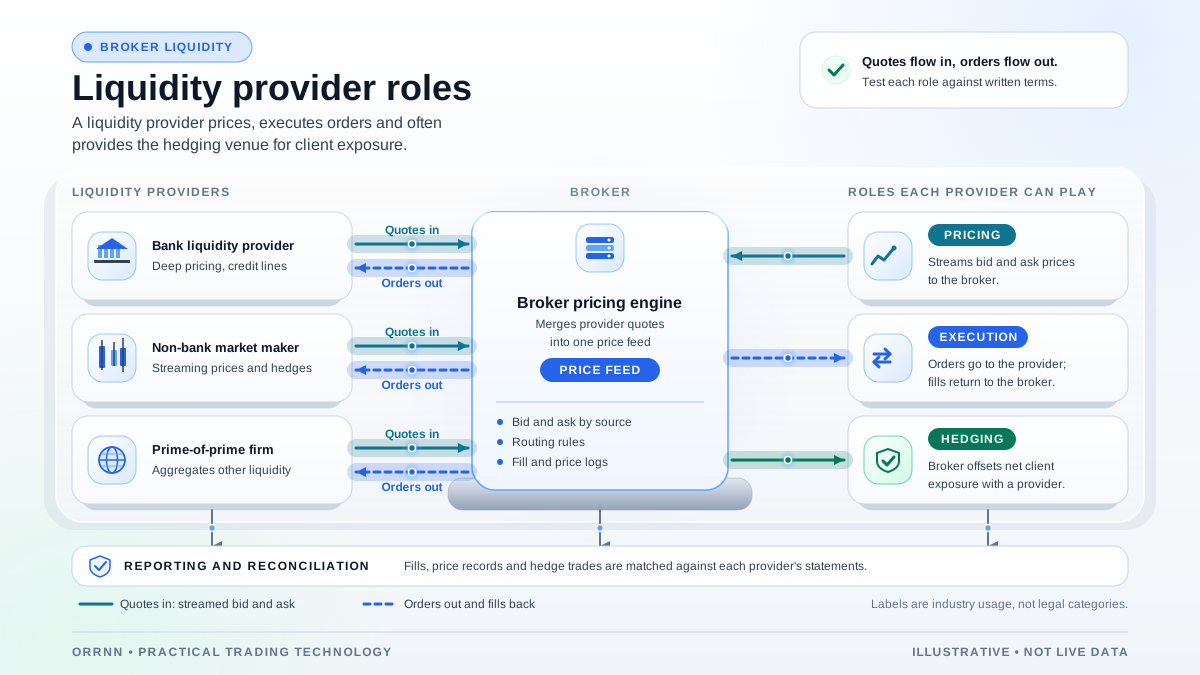
A liquidity provider is a bank, broker-dealer or non-bank firm that streams prices and accepts orders for financial instruments. For a broker, a liquidity provider supplies pricing, executes orders and often provides the hedging venue for client exposure. Its written terms, not its label, determine how well it serves the broker.
Key takeaways
- A liquidity provider supplies prices, executes orders and often offers the hedging venue a broker needs for client exposure.
- Bank, non-bank and prime-of-prime are common industry labels. They are not legal categories and do not show price quality.
- Spreads, markups and commissions can be combined in one arrangement, so compare all-in cost on the same trades.
- Last look and rejection rules change execution outcomes. Ask for the written terms and test them in fast markets.
- Connectivity needs a tested specification, reconciliation against your own records and a documented exit path.
Pricing, execution and hedging: what liquidity providers do
A liquidity provider does three jobs for a broker: it sets prices, fills orders and helps the broker manage the exposure those orders create.
Pricing comes first. The provider streams bid and ask prices, usually with indicative sizes, to the broker or to a bridge that combines several sources. The broker then decides what clients see, often after adding its own markup or spread policy. Feed quality depends on the provider's market access, the instruments it covers and how much size it is willing to show. A feed that looks tight in a demonstration can widen sharply in volatile conditions or when the provider cuts the size it will quote.
Execution comes second. When the broker sends an order, the provider accepts, rejects or partly fills it under the rules in their agreement. Execution terms cover minimum and maximum sizes, response-time limits, rejection reasons and what happens to an order that arrives during a fast market. These terms often matter more to the client's outcome than the headline spread.
Hedging is the third role. When client trades create exposure for the broker, the broker can carry that exposure or send an offsetting order to a provider. Hedging reduces some market risk but does not remove all of it. The broker still faces counterparty risk, timing gaps and basis differences between the hedge and the client position, and a provider can decline or reprice a hedge under its terms.
Bank, non-bank and prime-of-prime providers
Industry commentary often sorts providers into groups. Tier 1 usually means large global banks and major dealers that trade heavily with each other and with large institutions. Tier 2 is a looser label for smaller banks and other firms. Non-bank providers include proprietary trading firms and specialist market makers, which are common in retail-facing FX and CFD flow. Prime-of-prime firms sit between the broker and the underlying providers, aggregating broker flow and offering access and credit. These labels are common usage rather than legal categories, and a firm's group does not tell you the quality of its prices for your instruments.
Every group carries trade-offs. Bank relationships can offer deep access and established credit terms, but onboarding, minimum sizes and documentation can be demanding. Non-bank providers can move faster to onboard and may quote competitively, so the broker must test their risk appetite, capital support and behavior in stress. Prime-of-prime arrangements reduce the number of direct relationships, which can simplify operations, but they add a layer of dependency. Base the decision on documented evidence, not on the group name.
Common provider categories (industry usage, not legal definitions)
| Category | Typical role for a broker | Main questions to ask |
|---|---|---|
| Tier 1 bank or major dealer | Deep institutional pricing and established credit lines | Credit terms, minimum sizes, documentation and how quotes behave under stress |
| Tier 2 bank or smaller dealer | Alternative pricing and additional capacity | Financial strength, markets covered and continuity if the relationship ends |
| Non-bank market maker | Streaming prices and hedge execution | Risk limits, capital support, rejection policy and last look practice |
| Prime-of-prime firm | Aggregated access through one counterparty | Who holds which risk, how underlying access is documented and who sits behind the firm |
How spreads, markups and commissions are charged
Providers usually charge in one of three ways, and brokers often combine them. A spread model passes through the provider's bid and ask, and the broker adds its own markup on top. A raw spread with commission model passes through a tighter raw spread and charges a separate commission per lot or per side. In a markup model, the provider's price already includes its margin, and the broker may add a further markup for clients.
The useful comparison is all-in cost to the client and to the broker, not the headline spread. A tight raw spread with commission can cost more or less than a wider spread with no commission, depending on trade size, instrument, time of day and volatility. Get each provider to show worked examples using the same instrument, size and market condition. Include the cost of rejected orders, cancellations and partial fills, since these change real execution results.
Where a firm is subject to MiFID II, Article 27 requires it to take all sufficient steps to obtain the best possible result for clients when executing orders. Price, costs, speed and likelihood of execution are among the factors it must take into account. Qualified advisers should confirm how it applies to any particular firm.
Last look, explained neutrally
Last look is a practice in some OTC FX and CFD arrangements. After a client or broker sends an order against a streamed price, the provider can review it for a short window before accepting or rejecting it. Supporters describe it as protection against stale quotes and latency mismatches. Critics point out that it can cause rejections or requotes when the market moves against the provider, and that the client or broker may bear the timing cost.
Whether last look is acceptable depends on how it is disclosed, how often it is applied and what it means for the client. Request written rules from each provider: the window length, the rejection criteria, whether rejection reasons are logged, and whether the same policy applies to every account. Test it during fast markets, and reconcile rejected orders against your own records. The broker usually carries the client disclosure and outcome responsibility, so confirm the position for each jurisdiction with qualified advisers.
Connectivity between broker and provider
Providers connect through streaming price feeds and order interfaces. FIX is one widely used standard for electronic trading messages. The FIX Trading Community describes its standards as open, technology-neutral specifications for electronic trading and trade processing. Two firms that both say they support FIX still need agreed versions, session settings, message sets and custom tags before orders can flow. Testing and certification confirm the agreed configuration.
On its broker page, MetaQuotes describes gateways for MetaTrader 5 brokers that connect to external liquidity, and it refers to integration with liquidity providers in the forex market. The vendor page does not explain how each connection is built, so the broker must test the actual configuration with the specific provider it intends to use.
Due diligence checklist
Use this checklist to structure the review of any candidate provider. Selection criteria and Orrnn's evaluation role are on the liquidity providers page.
Checklist
- Regulatory status and prudential position confirmed with the provider and checked against the relevant regulator's public register
- Written pricing terms covering spreads, commissions, markups, and minimum and maximum order sizes
- Written execution and rejection policy, including whether last look applies and how it is disclosed
- Live and historical price tests in calm and volatile sessions, with timestamps recorded
- Credit, margin and settlement terms, including what happens if the relationship is suspended
- Connectivity specification with protocol version, session settings, message set and certification steps
- Reconciliation of executions, positions and fees against the broker's own records
- A tested exit path with a documented transition plan for replacing the provider
Limits of this guide
This guide is general information for brokers and their advisers. It is not legal, regulatory, tax or investment advice, and it does not describe any specific provider's prices, terms, licensing or performance. Trading FX and CFDs carries a high risk of losing money quickly. Liquidity conditions and provider behavior can change sharply in stressed markets, and past test results do not guarantee future execution.
Orrnn does not supply liquidity, does not hold a license to act as a liquidity provider and does not give regulatory or legal advice. Licensing, disclosure and client-protection questions must be answered by the broker's qualified advisers for each jurisdiction. Any Orrnn role in a project is limited to the technology, evaluation and integration scope agreed in writing.
Next steps: from definition to selection
Once the roles and models are clear, the next question is which providers to shortlist and how to test them. The liquidity providers page covers selection criteria, due diligence and how Orrnn approaches an evaluation. If you are still shaping the brokerage operating model, the broker page is the starting point for a project conversation.
Frequently asked questions
What is a liquidity provider in forex?
In forex and CFDs, a liquidity provider is a firm that streams bid and ask prices and accepts orders from a broker or a bridge. It may be a bank, a non-bank market maker or a prime-of-prime firm. The broker uses the provider's prices and execution to serve clients or to hedge the exposure that client trades create.
How is a liquidity provider different from a broker?
A broker serves clients. It opens accounts, applies its pricing policy and carries client-facing obligations. A liquidity provider supplies prices and executes orders for the broker, usually on a business-to-business basis. The broker therefore keeps its own client disclosures and execution records.
Is a liquidity provider the same as a market maker?
The terms overlap but are not identical. A market maker stands ready to quote both sides of an instrument and earns the spread for doing so. Many liquidity providers act as market makers, but some only feed prices to a bridge, some only execute hedges, and some are mainly banks with credit relationships.
Should a broker accept last look?
Last look is a commercial and regulatory judgment, not a simple yes or no. Ask the provider for the window length, the rejection criteria and whether rejection reasons are logged. Check how the policy is disclosed to clients, then test it during fast markets. Get advice from qualified advisers on disclosure duties in each jurisdiction before relying on any arrangement.
How many liquidity providers does a broker need?
There is no universal number. Many brokers start with a small group of providers to test pricing, execution and reconciliation, then add counterparties to reduce concentration risk or cover more instruments. The number should follow a documented need, such as coverage, capacity or failover.
Primary sources and further reading
These sources support the frameworks and definitions used in this guide. They do not endorse Orrnn or establish that any product complies with the referenced material.
- Directive 2014/65/EU (MiFID II) in the Interactive Single Rulebook
European Securities and Markets Authority
Entry point for the MiFID II directive, including the Article 27 best-execution obligation discussed in the pricing section.
- Triennial Central Bank Survey of foreign exchange and Over-the-counter (OTC) derivatives markets in 2025
Bank for International Settlements
Central bank survey of FX and OTC derivatives activity, built around a group of reporting dealers. Used for market-structure context only.
- FIX Protocol
FIX Trading Community
Describes FIX as an open, technology-neutral specification for electronic trading and trade processing.
- MetaTrader 5 for brokers
MetaQuotes
Vendor description of MetaTrader 5 broker gateways and liquidity connections. A vendor-stated capability, not an independent test.
Related reading
Forex liquidity explained
The market structure behind FX pricing, depth and fills, before you choose providers.
Read →Forex liquidity providers: selection and due diligence
Selection criteria, due diligence and how Orrnn approaches a provider evaluation.
Read →Liquidity bridge evaluation
Evaluate routing, aggregation, reconciliation and resilience for liquidity connections.
Read →Brokerage starting point
The brokerage-focused page for teams planning a trading platform or connectivity project.
Read →SDP meaning: single-dealer platforms
See how a single-dealer platform differs from a multi-dealer venue when a provider streams its own prices.
Read →