Glossary term
SDP Meaning: Single-Dealer Platforms Explained
SDP meaning: a single-dealer platform is a proprietary electronic system one dealer runs for its clients. See how it differs from a multi-dealer platform.
Definition
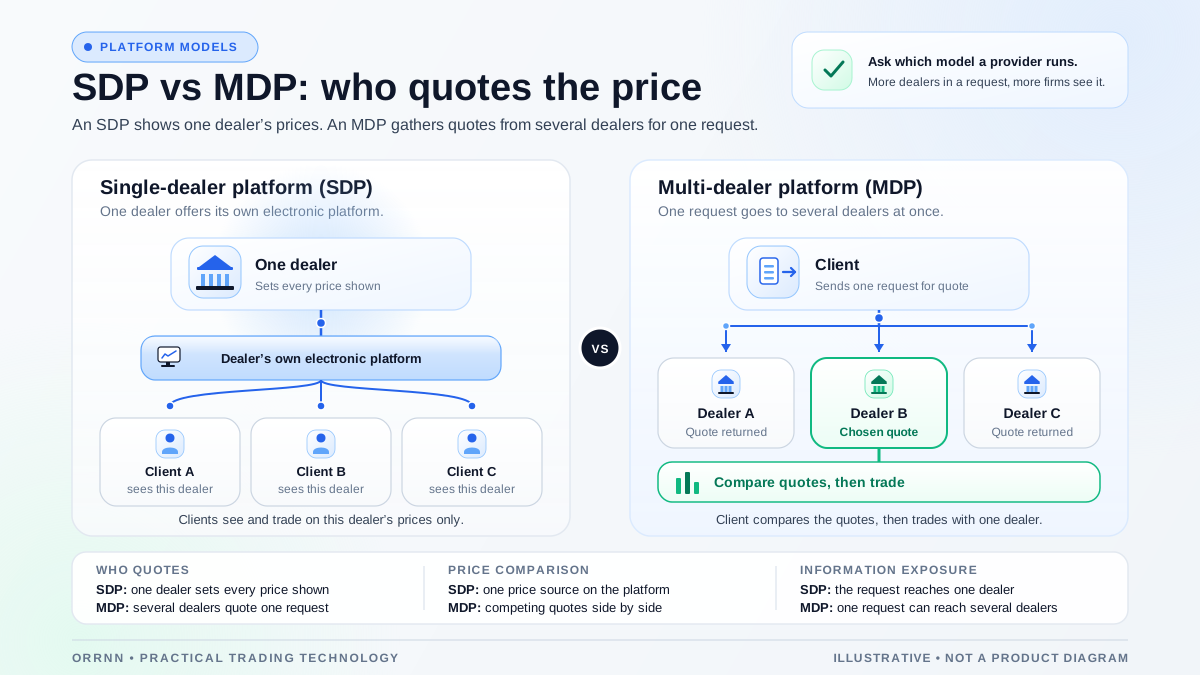
SDP stands for single-dealer platform: a proprietary electronic trading system that one dealer offers to its own clients, who see and trade on that dealer's prices. A multi-dealer platform (MDP) lets a client request quotes from several dealers at once, so they compete for the order.
Also known as: SDP, single-dealer platform, single dealer platform
Key takeaways
- SDP stands for single-dealer platform: one dealer offers its clients a proprietary electronic trading system.
- A multi-dealer platform lets a client request quotes from several dealers, so they compete for the order.
- More firms see a multi-dealer request, so information exposure is wider than on a single-dealer system.
- Ask every provider whether it uses last look, how long a quote stays valid and how it fills orders.
- Orrnn does not operate an SDP or MDP or supply liquidity. Its RTX5 bridge and FIX adapters have no published build yet.
SDP meaning: single-dealer and multi-dealer platforms defined
Both models are electronic dealer-to-client channels. They differ in how many dealers see the request and how many prices the client can compare.
A single-dealer platform (SDP) is a proprietary trading system that one dealer offers to its clients. The Bank for International Settlements (BIS) describes it as an electronic version of the bilateral dealer-client market. The client trades with the dealer that runs the system, and no other dealer is part of the request.
MDP meaning, in this context, is multi-dealer platform. An MDP lets an end investor request quotes from several dealers at once. The BIS says this puts dealers in competition for the trade, and that MDPs automate record-keeping, which makes best execution easier to audit.
SDP has unrelated meanings elsewhere, such as Session Description Protocol in networking. This page covers only the trading term.
SDP vs MDP comparison table
The main differences come from who sees the request, how prices are formed and what records the platform keeps.
| Feature | Single-dealer platform (SDP) | Multi-dealer platform (MDP) |
|---|---|---|
| Who quotes | The one dealer that runs the platform | Several dealers, each responding to the same request |
| Counterparty | The operating dealer, on a bilateral basis | The dealer whose quote the client accepts |
| Price discovery | One dealer's prices, which the client may check against other sources | Competing quotes for the same size, so the client sees a range |
| Information exposure | Limited to the one dealer that receives the request | Wider, because each dealer that receives the request sees the interest |
| Records | Set by the dealer's own systems | Automated record-keeping, which the BIS says makes best execution easier to audit |
| Typical users | Dealer-to-customer clients, such as asset managers, pension funds, insurers and corporations | End investors that want quotes from several dealers on each order |
| Connectivity | Vendor GUI, API or FIX session with the one dealer | Vendor GUI, API or FIX, with a session to each dealer or a shared hub |
Who uses each model
Use depends on who holds the client relationship and how many quotes the client needs.
The BIS places asset managers, pension funds, insurance companies and corporations in the dealer-to-customer segment. Buy-side firms that want several quotes often choose a multi-dealer platform, because competing quotes and automated records help show how a counterparty was picked. That is general practice, not a BIS finding.
Corporations sit in the same group. Whether a treasury team trades on a bank's own platform or on a multi-dealer platform depends on its banks and the platforms they offer.
Brokers can sit on either side. A broker that quotes its own clients from its own pricing acts as the counterparty, which is single-dealer in form. A broker that routes orders to several liquidity providers is closer to an aggregation model. Its disclosures say which applies.
Dealers, including banks, can run their own platform and also respond to requests on multi-dealer platforms, where the BIS describes them competing for the trade.
Pricing and liquidity implications
The model changes how a price is requested, how long it lasts and how much depth a client can see.
The BIS says dealer-to-customer platforms are usually based on request for quote (RFQ), where a client asks dealers for a price on a stated size. Click-to-trade streams executable prices instead, typically for smaller sizes.
The BIS also notes that multi-dealer competition tends to lower the cost of finding a counterparty with offsetting interest. Depth on either model depends on how much risk each dealer will take at the time.
The BIS paper covers fixed income, so applying its definitions to FX is an extension. FX Global Code Principle 17 covers last look, which it describes as a final opportunity for the receiving participant to accept or reject a trade request against its quoted price. Participants should disclose whether, and how, price moves affect that decision and how long it typically takes.
Where SDPs sit in a broker's or fund's stack
A single-dealer feed is one counterparty connection, usually one input to pricing, routing and risk.
A single-dealer feed usually arrives through a connector or bridge, often FIX or a vendor API. The price then feeds pricing, routing and risk, and it may be one source in a liquidity aggregation layer.
Orrnn is a trading software architecture and engineering provider. It does not supply liquidity, act as a dealer or hold a license, and it does not operate an SDP or MDP. Its work covers execution infrastructure, including FIX and liquidity bridges. The RTX5 roadmap lists the bridge and FIX 4.4 and 5.0 adapters as build not published (checked 9 November 2026), so each connection needs its own scope and acceptance tests.
Who holds funds, orders and client data is set by the contract for each deployment. Confirm it in writing before a liquidity connection goes live.
Checklist
- Confirm the protocol, version, session behavior and message scope with each dealer
- Test reject, resend and reconnect behavior before production use
- Record which dealer and price filled each order
- Document last look, quote validity and any markup rules in the routing policy
Related terms: liquidity, RFQ and venue definitions
These terms overlap in practice, but their definitions differ by market and product.
- Liquidity provider: a firm that quotes prices or takes the other side of trades. See the liquidity provider guide for due diligence.
- Liquidity aggregation: combining prices and depth from several sources into one view, then routing orders by rules.
- Request for quote (RFQ): a client asks one or more dealers for a price on a stated size.
- Electronic communications network (ECN): under US Regulation NMS, Rule 600(b)(36), an electronic system that widely disseminates market makers' orders to third parties and permits execution against them. Written for US equities; FX use is loose.
- Multilateral trading facility (MTF): under MiFID II Article 4(1)(22), a multilateral system that brings together multiple third-party buying and selling interests in financial instruments.
- Systematic internaliser: under MiFID II Article 4(1)(20), an investment firm that deals on its own account in equity instruments, on an organized, frequent and systematic basis, outside a regulated market, MTF or OTF. It applies only when the pre-set frequent and substantial limits are both crossed, or when the firm opts in. It is not a general label for FX platforms.
Limitations
This page explains terms. It is not legal, regulatory or investment advice, and it does not assess any dealer, platform or broker. Prices, depth and execution quality depend on the dealer, instrument and market conditions.
The BIS description comes from its March 2016 work on fixed income markets, and the FX application extends it. Check current vendor documentation. The MiFID II and Regulation NMS definitions are quoted for their wording only.
Orrnn does not operate an SDP or MDP, supply liquidity or give legal or regulatory advice. Platform capability is separate from a broker's configuration and permissions, and the operating broker remains responsible for its own regulatory permissions.
Frequently asked questions
What does SDP mean in trading?
In trading, SDP stands for single-dealer platform: a proprietary electronic system that one dealer runs for its clients, who trade with that dealer. Outside finance, SDP often means Session Description Protocol in networking, so check the context and the market you are reading about.
What is the difference between an SDP and an MDP?
An SDP is run by one dealer, and the client trades with that dealer. An MDP lets the client request quotes from several dealers at once, so they compete for the order. MDPs offer more price comparison and automated records, but they also show the request to more firms.
Is an ECN a multi-dealer platform?
Not necessarily. Under US Regulation NMS, an electronic communications network widely disseminates market makers' orders to third parties and permits execution against them. A multi-dealer platform is a dealer-to-client system where the client asks several dealers for quotes. FX usage is loose, so check who sees the order.
Do retail forex brokers use single-dealer platforms?
Some retail forex brokers act as the counterparty to their clients, so the relationship is single-dealer in form. Others route orders to outside liquidity providers. The CFTC advises checking an OTC forex dealer's registration and disciplinary history through NFA BASIC before making initial deposits. Ask the broker how it fills orders.
Does Orrnn operate a single-dealer platform?
No. Orrnn is a trading software architecture and engineering provider. It does not supply liquidity, act as a dealer or operate an SDP or MDP. Its work covers bridges and FIX connectivity. The RTX5 bridge and FIX 4.4 and 5.0 adapters have no published build yet, and each counterparty connection needs its own acceptance tests.
Primary sources and further reading
These sources support the definitions used on this page. They do not endorse Orrnn or establish that any product complies with the referenced material.
- Hanging up the phone: electronic trading in fixed income markets and its implications
Bank for International Settlements, BIS Quarterly Review, March 2016
Source of the SDP and MDP definitions, the RFQ and click-to-trade descriptions and the record-keeping point. Covers fixed income, not FX.
- Article 4: Definitions (MiFID II)
European Securities and Markets Authority, Interactive Single Rulebook
Article 4(1)(20) defines systematic internaliser and 4(1)(22) defines the MTF. The systematic internaliser status covers equity instruments.
- FX Global Code, Principle 17: Last Look
Global Foreign Exchange Committee (GFXC)
PDF of the FX Global Code. Principle 17 covers last look, and the Glossary of Terms defines an FX E-Trading Platform.
- 17 CFR 242.600: Definitions (Regulation NMS)
U.S. Securities and Exchange Commission, via the eCFR
Defines electronic communications network in Rule 600(b)(36), written for US equity rules.
- Customer Advisory: Eight Things You Should Know Before Trading Forex
U.S. Commodity Futures Trading Commission
Advises checking an OTC forex dealer's registration and disciplinary history, pointing to NFA BASIC.
Related reading
What Is a Liquidity Provider
Liquidity provider roles, pricing models, last look and due diligence for brokers.
Read →Forex Liquidity Explained
How brokers measure spreads, depth, fill rates and slippage, and how liquidity reaches a trading system.
Read →Liquidity Bridge: Definition and Evaluation
How a liquidity bridge routes prices and orders, and what to evaluate before go-live.
Read →Order Routing for FX and CFD Brokers
Routing rules, risk gates, LP adapters and audit records for FX and CFD order flow.
Read →RFQ Trading Explained
How request-for-quote execution works and who quotes.
Read →ECN Meaning: What an ECN Is in Forex
What an electronic communications network is, and how it differs from a market maker.
Read →