Glossary term
High Latency Definition: What Counts as High Latency in Trading
High latency definition for trading: a delay longer than a strategy, client or risk process can tolerate. Why tail latency matters more than averages.
Definition
In trading, high latency means the delay between a decision or order and the system's response is longer than the strategy, client or risk process can tolerate. It is a relative judgment, not a fixed number. A delay that is high for a scalping strategy can be ordinary for a fund that rebalances once a day.
Also known as: high latency, latency in trading, trading latency
Key takeaways
- High latency in trading means a delay beyond what a strategy, client or risk process can tolerate, so there is no universal threshold.
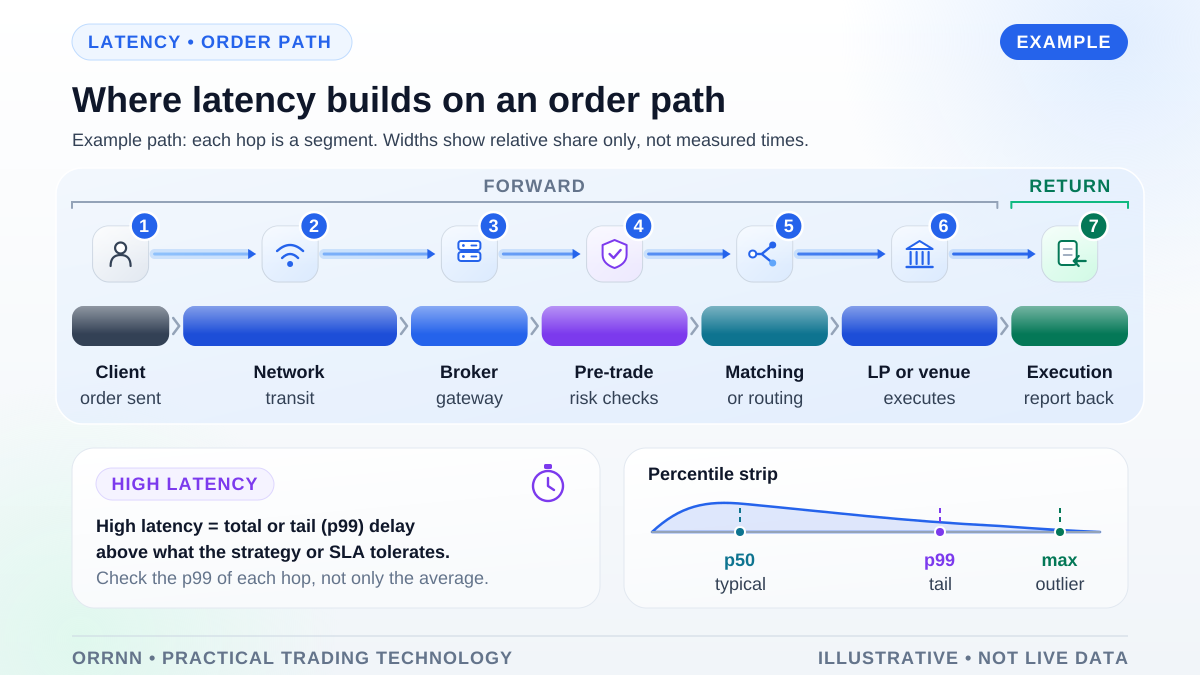
- Total latency is the sum of named stages, including network distance, queuing, risk checks, counterparty processing and any last-look hold.
- Averages can hide the tail. Report medians with percentiles, jitter, timeouts and sample counts.
- A timestamp is only as useful as its clock. Record the synchronization method and its uncertainty.
- This page gives no latency figures for Orrnn or RTX5. Measure your own path against your own requirement.
High latency definition: latency measured against tolerance
Latency is a time interval. High is a judgment about what that interval does to one specific trading process.
Latency in trading is the elapsed time between two named events, such as a strategy generating an order and the broker's system acknowledging it. The measure means little until both events and the clock used to time them are defined. Without that, two teams can quote different numbers for the same path and both be right.
High latency therefore has no universal threshold. The useful test is whether the delay breaks the outcome a process depends on, such as a stop that triggers late or a quote that expires before the order arrives. Each process has its own tolerance.
Where trading latency comes from
Latency accumulates along the whole path, so each stage needs its own measurement before any total is trusted.
Total delay is the sum of the stages an order actually traverses, plus any waiting between them. The table separates each source, how it can be measured and what usually reduces it.
Last look deserves its own interval. The FX Global Code, Principle 17, describes last look as a practice in which the receiving participant has a final opportunity to accept or reject a trade request against its quoted price, and it asks participants to disclose the expected or typical time taken to decide. The hold adds delay and can change the fill outcome, so record it separately rather than inside a generic fill time.
| Source | How to measure it | What usually reduces it |
|---|---|---|
| Network distance | Round-trip time and loss from the client host to the broker endpoint, sampled over representative periods | A shorter or better-routed path. Geography alone does not set the delay. |
| Serialization and message size | Time from message build to send, and bytes per message | Smaller messages, efficient encoding and fewer repeated fields |
| Queuing | Time waiting in socket buffers, thread pools and internal queues, from timestamps at each boundary | Less contention, sized queues and no blocking calls on the critical path |
| Software processing and risk checks | Timed spans around validation, pricing and limit checks, reported as percentiles | Moving non-critical work off the path and placing each check where it is needed |
| Venue or liquidity provider processing | Acknowledgement and fill timestamps from the counterparty, compared with the send time | Choice of venue or provider and its service levels |
| Last-look hold | Time from request to the accept or reject response, recorded per request | Choosing providers that disclose their hold behavior and set clear quote validity |
Why averages mislead: percentiles, jitter and tail latency
A healthy average can sit alongside a slow tail that harms specific orders.
An average blends fast and slow events into one number. Tail latency is the slow end of the distribution, usually described with percentiles such as the 95th or 99th. Google's Site Reliability Engineering guidance notes that a mean can hide a slow tail and recommends tracking high percentiles, such as the 99th.
Jitter is the variation between samples. Example: two paths with the same median can differ sharply if one swings between 20 and 400 milliseconds while the other stays near 25. Jitter matters for heartbeats, reconnection logic and any process that waits for a reply.
Example, not a benchmark: a test sends 10,000 order requests. The median is 40 ms and the 99th percentile is 310 ms. The median suggests normal behavior, but roughly one order in one hundred takes longer than 310 ms. If a process needs a reply within 250 ms, that tail is the risk to examine first.
Percentiles need enough observations, so a 99.9th percentile from a few hundred samples is unstable. Report the sample count and timeout rate, and count timeouts as outcomes.
When high latency matters and when it does not
The same delay can be decisive in one workflow and irrelevant in another.
The importance of a delay depends on how quickly the process has to act on what it received. Three patterns show up most often. Whatever the pattern, name the decision the delay could change, write the tolerance for that decision in the workflow's own terms, and compare the observed percentiles with that tolerance rather than with a figure from another product.
- Matters more: strategies that react to short-lived quotes, hedges that must follow a fill quickly, and client flows where a quote can expire before the order arrives.
- Matters less: end-of-day reporting, reconciliation jobs, manual account administration and strategies that trade on daily or weekly signals.
- Matters in a different way: order status and acknowledgements that drive client messages, where a long silence without status can cause more harm than a moderate, predictable delay.
Clock synchronization and timestamps
A latency figure is only as reliable as the clock that timed it.
A one-way or cross-system interval needs both ends to share a time reference. Round-trip time on a single host can use a monotonic clock, because the same clock measures the start and the finish. Across machines, clocks must agree within a known error, and that uncertainty should be recorded with the result.
The Network Time Protocol (NTP) is widely used to synchronize computer clocks in the Internet, as specified in RFC 5905. The National Institute of Standards and Technology (NIST) distributes its time and frequency signals freely to the public, including through the Internet Time Service and time.gov.
Timestamp resolution is not the same as accuracy. A field with nanosecond resolution can still be off by milliseconds if the clock is poorly disciplined. Store the event definition with each timestamp.
EU rules also set business-clock synchronization standards for some trading activity. Since 1 March 2026 they sit in Commission Delegated Regulation (EU) 2025/1155, which repealed the earlier RTS 25 (Delegated Regulation (EU) 2017/574). Which requirement applies depends on the activity and the firm's status, so confirm it with qualified counsel before building a compliance control around it.
Measuring latency without overstating the result
Defining the term is the first step. Measurement needs a defined test, a clock method and honest reporting.
The guide on how to measure latency to a broker server covers the procedure: intervals, clock method, sample design and reporting. Use this entry for the definition and that guide for the test plan. Host sizing is covered separately in the VPS sizing guide.
Report the median, the relevant percentiles, the maximum with context, the timeout rate, the sample count and the measurement boundary. Compare like with like. A validation rejection, an asynchronous acceptance and a fill are different outcomes.
Limitations of this definition
This entry defines a term. It does not set latency thresholds for any venue, broker, product or regulator, and no figure on this page describes Orrnn or its RTX5 platform.
Latency is one dimension of execution quality. Price, spread, fill probability and slippage can matter more to a client outcome. Orrnn is a trading software architecture and engineering provider. It does not supply liquidity, act as a broker or give investment, legal or regulatory advice.
Frequently asked questions
What is the high latency definition in trading?
In trading, high latency is a delay longer than a strategy, client or risk process can tolerate for its intended outcome. There is no fixed number. Teams first name the interval, such as order send to acknowledgement, and then decide whether the observed percentiles are acceptable for that workflow.
What is tail latency?
Tail latency is the slow end of a latency distribution, described with high percentiles such as the 95th or 99th. A small share of very slow events can cause a missed hedge or an expired quote even when the average looks healthy.
Is 10 milliseconds high or low latency?
Neither, on its own. A figure of 10 milliseconds means little until the interval, the process tolerance and the spread of results are known. Example: 10 milliseconds can decide a quote-driven strategy and be irrelevant to a daily reporting job.
Is latency in trading the same as ping?
No. Ping measures round-trip network delay to a host, usually with a simple diagnostic packet. Trading latency can include serialization, queuing, authentication, risk checks, counterparty processing and last-look holds. A ping result can show part of the path, but it does not establish order-path latency.
Why do clocks matter when measuring trading latency?
Clocks matter whenever the start and end events are recorded on different machines. If the clocks disagree, durations can come out negative, too short or too long, and the error looks like real delay. Use a monotonic clock for an interval on one host, and synchronized clocks with recorded uncertainty for intervals that cross systems.
Primary sources and further reading
These sources support the definitions used on this page. They do not endorse Orrnn or establish that any product complies with the referenced material.
- NIST Time and Frequency Division: Time Services
National Institute of Standards and Technology
Says NIST distributes time signals freely to the public, including the Internet Time Service and time.gov. Checked 9 November 2026.
- RFC 5905: Network Time Protocol Version 4
Internet Engineering Task Force, via the RFC Editor
Protocol and algorithms specification (Proposed Standard, June 2010) for synchronizing computer clocks in the Internet. Checked 9 November 2026.
- Monitoring Distributed Systems, Site Reliability Engineering
Google
Explains why an average can hide a slow tail and recommends tracking high percentiles such as the 99th. Checked 9 November 2026.
- FX Global Code, Principle 17: Last Look
Global Foreign Exchange Committee (GFXC)
Principle 17 defines last look as a final opportunity to accept or reject a trade request, and asks for disclosure of the typical decision time. Checked 9 November 2026.
- Commission Delegated Regulation (EU) 2025/1155
EUR-Lex, Publications Office of the European Union
Sets regulatory technical standards that include the synchronisation of business clocks and repeals Delegated Regulation (EU) 2017/574 (RTS 25). In force when checked on 9 November 2026.
Related reading
How to Measure Latency to a Broker Server
Intervals, clock method, sample design and reporting for a defensible broker-path latency test.
Read →Trading Bot VPS Sizing Guide
Size and measure a host for a trading process, covering CPU, storage, network and recovery.
Read →WebSocket vs REST vs FIX Trading APIs
How each interface handles sequencing, recovery and ambiguous outcomes that shape measured delay.
Read →Order Routing for FX and CFD Brokers
Where routing, risk gates and LP adapters sit in the order path, and what each one adds.
Read →