Glossary term
Order Book Explained: Bids, Asks and Matching Basics
An order book lists resting bids and asks by price and size. Learn best bid and offer, spread, depth, Level 2 data and how price-time matching works.
Definition
An order book is the live list of buy orders (bids) and sell orders (asks) resting at a trading venue, grouped by price and showing how much size sits at each price level. The best bid is the highest buy price, the best ask is the lowest sell price, and the gap between them is the spread.
Also known as: order book, what is an order book, order book trading, bid and ask, orderbook
Key takeaways
- An order book is the live list of resting bids and asks, grouped by price level.
- The best bid, best ask and spread describe the top of the book. Depth describes the size behind them.
- Limit orders rest in the book. Market orders take size from it, often in parts.
- Over-the-counter FX has no single central order book, so a visible ladder covers one venue or set of sources.
- A displayed book leaves out hidden orders, last-look rejections and dealer-to-client liquidity.
What an order book shows
Each side of the book lists prices in order, with the size resting at each one.
The book has two sides. Bids are buy orders, ranked from the highest price down. Asks, also called offers, are sell orders, ranked from the lowest price up. Each row, or price level, shows the total size resting at one price. The displayed book shows prices and sizes. Whether it also shows who placed each order depends on the venue's display rules.
The best bid and best ask form the top of the book. The spread is the best ask minus the best bid, and the mid price is their average. Depth is the size resting beyond the top of the book.
- Price level: all resting orders at one price, shown as one row of the ladder.
- Best bid and best offer: the highest bid and the lowest ask, also called the top of book.
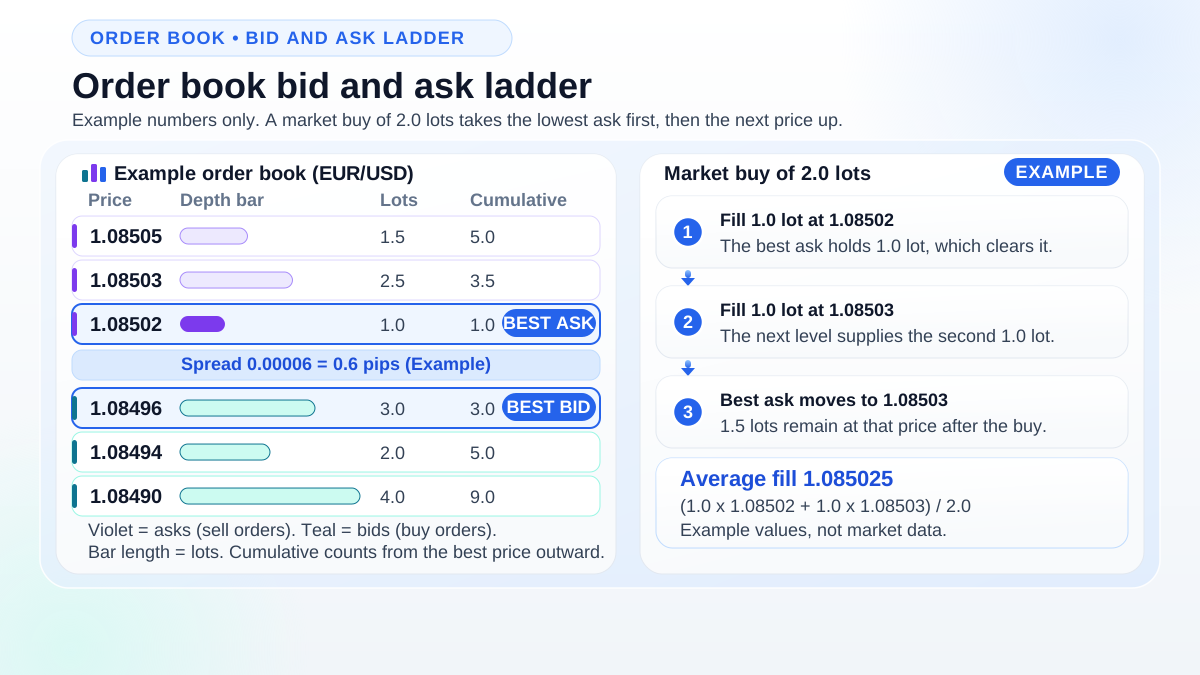
- Spread: best ask minus best bid. Example: 1.08502 minus 1.08496 is 0.00006, or 0.6 pips.
Annotated ladder: a worked example
A simplified EUR/USD ladder with consistent example numbers. The prices and sizes are illustrative, not market data.
Read the ladder from the middle outward. The best ask is 1.08502 with 1.0 lot, and the best bid is 1.08496 with 3.0 lots. The spread is 0.6 pips, and the mid price is 1.08499 (Example).
Displayed size totals 5.0 lots on the ask side and 9.0 lots on the bid side across three levels each. Those totals describe what is shown at one moment. They do not say how much will trade, and the figures change as orders arrive, fill or are cancelled.
| Side | Price level (Example) | Size, lots (Example) | Cumulative size (Example) |
|---|---|---|---|
| Ask | 1.08505 | 1.5 | 5.0 |
| Ask | 1.08503 | 2.5 | 3.5 |
| Ask (best) | 1.08502 | 1.0 | 1.0 |
| Bid (best) | 1.08496 | 3.0 | 3.0 |
| Bid | 1.08494 | 2.0 | 5.0 |
| Bid | 1.08490 | 4.0 | 9.0 |
How orders interact with the book
A limit order rests in the book. A market order takes size from it.
A limit order sets the worst price the trader will accept. FINRA's order types guidance says a buy limit order can be executed only at or below its limit price. If the price does not reach the opposite side, the order rests in the book and waits. A market order asks for an immediate fill at the best available prices, and its fill price can differ from the price shown when it was sent.
Example: a market buy for 2.0 lots against the ladder above fills 1.0 lot at 1.08502 and 1.0 lot at 1.08503. The average fill is 1.085025 (Example). The order walked two price levels because the best ask could not cover its full size, and 1.5 lots remain at 1.08503. A limit buy for 1.0 lot at 1.08496 would join the queue behind the 3.0 lots already resting there.
Partial fills are normal. An order can fill in part and leave the rest resting. Price-time priority ranks orders by price first and, at the same price, by arrival time. Matching-engine design is covered at /architecture/core-engine. This entry covers the book itself, not the engine that matches orders against it.
Level 1, Level 2 and full depth data
The three data levels show the same book with different amounts of detail.
Vendors do not use these labels identically, so check the feed specification. On the example ladder, Level 1 shows only 1.08502 and 1.08496, while Level 2 shows all six rows.
- Level 1: the best bid and best ask with the size at each. This is the top of book only.
- Level 2: aggregated size at several price levels on each side, usually shown as a ladder. The number of levels depends on the feed.
- Full depth: every resting order, sometimes with an order identifier that shows queue position. Availability depends on the venue and the data contract.
Where the order book lives
Some venues run a visible central book. Over-the-counter FX has no single one.
On an exchange or other venue that runs a central limit order book, one matching system holds the resting orders for each instrument.
A broker's internal book is different. A broker that matches client orders in-house keeps its own record of open orders, and the prices it shows may come from several sources. A liquidity provider's stream is a set of prices rather than a book, and whether an order against it is accepted depends on the provider's terms.
FX is structured differently. The BIS says spot and most FX derivatives trade over the counter, with dealers as intermediaries, unlike equities and futures on centralised exchanges. It describes the market as decentralised and fragmented, and says dealers match a large share of customer trades in their own internal pools, so much of the activity is not publicly visible. No single public FX order book shows the whole market, so a ladder in a trading app reflects the venues or providers behind it.
RFQ and click-to-trade models differ again. RFQ is an electronic version of OTC trading in which a client asks dealers for a price on a stated size. Click-to-trade streams executable prices. Neither displays a full public book.
What an order book does not show
The displayed book is a partial, time-stamped view. Several parts of the market sit outside it.
- Hidden and iceberg orders: a venue may allow a trader to hide size or show only part of an order. Hidden size does not appear in the book, so displayed depth can understate real interest.
- Last look: some liquidity providers check an order after it arrives and can reject it, so a streamed price does not show whether an order will be accepted. The FX Global Code covers last look in Principle 17. The liquidity provider guide covers the questions to ask.
- Dealer-to-client liquidity: bilateral quotes, internal pools and RFQ responses do not appear in a public book.
- Intent: resting size is not a promise to trade. Orders can be pulled before they reach the market.
Limitations
This page defines terms. It is not investment, legal or regulatory advice, and it does not suggest a trading strategy or price direction. Displayed quotes can change or disappear before an order reaches them, so reading depth to predict a move is unreliable.
The RFQ and click-to-trade descriptions come from BIS work on fixed income, not FX. Check current venue and vendor documentation before relying on any detail for a specific market.
Orrnn is a trading software architecture and engineering provider and builds the RTX5 trading platform. Orrnn does not operate an exchange, supply liquidity or hold a licence, and it does not publish a live order book for any market.
Frequently asked questions
What is an order book in trading?
An order book is the record of open buy and sell orders for one instrument at one venue. It lists bids and asks by price and shows the size at each level. Traders use it to see where resting orders sit. It changes as orders are placed, filled or cancelled, so it is a live but partial view.
What is the difference between a bid and an ask?
A bid is a price a buyer is willing to pay, and an ask, also called an offer, is a price a seller is willing to accept. The difference between them is the spread. A market buy usually fills at the ask, and a market sell usually fills at the bid.
Is an order book the same as a matching engine?
No. The order book is the list of resting orders. The matching engine is the software that decides which orders trade against each other, using rules such as price-time priority. A central venue needs both. Orrnn's matching-engine design is covered on the core engine architecture page, which is separate from this definition.
Does forex have an order book?
Some electronic venues and brokers display order books for FX. Most over-the-counter FX trades between dealers and clients, with no single central book. The BIS describes the market as decentralised and fragmented, with much activity matched inside dealers. A ladder in a trading app may combine prices from several providers, so check which sources it shows.
Does an order book show every order?
No. A book shows displayed orders only. Hidden or iceberg size, dealer-to-client quotes, internal pools and last-look rejections can sit outside the visible book. A level that looks thin may still have size behind it that is not shown. Treat depth as partial information about interest at one moment, not as a full record of the market.
Primary sources and further reading
These sources support the definitions used on this page. They do not endorse Orrnn or establish that any product complies with the referenced material.
- The FX trade execution landscape through the prism of the 2025 BIS Triennial Survey
Bank for International Settlements, BIS Quarterly Review, December 2025
Used for OTC FX structure and the decentralised, fragmented description. Checked 9 November 2026.
- The foreign exchange market
Bank for International Settlements, Working Paper No 1094, April 2023
Used for OTC FX trading and inter-dealer electronic brokers. Checked 9 November 2026.
- Hanging up the phone: electronic trading in fixed income markets and its implications
Bank for International Settlements, BIS Quarterly Review, March 2016
Used for RFQ and click-to-trade descriptions. Covers fixed income, not FX. Checked 9 November 2026.
- Order Types
FINRA, Investor Education
Used for the limit order rule that a buy limit order can be executed only at or below its limit price. Equity guidance. Checked 9 November 2026.
- FX Global Code, Principle 17: Last Look
Global Foreign Exchange Committee (GFXC)
Used for last look, which Principle 17 of the FX Global Code covers. The PDF is the same source already cited in the glossary.
Related reading
Core Engine Architecture
Matching-engine design for price-time and pro-rata rules, order lifecycle and pre-trade controls. The engine, not the order book term.
Read →Forex Liquidity Explained
How brokers measure spreads, depth, fill rates and slippage, and how liquidity reaches a trading system.
Read →What Is a Liquidity Provider
Liquidity provider roles, pricing models, last look and due diligence for brokers.
Read →SDP Meaning: Single-Dealer Platforms
How a single-dealer platform differs from a multi-dealer platform in dealer-to-client trading.
Read →RFQ Trading Explained
How request-for-quote execution works and who quotes.
Read →