Glossary term
RFQ Trading Explained: Request-for-Quote Execution
RFQ trading explained: a client asks dealers for a price on a stated size, then chooses one quote. See the flow, quote types, last look and records.
Definition
RFQ trading, or request-for-quote trading, is an execution method where a client asks one or more dealers or liquidity providers for a price on a stated instrument and size. The client then chooses which quote, if any, to accept. The BIS describes RFQ as the usual protocol on dealer-to-customer platforms in fixed income markets.
Also known as: RFQ, request for quote, request-for-quote trading, request for quote trading, what is RFQ in trading
Key takeaways
- RFQ trading lets a client ask several dealers or liquidity providers for a price on a stated size, then choose one quote or none.
- Quotes can be firm or indicative. Check validity and whether last look applies before relying on a price.
- More dealers can improve price competition, but each one also learns about the client's interest.
- Orrnn does not supply liquidity or operate an RFQ venue. Its RTX5 liquidity bridge and FIX 4.4 and 5.0 modules have no published build.
RFQ trading defined and where it is used
RFQ is a price request for a stated size. Nothing trades until the client accepts a quote, which sets it apart from a price that is already streaming.
In an RFQ, the client states the instrument, side and size, and one or more quoting parties respond with prices. The client then decides whether to deal. A streamed price can be hit at once if it is executable, so the request step is the main difference.
The Bank for International Settlements (BIS) describes RFQ as the usual protocol on dealer-to-customer platforms. That description comes from fixed income, so check each FX venue's own terms.
For a broker, RFQ matters when a liquidity provider prices on request rather than streaming, or when a large order should not be shown to the wider market.
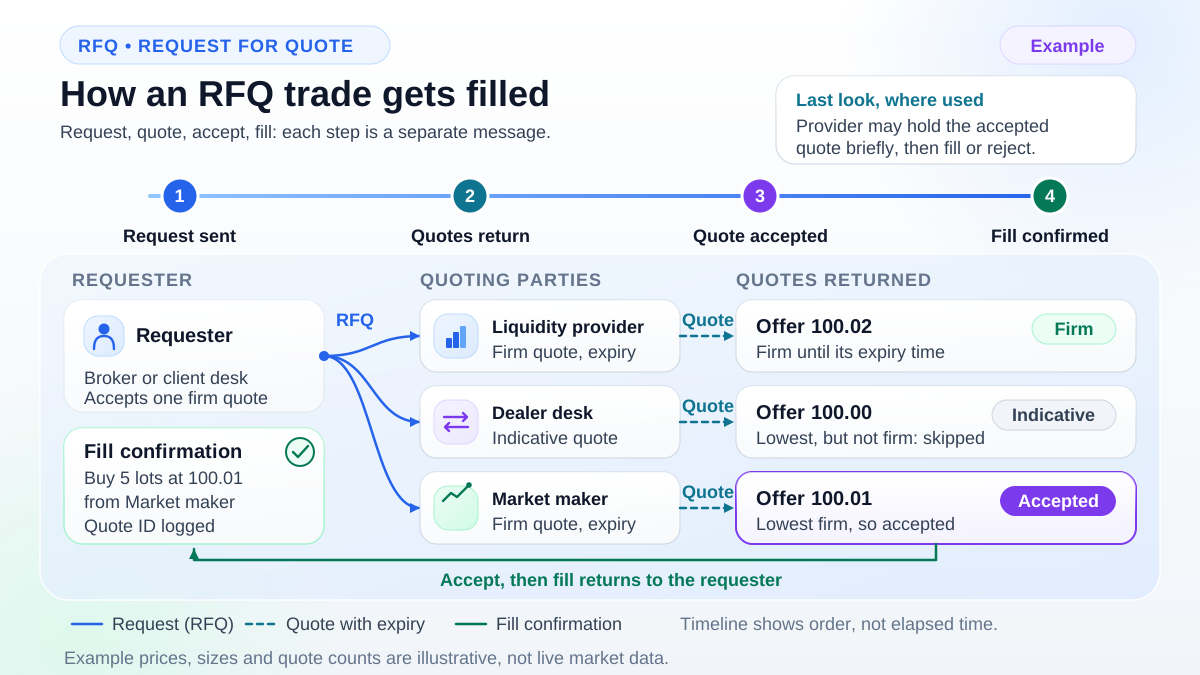
The request, quote and fill flow, step by step
Each stage creates a record. Platforms differ in the steps they add or skip, so map the actual flow before go-live.
In FIX, the FIX Protocol standard places RFQ workflows in trade messaging and quoting in pre-trade messaging. Message names and session rules vary by version, so test each connection.
- Request: the client sends the instrument, side, size and, where allowed, a response time to selected dealers.
- Quote: each responding dealer returns a price, a size and usually a validity period. A dealer may decline.
- Choice: the client compares responses and selects one quote, or none.
- Acceptance: if the chosen quote is firm and still valid, the trade is agreed at that price.
- Last look and fill: the quoting party may apply last look before filling, depending on the agreement.
- Record: the request, responses, accepted quote, fill or reject reason and timestamps are stored.
RFQ vs streaming (RFS/ESP) vs central limit order book
The three models differ in who sets the price, when it becomes tradable and who sees the interest.
| Feature | RFQ | Streaming (RFS, ESP) | Central limit order book |
|---|---|---|---|
| Price formation | Dealers price the specific request | Dealers stream continuously, or on request for a period | Resting limit orders set the prices |
| Who sees the interest | Only the dealers the client selects | The dealers streaming to the client | Participants that can see the book |
| When trade is committed | When the client accepts a valid quote | On click, where the price is executable, subject to any last look | When an order matches a resting order |
| Records | Request, responses, accepted quote and fill | Stream, click and fill records, set by the platform | Order and trade messages from the venue |
Who quotes: liquidity providers, dealer banks and market makers
The quoting party affects price quality, credit terms and the record of each fill. One firm can fill more than one role.
| Quoting party | What it usually is | What a broker should check |
|---|---|---|
| Liquidity provider (LP) | A firm that prices and takes the other side of client flow over an agreed API or FIX connection | Connection terms, fill policy, last look disclosure and reject rates |
| Dealer bank | A bank trading desk that quotes from its own balance sheet | Credit and settlement terms, and whether quotes are firm |
| Non-bank market maker | A specialist firm that quotes on its own capital | Coverage of instruments, depth at stated sizes and behavior when prices move |
| Multi-dealer platform (MDP) | A venue, not usually a quoter, that passes the request to several quoting parties and keeps a record | Who sees the request, quote validity rules and the audit trail |
Firm and indicative quotes, quote expiry and last look
A quote is only as useful as its terms. Confirm whether it is firm, how long it lasts and whether last look applies.
A firm quote is a price the quoting party will deal at, for the stated size, while the quote is valid. An indicative quote gives a view of price without that commitment.
Quote expiry sets how long a price holds. A late acceptance may be refused or re-quoted. Measure expiry and delays from the broker's own traffic rather than assume a figure.
Last look is a final opportunity for the receiving participant to accept or reject a trade request against its quoted price. FX Global Code Principle 17 asks participants that use last look to be transparent about its use and to disclose whether, and if so how, price changes in either direction may affect that decision, and the typical time taken to make it.
Example: a client accepts a quote for 5 lots that is valid for 3 seconds. The provider's fill arrives 4 seconds later and is refused as a timeout. The broker logs the reason code.
Information leakage and how many dealers to ask
Each extra dealer adds price competition and also one more firm that learns about the client's interest.
The BIS says multi-dealer platforms let an end investor request quotes from several dealers at once, which creates competition. Each dealer that receives the request also sees it.
That visibility is the leakage cost. A dealer that sees a large request may adjust its prices or hedge before the client trades. The BIS paper does not analyze leakage, so this is general practice, not a BIS finding.
No general number of dealers is correct. Set it by testing: compare the best price, the spread between responses and fill rates for each dealer set.
Checklist
- Set a dealer list per instrument and size band, not one list for all flow
- Record which dealers were asked and which of them responded
- Compare fill and reject results by dealer set each month
Where RFQ sits in a broker's stack
RFQ is a request path through the liquidity layer, so it needs routing rules, pre-trade risk checks and an audit trail.
An RFQ path usually starts in the order or pricing layer, passes routing and pre-trade risk checks, and leaves through a liquidity provider connection.
Orrnn does not supply liquidity, act as a dealer or operate an SDP or MDP. Orrnn sells RTX5, so it is not a neutral reviewer of RTX5. Its RTX5 liquidity bridge and FIX 4.4 and 5.0 modules have no published build, so an RFQ path needs its own scope and acceptance tests.
Who holds orders, funds and client data depends on each contract. Confirm it in writing before an RFQ connection goes live.
Records and best execution evidence
A fill can only be defended as far as the request, quotes and timestamps behind it.
For each RFQ, keep the request and timestamp, every response with price, size and validity, the accepted quote, and the fill or reject with its reason code.
Best execution and retention duties come from the rules that apply to each firm. This page states no retention period, so check with compliance.
Limitations
This page explains a trading term. It is not legal, regulatory or investment advice, and it does not assess any dealer, platform or broker. Prices and depth depend on the counterparty, instrument and market conditions at the time of a request.
The BIS description covers fixed income, and FX use is an extension of it. Platform protocols change, so check current FIX and platform documentation before relying on any message detail.
Orrnn does not supply liquidity, operate a venue, hold a license or give legal, regulatory or investment advice.
Frequently asked questions
What is RFQ in trading?
RFQ stands for request for quote. A client asks one or more dealers or liquidity providers for a price on a stated instrument and size, then decides whether to accept a quote. Quotes can be firm or indicative, so check the validity and terms first.
What is request for quote trading in FX?
In FX, request for quote trading is a dealer-to-client process. The client asks selected dealers for prices on a stated size and picks one. The BIS describes RFQ as the usual protocol on dealer-to-customer platforms, based on fixed income, so FX venues set their own rules.
Is an RFQ quote always firm?
No. A firm quote is one the quoting party will deal at for the stated size while it is valid. An indicative quote gives a view of price without that commitment. Last look may still apply to a firm quote, so read the platform's quote terms before relying on a price.
How many dealers should a client ask in an RFQ?
No general number is stated in the sources reviewed. More dealers can improve competition, but each one also learns about the client's interest. Set the number by comparing prices and fill rates by dealer set, for each instrument and size band.
Primary sources and further reading
These sources support the definitions used on this page. They do not endorse Orrnn or establish that any product complies with the referenced material.
- Hanging up the phone: electronic trading in fixed income markets and its implications
Bank for International Settlements, BIS Quarterly Review, March 2016
Checked 9 November 2026. Source of the RFQ and click-to-trade descriptions. Covers fixed income, not FX, and does not discuss information leakage.
- The FIX Protocol
FIX Trading Community
Checked 9 November 2026. Places RFQ workflows in trade messaging and quoting in pre-trade messaging. Individual message names are not listed.
- Standards
FIX Trading Community
Checked 9 November 2026. Says the FIX specifications cover the trade lifecycle from pre-trade and execution onward. Cited only for the general scope of FIX, not for RFQ message names or versions.
- FX Global Code, Principle 17: Last Look
Global Foreign Exchange Committee (GFXC)
Checked 9 November 2026 against the PDF text (Principle 17 and its key elements, and the last look definition as a final opportunity to accept or reject against the quoted price). Source for the last look wording.
Related reading
What Is a Liquidity Provider
Liquidity provider roles, pricing models, last look and due diligence for brokers.
Read →Forex Liquidity Providers: Selection and Due Diligence
LP selection criteria, direct LP versus aggregation, and the limits of Orrnn's evaluation-only role.
Read →SDP Meaning: Single-Dealer Platforms
Single-dealer and multi-dealer platforms, and where each sits in a broker's stack.
Read →Order Routing for FX and CFD Brokers
Routing rules, risk gates, LP adapters and audit records for FX and CFD order flow.
Read →Order Book Explained: Bids and Asks
How an order book lists resting bids and asks, with best bid and offer, spread and depth.
Read →