Glossary term
Tick-by-Tick Data Explained: Feeds, Storage and Timestamps
Tick by tick data is a time-stamped record of every quote and trade update. Learn how brokers and funds handle feeds, storage, clock sync and replay.
Definition
Tick-by-tick data is a time-stamped record of every quote and trade update a market data feed delivers for an instrument, in the order it arrived. Each tick usually carries a price, a size, and a timestamp. Brokers and funds use it for execution analysis, backtesting and latency measurement.
Also known as: tick-by-tick data, tick by tick data, tick data, tick-by-tick market data
Key takeaways
- Tick by tick data keeps every quote and trade update with its timestamp, in the order the feed delivered it.
- Quote ticks show changes in bid, ask and displayed size. Trade ticks show executed price and size.
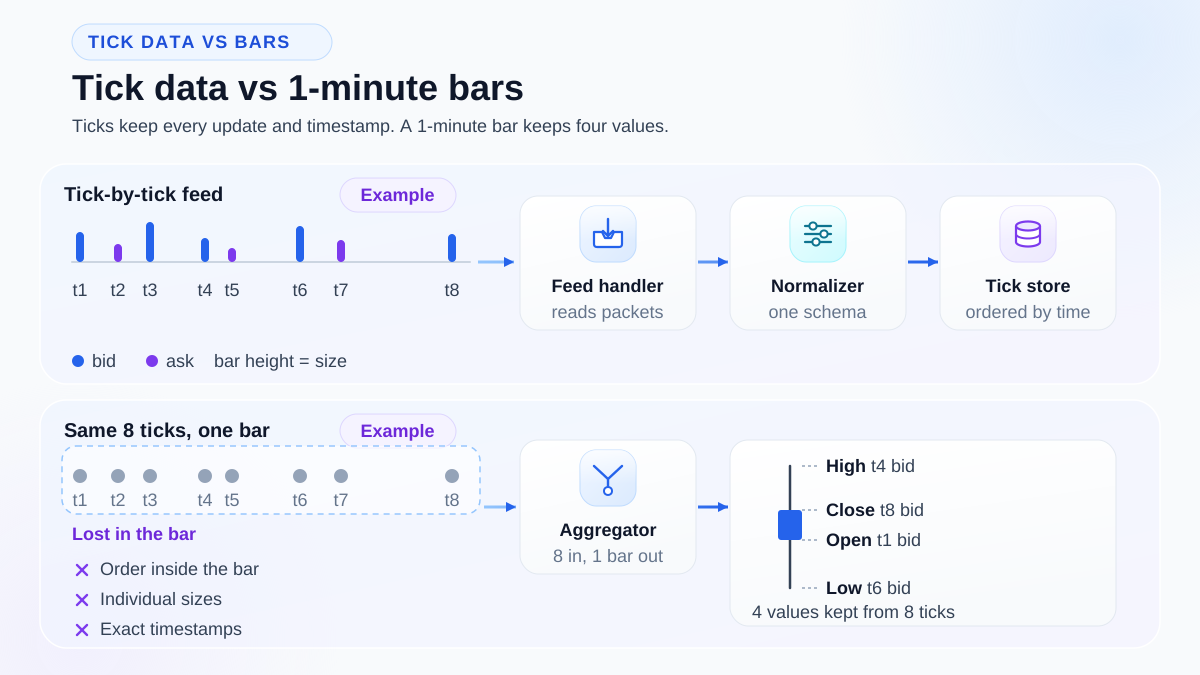
- Aggregated bars are smaller and cheaper to store, but they drop the sequence of updates inside each interval.
- Feed handlers must normalize symbols, detect sequence gaps and agree on a clock source before the data is usable.
- Vendor and exchange license terms set what you may store and share. Check them before you build an archive.
Tick by tick data defined: every quote and trade update
A tick is one update from a market data feed. Tick by tick data keeps all of them, not a summary of them.
A tick is one change reported by a market data feed: a new bid or ask, or a trade. Tick by tick data, also called tick-by-tick market data, is the full series of those changes for one or more instruments, each stored with a time. Nothing is averaged or dropped at capture, so the record shows what the feed reported and when.
MetaQuotes documents one concrete shape for a tick in MetaTrader 5. The MqlTick structure holds a time in seconds, a time in milliseconds, the bid, the ask, the last deal price, the volume, and flags showing which values changed. Every field is filled on every tick (MQL5 documentation, MqlTick, checked 9 November 2026).
Brokers and funds apply the same idea at a larger scale. A liquidity or exchange feed may add depth levels, order identifiers or venue codes, but the record still needs a stable instrument identifier, a timestamp and a position in the message sequence.
Quote ticks and trade ticks
Quote ticks describe the prices on offer. Trade ticks describe what executed. Analysts usually need both.
A quote tick reports a change in the displayed bid or ask, or in the size shown at those prices. It shows where a client could have traded and how the spread moved. On a busy instrument, quote updates can far outnumber trades, so most of the messages in a feed are quotes.
A trade tick reports an executed transaction: a price, a size and, where the venue supplies it, an aggressor side. It shows what traded, not what was offered. A trade tick alone cannot show the spread or the depth that existed before it.
Quote ticks support spread, depth and slippage studies. Trade ticks support volume profiles, fill checks and reconciliation against execution reports. Some feeds send only one type, so confirm which fields your vendor delivers before you design a schema.
Tick data and aggregated bar data compared
Aggregated bars trade detail for size. The right format depends on the question you need to answer.
| Feature | Tick-by-tick data | Aggregated bar data (OHLC bars) |
|---|---|---|
| Granularity | Every quote or trade update, each with its own timestamp | One record per fixed interval, such as one minute, holding open, high, low and close |
| Size | Large. Depends on feed activity, instrument count and fields kept | Small. One record per interval per instrument |
| Use cases | Execution analysis, microstructure, replay for backtests, feed-quality checks | Charting, trend work, long-horizon research and management reporting |
| What is lost | Nothing at capture, but the series is only as complete as the feed | Update order inside the interval, intrabar spread changes, short spikes and exact fill timing |
| Storage | Time-series storage, usually partitioned by instrument and day | Compact, and easy to hold in a standard relational or columnar table |
| Typical consumers | Execution quality, quant research, risk and surveillance, feed monitoring | Client charts, dashboards, management reports and simple strategy research |
Feed handling: normalization, sequence gaps, conflation and clocks
A raw feed is not ready for analysis. A feed handler turns each vendor format into one internal record and marks anything it cannot trust.
Normalization maps each source into one internal schema. The same instrument from two providers must resolve to one identifier, prices need consistent decimal places and tick sizes, and times need one unit. Keep the raw message beside the normalized record so a disputed value can be traced.
A sequence gap means one or more updates never arrived. The handler should flag it, mark the affected interval as incomplete and request recovery where the feed allows it. Recovery rules depend on the protocol and vendor. FIX, which the FIX Trading Community describes as the leading standard for real-time electronic trading, is one common source format (FIX Trading Community, checked 9 November 2026).
Conflation keeps only the latest value in each fixed window. It suits dashboards, low-frequency risk views and some reporting. It is not acceptable for execution analysis, slippage studies or any replay meant to reproduce the market, because it hides intermediate prices. Record the rule in the data dictionary.
Timestamps are useful only when clocks agree. Servers should synchronize to a trusted reference, usually over the Network Time Protocol. NTP passes time from primary servers through secondary layers, and accuracy falls with each step from the primary source (RFC 5905, checked 9 November 2026). Some regulated markets also set clock accuracy rules. In the EU, business-clock synchronization standards have sat in Commission Delegated Regulation (EU) 2025/1155 since 1 March 2026, replacing the earlier RTS 25, so confirm the requirement that applies to your firm from the official text.
Storage and replay for backtesting and transaction cost analysis
A tick archive is valuable only if it can be replayed the way the market delivered it.
Store ticks append-only, partitioned by instrument and day, with a checksum per file. Keep normalized fields, a reference to the raw message, the sequence status and the receive time. Retention should follow the data license and the firm's record-keeping policy.
A terminal is not an archive. MetaQuotes documents that MetaTrader 5 keeps the most recent 4,096 ticks per instrument in a fast cache, or 65,536 with Market Depth running. (MQL5 documentation, CopyTicks, checked 9 November 2026).
Replay should feed the same logic a live system uses, with the same timing rules, so no decision sees information it could not have had. Backtests that fill at the mid-price or ignore spreads tend to overstate results. Transaction cost analysis needs a benchmark taken from the tick record at the order time, with a documented window and a stale-quote rule.
Measuring latency with tick timestamps
Tick timestamps can show feed delay, but only when the clocks and measurement points are defined.
A tick can carry up to three times: the venue or provider time, the time your gateway received it, and the time your system processed it. Feed delay sits between the first two. Internal processing sits between the last two.
Measure at defined points, use synchronized clocks and report percentiles, not one average. The latency measurement guide covers test design and common mistakes. This page gives no latency figures for Orrnn or RTX5, because any figure depends on the path, hardware, feed and load under test.
Data licensing and rights
Feed and archive rights come from the vendor or exchange contract, not from the trading software.
Exchanges and data vendors license market data for stated uses. Terms often limit redistribution, display to clients and retention after a subscription ends. The terms for any specific feed are not stated here.
Before you build an archive, confirm in writing what the license allows for storage, internal research, client reporting and third-party sharing. A platform connection does not by itself grant data rights.
Limitations
This page defines the term and its engineering use. It is not legal, regulatory or investment advice. Tick data describes past market events and does not predict prices, and a clean archive does not make a strategy profitable.
The MetaTrader figures describe one platform's behavior when checked and may change in a later build. RTX5's market-data product is described on rtx5.orrnn.com and sits outside this definition.
Frequently asked questions
What is tick-by-tick data?
Tick-by-tick data is a complete, time-stamped record of each quote and trade update from a market data feed. Unlike a bar, it keeps the order and timing of each update inside a time interval. Brokers, funds and analysts use it for execution analysis, replay and feed-quality checks. A bar shows the range of a move, but not the path the price took.
What is the difference between quote ticks and trade ticks?
Quote ticks record changes in the bid, the ask and the displayed size, so they show where trading could have occurred. Trade ticks record executed transactions with their price and size. Quote ticks support spread and depth analysis, while trade ticks support volume and fill checks. Many feeds send both, but some send only one, so check the vendor's fields first.
Why do sequence gaps matter in tick data?
A sequence gap means updates were missed or have not yet arrived. If the handler does not detect it, the stored series looks complete but is not. A backtest or execution review built on that series can give false results. Flag the gap, mark the interval as incomplete, and recover from a snapshot or retransmission where the feed allows it.
Do I need synchronized clocks to use tick data?
For analysis that compares systems, yes. Timestamps from different servers compare reliably only when each clock is disciplined to a trusted reference, such as one supplied over NTP. NTP accuracy falls with each step from its primary sources. Store the venue time where supplied and your receive time, and document the clock source so any latency figure can be checked.
Primary sources and further reading
These sources support the definitions used on this page. They do not endorse Orrnn or establish that any product complies with the referenced material.
- MqlTick structure
MetaQuotes Ltd, MQL5 documentation
Tick fields, including time in seconds and time_msc in milliseconds. Cited for the tick structure example. Checked 9 November 2026.
- CopyTicks
MetaQuotes Ltd, MQL5 documentation
Tick history and terminal cache sizes. Cited for the cache limit example. Checked 9 November 2026.
- RFC 5905: Network Time Protocol Version 4
IETF, via the RFC Editor
Describes NTP and the decline in accuracy with each stratum. Cited for the clock point. Checked 9 November 2026.
- FIX Protocol
FIX Trading Community
Describes FIX as the leading standard for real-time electronic trading. Cited only to identify the standard. Checked 9 November 2026.
- Commission Delegated Regulation (EU) 2025/1155
EUR-Lex, Publications Office of the European Union
Sets regulatory technical standards that include the synchronisation of business clocks and repeals Delegated Regulation (EU) 2017/574 (RTS 25). In force when checked on 9 November 2026.
Related reading
How to Measure Latency to a Broker Server
Test design, measurement points and common errors when timing feed and order paths.
Read →Backtesting Bias, Data Quality, and Slippage: A Practical Checklist
Data quality checks, bias controls and slippage assumptions for replay and backtests.
Read →High Latency: Definition
What high latency means in trading, and how teams decide whether a delay matters.
Read →Order Book: Definition
The record of resting buy and sell orders, the depth view that quote ticks update.
Read →