Decision guide
How to Choose a Trading Platform Architecture Partner
How brokers and hedge funds choose a trading platform architecture partner: scope, test evidence, connectivity tests, data ownership, exit and conflicts.
Direct answer
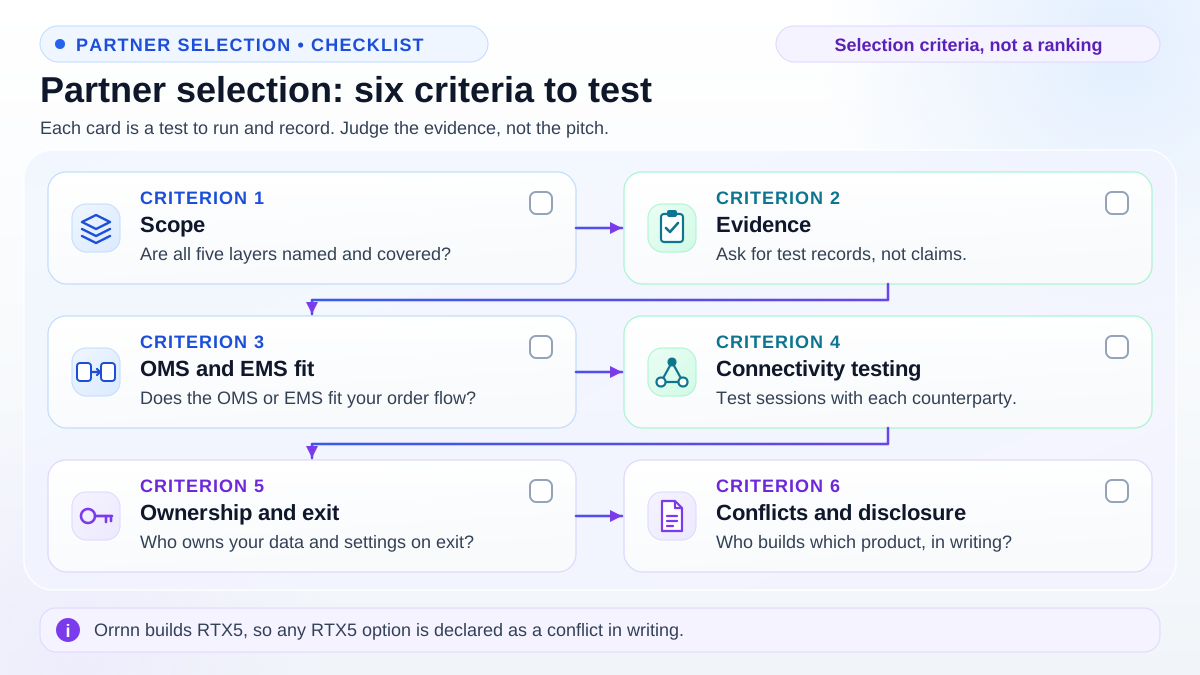
A broker or hedge fund should choose a trading platform architecture partner by the scope of work it covers, the evidence it provides, how it tests connectivity, who keeps the data and configuration, and how it discloses conflicts. The criteria below apply to every option, including Orrnn's own RTX5 platform.
Key takeaways
- Choose by scope, test evidence, connectivity testing, data ownership and conflict disclosure.
- Ask for test records and acceptance results on named builds, not diagrams or verbal assurances.
- Mark each of the five layers as in scope, out of scope or shared, with a named owner.
- Require written disclosure of any product a firm builds, sells or resells, and of any recommendation involving it.
- Orrnn builds RTX5, and the same criteria apply to it. Check each module against its published status.
What a trading platform architecture partner must cover
A trading platform architecture partner designs, assesses or integrates the systems that take an order from entry to confirmation, plus the connections and hosting around them. For a broker, that means the order path, pre-trade risk checks, market data, liquidity links and back-office feeds. A hedge fund should also ask about allocation, mandate limits and reconciliation with administrators and custodians. A firm that says it designs trading platform architecture for forex brokers and hedge funds should be judged on the work and the evidence, not the label.
Six criteria for choosing a trading platform architecture partner
| Criterion | Question to ask | Evidence to request | Red flag |
|---|---|---|---|
| Scope | Which of the five layers does the work cover? | Written scope with a named owner for each layer | One diagram with no owners |
| Evidence | What was tested on this build, and who signed it off? | Test records, acceptance results and open defects | Diagrams or verbal assurances instead of results |
| OMS and EMS fit | Where does the order record end and routing begin? | Interface specification and a demonstration on your order flow | An undefined boundary |
| Connectivity testing | How is each counterparty session tested before live use? | Per-session scripts and results, with protocol version and dialect | A protocol name offered as proof |
| Ownership and exit | Who holds the data, configuration and source access? | Sample exports, source-access terms and a migration plan | Exports only through paid services |
| Conflicts and disclosure | Which products does the firm build, sell or resell? | Written disclosure of interests, with each recommendation labeled | Recommendations of own products with no disclosure |
Scope: which of the five layers the work covers
The trading infrastructure glossary entry on this site splits the stack into five layers: matching, market data, risk, connectivity, and hosting and disaster recovery. That split is this site's own framing, not an industry standard. Ask each firm to mark every layer as in scope, out of scope or shared, and to name an owner for each. A firm that offers hosting but says nothing about risk checks has not answered the scope question. Write the scope as components and interfaces, stating what the firm delivers, what you deliver and what a third party supplies.
Evidence: ask for test records, not diagrams
A diagram shows intent. A test record shows behavior on a named build, with the inputs, expected and actual results, and the sign-off owner. Ask which build each result came from, because a result from another version or counterparty does not transfer. Where a US broker-dealer has market access, SEC Rule 15c3-5 requires controls reasonably designed to prevent the entry of orders that exceed appropriate pre-set credit or capital thresholds, or that appear to be erroneous. Ask for the test cases behind those controls, and have counsel confirm which rules apply to you.
OMS and EMS fit
ESMA's 2023 report on the trading venue perimeter, recalling its consultation paper, refers to an OMS as an inward-looking tool that automates order submission and follows the order lifecycle, and to an EMS as a tool that shows liquidity and prices across venues and sends orders to the chosen ones. It also says systems combining OMS and EMS features appear to be becoming more common. The report's subject is when systems should be considered multilateral and seek authorization as trading venues, so use it for the descriptions only. Ask the firm to write the boundary: which system owns order state, routing and allocation, and what each one sends to the other. Test a partial fill, a rejection and a late cancel.
Connectivity: test each session before live use
A protocol name does not prove compatibility. The FIX Trading Community describes the FIX Protocol as a global, open standard. Ask each firm which FIX version, dialect and custom tags it supports on each session, and how it handles resend and sequence recovery. Ask for a test script and result for each session, a test run against your actual counterparties, and a recovery record for a dropped session. Confirm which connections are built and which remain roadmap items.
Ownership of data, configuration and exit
Ask who holds your order and trade history, reference data, client records, logs and configuration, and in what formats each can be exported without professional services. Ask who holds source access and deployment keys, and whether you can keep running the system if the contract ends. Plan the exit before signing: the export, cutover steps, rehearsal dates and fallback. A firm that charges for each extract has already told you what leaving will cost.
Conflicts and disclosure
A firm that builds a platform may recommend its own platform. That is not wrong in itself, but it changes how the advice should be read. Ask each firm to state which products it builds, sells or resells, whether it earns a fee or margin on the option it recommends, and which options it considered and rejected. Require that disclosure in writing, with any recommendation involving its own products labeled as such, and keep it with the proposal file.
Questions to put to any firm
Put these in writing before the first demonstration, and ask for test records wherever a question asks for evidence.
Checklist
- Which of the five layers does your work cover, and which must we supply?
- Which tests have you run on this build, with results and dates?
- Which counterparty sessions have you certified, on which protocol version and dialect?
- Can you show the boundary between the order record and routing, using our order types?
- Who holds our data, configuration and source access, and how do we export all of it?
- What does our exit look like, including the cutover rehearsal and the fallback?
- Which products do you build, sell or resell, and will you disclose any interest in writing?
- Which options did you reject, and on which criteria?
Disclosure: who publishes this guide
Orrnn publishes this guide. It builds and sells RTX5, its own trading platform, so it is one of the firms the criteria apply to, and the same six criteria apply to RTX5. Status, from the RTX5 roadmap checked on 10 November 2026: its Preview group includes the Desktop Trading Terminal, CRM, Bridge / Gateway and FIX 4.4 / 5.0, and its Planned group includes the Web Trading Terminal, Mobile Trading and the REST & WebSocket API. The roadmap marks every module in both groups as build not published. It says Planned describes intended scope and Preview communicates an early demonstration or concept.
On the conflict questions above, this page does not state whether Orrnn resells other firms' products, what fee or margin it earns on any recommendation, or which options it has considered and rejected. Ask for all three in writing, as you would of any firm. This page gives no engagement examples.
Orrnn does not supply liquidity, is not a broker and does not hold licenses. It does not give investment, legal, tax or regulatory advice. Launch and licensing inquiries go to FxTrusts, a separate company.
Limits of these criteria and where to look next
These criteria are not a ranking of firms, and they do not replace legal, regulatory, tax or procurement advice. This page is not an offer of services or software. Test results from one deployment do not predict another, and nothing here promises a performance or business outcome. For advisory scope, see the trading technology consulting service. For a structured request, use the white-label RFP guide, and for side-by-side options, the comparison framework in the broker guides.
Frequently asked questions
Do I need an architecture partner or a platform vendor?
Choose an architecture partner when you need design, assessment and integration work across several systems. Choose a vendor when a finished product fits your requirements and you can work within its configuration limits. You may need both. Write down which layers each party covers and who owns the join between them. Use the same six criteria for either choice.
What evidence should a firm show?
Ask for test records and acceptance results from named builds, showing inputs, expected and actual results, defects, dates and the sign-off owner. Ask for a live demonstration on your own order types in a test environment connected to your counterparties. Diagrams and verbal assurances show intent, so treat them as supporting material only.
Should I ask a firm to name its competitors?
Ask which options the firm considered and why it rejected the ones it did not recommend. The criteria and evidence behind a rejection are more useful than a list of names. A firm that will not explain its shortlist cannot show that its recommendation followed from your requirements. Ask for the answer in writing.
What if the firm builds the platform it recommends?
That alone is not a reason to refuse. It is a reason to require written disclosure of the interest, a comparison that includes options the firm does not sell, and test records for each claim. For Orrnn, the RTX5 roadmap groups modules under Preview or Planned and marks each as build not published, and the same criteria apply to them.
Primary sources and further reading
These sources support the frameworks and definitions used in this guide. They do not endorse Orrnn or establish that any product complies with the referenced material.
- Small Entity Compliance Guide: Rule 15c3-5
U.S. Securities and Exchange Commission
Risk controls for broker-dealers with market access, including pre-set credit or capital thresholds and erroneous orders. Rule adopted 3 November 2010. Checked 10 November 2026.
- Final Report on ESMA's Opinion on the Trading Venue Perimeter
European Securities and Markets Authority
Section 5.1.2, paragraphs 83 to 87, on OMS and EMS, and the introduction for the report's subject. The cover reference is ESMA70-156-6360, dated 2 February 2023; the file name on ESMA's site carries 6383. Used for the OMS and EMS descriptions only. Checked 10 November 2026.
- FIX Protocol
FIX Trading Community
Describes the FIX Protocol as a global, open standard, developed and maintained by the FIX Trading Community. Checked 10 November 2026.
- RTX5 Roadmap
Orrnn Traders, RTX5 product site
Orrnn's own status record for RTX5 modules. Groups modules under Preview or Planned and marks each as build not published. Checked 10 November 2026.
Related reading
Trading Infrastructure: A Layer-by-Layer Definition
The five layers used in the scope criterion, with what to test in each.
Read →OMS vs EMS for Brokers
Which functions belong to the order record and which to execution.
Read →Trading Technology Consulting
Advisory scope for architecture assessment and platform decisions.
Read →White-Label Trading Platform Buyer and RFP Guide
How to structure an evidence-led request for proposal for a white-label platform.
Read →Trading Platform Comparison Framework: cTrader vs MT5
A side-by-side comparison structure, worked through for cTrader and MT5.
Read →Broker Platform Migration Checklist
Discovery, rehearsal, cutover and rollback steps for the exit criterion.
Read →