Decision guide
OMS vs EMS for Brokers: Which System Does What
OMS vs EMS for brokers: what each system does, where they overlap, which functions to compare, and the questions to settle before you choose one.
Direct answer
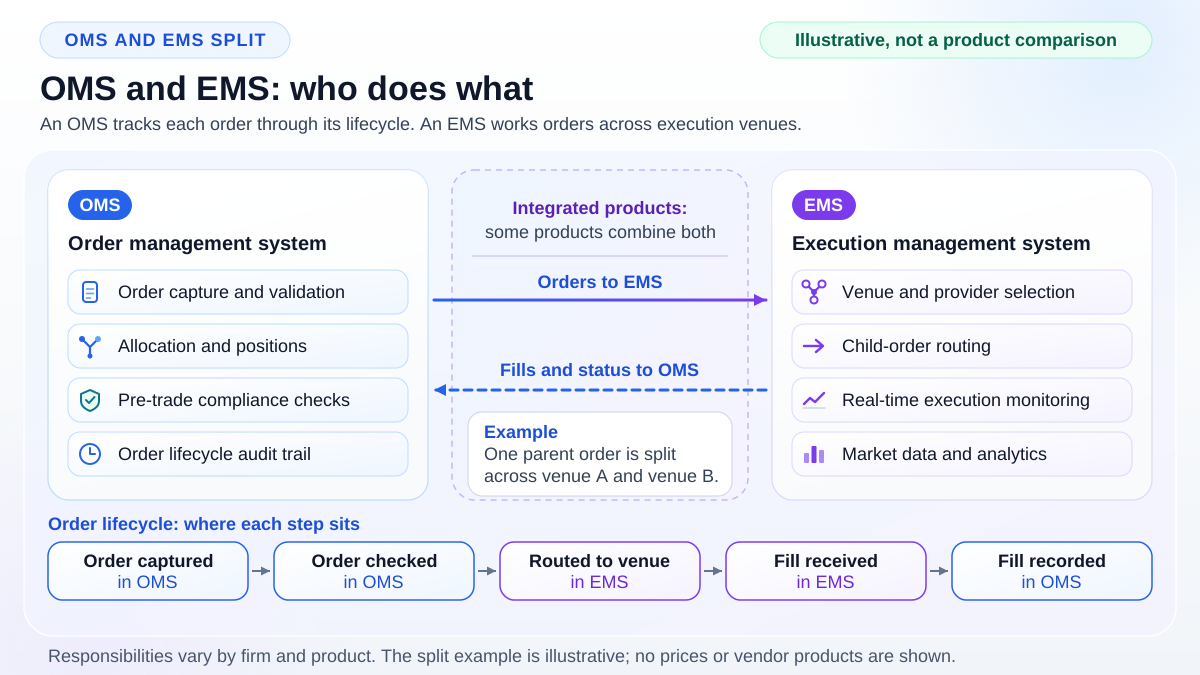
An OMS manages the lifecycle and records of orders; an EMS manages how orders are executed across venues and liquidity providers. ESMA describes both in its 2023 report on the trading venue perimeter and says systems that combine them appear to be becoming more common, so choose by function.
Key takeaways
- An OMS holds the record of each order. An EMS works the order in the market. Both must agree on order state.
- ESMA's 2023 report describes both systems and says integrated systems appear to be becoming more common.
- Compare the systems function by function, then test an integrated product one function at a time.
- Record-keeping and pre-trade checks need an owner, a log and a test, whichever layer runs them.
- Orrnn advises on selection and builds RTX5, so any RTX5 recommendation is disclosed with its status.
OMS vs EMS: what each system is responsible for
OMS vs EMS is a question about jobs. The regulatory description used here is in ESMA, Final Report on ESMA's Opinion on the Trading Venue Perimeter, 2 February 2023, section 5.1.2. The report gives guidance on when systems should be considered multilateral and seek authorization as trading venues. This guide uses the report's descriptions of the two systems and repeats its views on authorization as ESMA's views. The guide gives no view of its own on authorization. Paragraph 83 says a significant number of market participants use proprietary or third-party systems, such as an OMS and an EMS, that are intended to let firms manage their orders more efficiently. Paragraph 85 recalls the view ESMA took in its consultation paper: an OMS built to automate order submission, structure the order flow and follow each order's lifecycle is an inward-looking tool, and should not be considered a multilateral system as long as it does not bring together, or allow the interaction of, multiple third-party buying and selling interests.
Paragraph 86 describes an EMS as more tilted towards managing orders across multiple execution venues, offering traders real-time market data and analytics. Paragraph 87 recalls the consultation paper's view that an EMS gives an overview of liquidity and prices on various venues and sends orders to the preferred venue or venues. It adds that an EMS which supports execution on trading venues, and does not allow multiple third-party buying and selling interests to interact, should not be considered a multilateral system. Paragraph 88 notes that an EMS may show specific features, function in a similar way to the trading systems that trading venues operate, and so require authorization. The report's conclusion, in paragraphs 100 to 103, says an EMS that purely supports routing orders, without a third party prescribing the rules for the interaction, should not be considered a multilateral system. It says systems with additional features and complexity that allow multiple third-party buying and selling interests to interact, and so combine all four criteria of a multilateral system, should be required to seek authorization. Paragraph 102 says an EMS that lets firms gather multiple quotes from multiple sources, where those trading interests can interact with other trading interests in the system, could, depending on the specifics, be considered a multilateral system. It adds that where a software vendor has embedded rules that govern that interaction and does not let firms set their own, the vendor would be operating a multilateral system. Paragraph 103 adds that how a system functions decides whether it falls within the definition of a multilateral system, not how the system classifies itself.
In plain terms, and in this guide's own words rather than ESMA's, the OMS holds the record of an order: how it was created, validated, changed, allocated and audited. The EMS works the order in the market: which venues and liquidity providers it reaches, how it is split, and how fills come back. Anyone comparing an order management system vs execution management system should start from those two jobs.
Function-by-function comparison
The table is this guide's own practitioner framing, not ESMA's definitions and not the features of a named product. Where a row says usually, the split varies between firms.
Typical roles of an OMS and an EMS, with what to check when buying
| Function | OMS | EMS | What to check when buying |
|---|---|---|---|
| Order capture and validation | Receives orders; checks account and instrument rules | Receives parent orders from the OMS or a front end | Where each check runs; one log of rejections |
| Allocation and positions | Splits fills across accounts; keeps positions | Reports execution fills; allocation usually stays in the OMS | Which system is the allocation record |
| Pre-trade compliance checks | Account, limit and instrument rules | Venue-level limits, if the EMS holds them | Which checks can stop an order; where the stop is logged |
| Order lifecycle audit trail | Each state change, amendment and cancellation | Child orders, routes and venue responses | A shared order identifier across both trails |
| Venue and provider selection | Usually not its job | Chooses venues or providers by liquidity and price | Connected venues; who sets the selection rules |
| Child-order routing | Usually passes the order to execution | Splits parent orders, routes children, revises the plan | Partial fills, rejects and cancel-replace across both layers |
| Real-time execution monitoring | Order status and exceptions | Fills, rejects and venue activity as they happen | The same status for traders and operations |
| Market data and analytics | Order, position and cost values | Prices and liquidity across venues, with analytics | Data source, license terms and feed-loss behavior |
| FIX or API connectivity | Back-office, risk and counterparty reports | Venue and provider links, usually FIX or an API | Protocol version, custom fields and interface owner |
Where the two systems overlap
ESMA's report says systems that integrate OMS and EMS features appear to be becoming more common (paragraph 84). The real question is which functions stay in one record and which pass to another system.
The risk sits at the seam: duplicate records that disagree, or a step that each system assumes the other owns. An integrated product can remove the seam, but it can also hide it. Test each function separately, using the same order flow:
- Capture: send valid and invalid orders; confirm each rejection is logged once.
- Allocation: split a partial fill across two accounts and check positions against the record.
- Pre-trade checks: breach a limit and confirm the stop and its reason are logged.
- Audit trail: trace one order from capture to final fill and export every event.
- Routing: change a rule and confirm which venue receives each child order.
- Connectivity: test each counterparty's FIX version and custom fields in a test environment.
Broker decision criteria before choosing
Answer these questions in writing before comparing products.
Checklist
- Which functions in the table are needed on day one, and which can wait?
- Who owns configuration, rules, incidents and the vendor relationship, at the broker and at the supplier?
- Which liquidity providers and venues must the system reach, over which protocol and version?
- Which records must be kept, for how long and in what format, as confirmed by counsel?
- Who can change limits, routing and allocation rules, and how are those changes approved and logged?
- If the system fails mid-session, how are orders recovered and uncertain orders resolved?
- How would records and configuration leave the system if the supplier changes?
Record-keeping and pre-trade controls: where they sit
In the United States, FINRA Rule 4511 requires members to make and preserve the books and records that FINRA rules and the Exchange Act require. For FINRA books and records with no period set by FINRA or Exchange Act rules, the minimum retention is six years.
For broker-dealers with market access, SEC Rule 15c3-5 requires risk management controls that are reasonably designed to systematically limit the firm's financial exposure and to prevent the entry of orders that exceed appropriate pre-set credit or capital thresholds or appear to be erroneous. The SEC's compliance guide says the broker-dealer must have direct and exclusive control of its financial and regulatory risk management controls and supervisory procedures, with a limited exception that lets certain regulatory controls be allocated to a customer that is a registered broker-dealer.
So the question is not only which layer runs a check. Decide which record proves it ran, where it is kept and who can change its settings.
Connectivity to liquidity providers and back offices
The FIX Trading Community describes the FIX Protocol as a global, open standard, which it develops and maintains. A shared protocol name does not prove two systems behave alike, so confirm versions, message sets and custom fields one connection at a time.
Decide where each connection ends. That choice decides who sees a reject first and who resends it.
How Orrnn advises on OMS and EMS selection
Orrnn advises brokers on OMS and EMS selection. This page gives no engagement examples, client names or results. Orrnn's wider advisory scope is set out on the trading technology consulting page, and each engagement is scoped in a written proposal. Engineering delivery is a separate engagement.
Orrnn builds RTX5, its own trading platform. Any proposal that recommends RTX5 must say so, and this page does not describe RTX5 as an OMS or an EMS. The RTX5 roadmap, checked on 10 November 2026, marks every module it lists as build not published. The architecture partner guide names the roadmap's two groups and some of their modules in its disclosure section.
Orrnn is not a broker or a liquidity provider, and it holds no licenses. It gives no investment, legal, tax or regulatory advice, and it refers launch and licensing questions to FxTrusts, a separate company. The trading infrastructure glossary entry on this site splits the wider stack into five layers: matching, market data, risk, connectivity, and hosting and disaster recovery. That split is this site's own framing, not an industry standard. Read this section as the view of a company that builds a platform and also advises on selecting one.
Limitations and risk notes
This page is general information, not legal, regulatory, tax or investment advice. It does not rank or endorse any OMS or EMS product. Regulatory treatment depends on the activity, the legal entity and the jurisdiction, so counsel and compliance should review any design.
A product may split the functions differently from the table. Nothing here promises trading results, speed or performance. A system meets a requirement only after it passes tests on your own flows, and integration does not remove the firm's duty for its controls and records.
Frequently asked questions
Does a broker need both an OMS and an EMS?
Not always. A broker needs an accurate, controlled and auditable order record, which is the OMS job. It needs an execution layer when it works orders across several venues or providers, or uses routing rules and algorithms. A simple flow to one counterparty may need less.
Can one product do both?
Yes. ESMA's report recalls its consultation-paper view that the complexity of OMS and EMS systems varies considerably from firm to firm, and says systems integrating both sets of features appear to be becoming more common. One product can hold both the order record and the execution logic. Check each function against the documented scope, then test the seams with your own order flow.
Is an EMS needed for FX and CFD order flow?
For FX and CFD flow, it depends on the execution model. An EMS suits a broker that routes orders to several liquidity providers, manages child orders, or monitors fills across counterparties in real time. Decide from your counterparties, records and controls. This is a criterion, not a recommendation, and a broker that handles all flow in-house may need a different set of functions.
What should a broker test before choosing?
Trace one complete order from capture to final fill, including a rejection, a partial fill, an amendment and a cancellation. Confirm each function has one owner and one record. Test each counterparty connection, the audit export, recovery of uncertain orders after a restart, and the change log for limits and routing.
Is an OMS the same as a trading platform?
Not necessarily, so test the product rather than its name. Ask whether it is a client front end, an order record, or both, then compare its function list with the OMS column in the comparison table. A trading platform may include order management functions, so the function list decides the question.
Primary sources and further reading
These sources support the frameworks and definitions used in this guide. They do not endorse Orrnn or establish that any product complies with the referenced material.
- Final Report on ESMA's Opinion on the Trading Venue Perimeter
European Securities and Markets Authority
Cited for paragraphs 83 to 88 and 100 to 103 in section 5.1.2 on OMS and EMS, and for the report's subject as stated in its introduction. The cover reference is ESMA70-156-6360, dated 2 February 2023; the file name on ESMA's site carries 6383. Checked 10 November 2026.
- FINRA Rule 4511 (General Requirements)
Financial Industry Regulatory Authority
Cited for the general books-and-records requirement and the six-year minimum for FINRA records with no period set elsewhere. Checked 10 November 2026.
- Small Entity Compliance Guide: Rule 15c3-5
U.S. Securities and Exchange Commission
Cited for the risk management controls required of broker-dealers with market access and the direct and exclusive control requirement. Checked 10 November 2026.
- FIX Protocol
FIX Trading Community
Describes the FIX Protocol as a global, open standard, developed and maintained by the FIX Trading Community. Checked 10 November 2026.
- RTX5 Roadmap
Orrnn Traders, RTX5 product site
Orrnn's own status record for RTX5 modules. Groups modules under Preview or Planned and marks each as build not published. Checked 10 November 2026.
Related reading
Order management system for brokers
The OMS record in depth: functions, buyer criteria and audit evidence.
Read →Execution management system (EMS)
Definition and buyer criteria for the order-working layer.
Read →WebSocket vs REST vs FIX: Which Trading API to Use
How the interface type changes connectivity and order handling.
Read →How to choose a trading platform architecture partner
Selection criteria, with the RTX5 roadmap status in its disclosure section.
Read →Trading technology consulting
The scope of Orrnn's advisory work on platform and system selection.
Read →Trading infrastructure
The five layers of trading infrastructure and what to test in each.
Read →