Decision guide
What Is Algorithmic Trading? Definition, Types and Infrastructure
Algorithmic trading defined under MiFID II, the main types including high-frequency trading, the infrastructure it needs and the controls that apply.
Direct answer
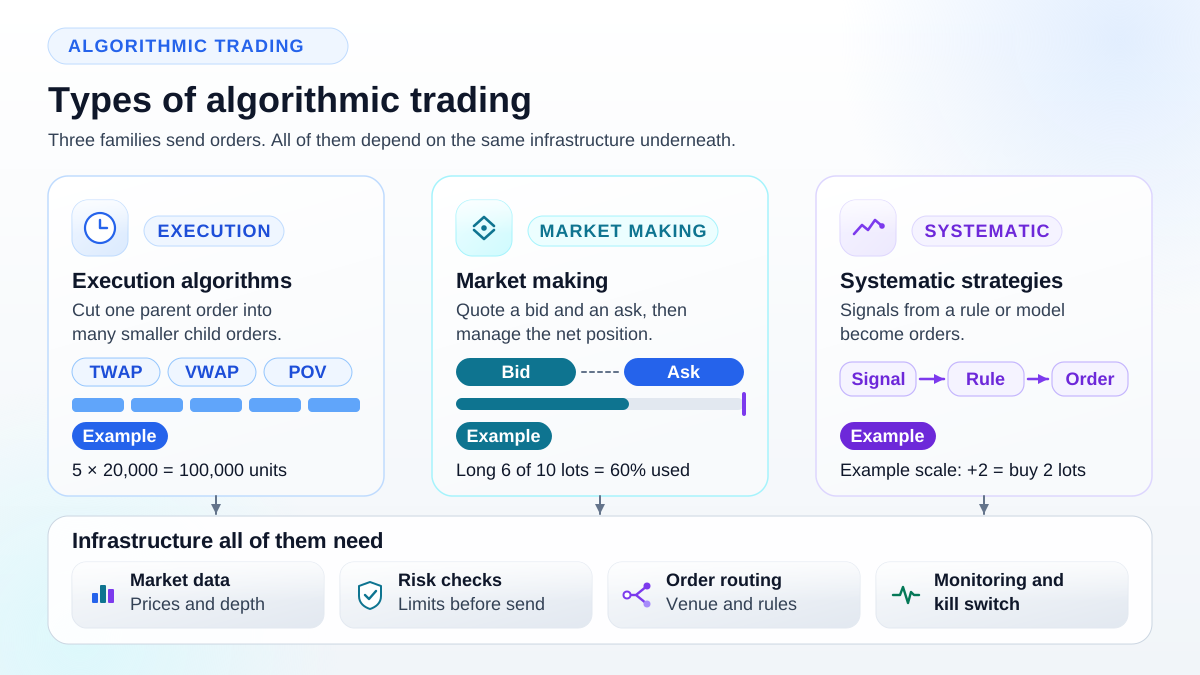
Algorithmic trading is trading in financial instruments where a computer algorithm automatically sets order parameters, such as timing, price or quantity, with limited or no human intervention. MiFID II uses this definition in the EU and excludes systems that only route orders to venues. The term covers execution algorithms, market making, systematic strategies and high-frequency techniques.
Key takeaways
- Algorithmic trading means a computer sets order parameters automatically, with limited or no human intervention, under the MiFID II wording.
- The common types are execution algorithms, market making, systematic statistical strategies and high-frequency techniques. Each has a different goal and risk.
- High-frequency trading is a subset, defined by low-latency infrastructure, system-determined orders and high intraday message rates.
- A working system needs clean data, tested logic, pre-trade risk limits, monitoring and a tested kill switch.
- Backtests can overstate results, and automated services can cause losses before a user notices them.
- This guide is educational. It does not give investment, legal or regulatory advice, and it does not promise any return.
Definition under MiFID II and U.S. usage
Algo trading is the short form of the same term. The clearest legal definition comes from the EU. MiFID II describes algorithmic trading as trading in financial instruments where a computer algorithm automatically determines individual order parameters, such as whether to initiate an order, its timing, price or quantity, or how to manage it after submission. Human intervention is limited or absent. The definition excludes any system used only to route orders to one or more trading venues, and systems used only to confirm orders or process them after execution.
U.S. rules do not use one matching definition. The market access rule, Exchange Act Rule 15c3-5, is about controls rather than strategy types. It requires broker-dealers with market access to establish, document and maintain risk management controls and supervisory procedures. Check the rules that apply to the firm or person involved.
Types of algorithmic trading at a glance
The table groups the common types by goal, typical user and key risk.
The descriptions are conceptual and do not rank the types. Real strategies often combine several, so ask which goal and failure mode apply to a given system.
Common types of algorithmic trading (typical, not exhaustive)
| Type | Main goal | Typical user | Key risk |
|---|---|---|---|
| Execution algorithms | Fill a large parent order over time with less market impact than one order would cause | Asset managers, brokers handling client flow, corporate treasuries | Poor timing, information leakage and slippage against the benchmark |
| Market making | Quote both sides of a market and earn the spread while managing inventory | Market makers, liquidity providers and some broker desks | Inventory build-up and adverse selection when prices move against quotes |
| Statistical arbitrage and systematic strategies | Trade relationships in prices or spreads that the data suggests recur | Hedge funds, proprietary firms and quantitative traders | Overfitting, regime change and crowding into the same signal |
| High-frequency trading (a subset) | Act on very short-lived price or spread opportunities at high message rates | Specialist proprietary firms and market makers | Technology failure, competition on speed and regulatory scrutiny |
High-frequency trading as a subset
High-frequency trading is a narrower category than algorithmic trading. The MiFID II definition of a high-frequency algorithmic trading technique lists three characteristics. The first is infrastructure intended to minimize network and other latencies, such as co-location, nearby hosting or fast direct market access. The second is system determination of order initiation, generation, routing or execution without human intervention. The third is high intraday message rates made up of orders, quotes or cancellations.
Speed alone does not decide the question. A firm where a person approves each order is not high-frequency under this definition, while a slow automated system can still be algorithmic trading. Many retail algorithms are not built to compete on speed.
How an algorithm turns a signal into orders
Most algorithmic systems follow the same chain. Data arrives, a rule or model decides whether to act, a sizing step sets the quantity, checks confirm the order is within limits, and an execution layer sends it to a venue or liquidity provider. The system then tracks fills and rejects until the trade is closed or cancelled.
- Input: market data and account state, with timestamps recorded at each step
- Signal: a rule or model that proposes a trade, such as a moving-average crossover or an inventory target
- Sizing and parameters: quantity, price limit, time horizon and stop rules
- Pre-trade checks: limits on order size, notional value, position and order rate
- Execution: venue or provider choice, order type and any slicing into child orders
- Post-trade: fill reconciliation, position update and performance logging
Worked example: splitting a parent order
Example: a rule wants to buy 100,000 units of a currency pair. The execution layer splits the order into 5 child orders of 20,000 units each, and 5 × 20,000 = 100,000 units. Suppose a pre-trade limit caps any single order at 25,000 units. Each child order passes that check, but a single 100,000-unit order would be rejected. The system should log which check applied.
Infrastructure requirements for a working system
Each item below can fail on its own, so test each one before live trading.
Checklist
- Data: clean historical and live feeds, with a known source and timestamp for each symbol
- Backtesting and validation: a test environment that models costs, delays and partial fills, as set out in the backtesting guide
- Pre-trade risk controls: limits on order size, exposure and order rate, applied before any order leaves the firm
- Execution connectivity: FIX sessions or APIs with tested reconnection and duplicate-order handling
- Monitoring: alerts for latency, rejects, fill quality, positions and feed health
- Kill switch: a tested way to halt new orders by strategy, account or the whole system
- Hosting: a stable environment sized for the strategy's CPU, memory and network needs
Regulation and controls to check
In the EU, MiFID II Article 17 requires an investment firm that engages in algorithmic trading to have effective systems and risk controls. ESMA's MiFID II rulebook lists the technical standards made under Article 17, including RTS 6, which sets detailed organizational requirements. Scope depends on the firm and the activity, so it needs professional assessment.
In the U.S., Rule 15c3-5 requires broker-dealers with market access to maintain pre-trade controls. Those controls include blocking orders that would breach preset credit or capital limits, or that look erroneous. Other regions have their own requirements, so map each obligation to a named control and take local legal advice.
Risks and limitations
Algorithmic trading does not promise profits, and its common failures are predictable. Overfitting comes first. A strategy can look strong on past data because it was tuned to noise. An arXiv preprint that tests several published autonomous trading strategies, many in FX, finds that many perform very poorly on unseen data, which is why out-of-sample testing matters.
Technology failure comes second. A bug, a stale feed, a dropped session or a runaway loop can send many orders in seconds. Market impact and slippage come third. A large order moves the price, and a backtest that ignores this overstates results.
Regulators warn retail users too. FINRA's investor page on auto-trading says a user may incur significant losses before realizing that transactions were placed. It warns against vague or unverified past-return claims and treats guarantees of performance as a red flag.
Scope of this guide
This guide explains terms, types and controls. It is not investment, legal or regulatory advice, and nothing in it recommends a strategy, product or trade. Orrnn builds the RTX5 trading platform and provides engineering services, so it has a commercial interest in this subject. Readers planning a live system should take advice from qualified professionals in their own jurisdiction.
Frequently asked questions
Is algo trading the same as algorithmic trading?
Yes. Algo trading is the informal short form of algorithmic trading, and both describe trading in which a computer algorithm sets order parameters with limited or no human intervention. The short form is common in retail marketing, where it can also describe automated tools that have no regulated status. Check who provides a service before relying on it.
Is high-frequency trading the same as algorithmic trading?
No. High-frequency trading is a subset. Under MiFID II, it is an algorithmic technique that also uses low-latency infrastructure, system-determined orders and high intraday message rates. Much algorithmic trading is slower, such as execution algorithms that spread a large order across a session.
Does algorithmic trading guarantee profits?
No. An algorithm carries out rules, and the rules may be wrong for the market they face. Backtests can overstate results because of overfitting, omitted costs and data errors. Regulators warn that automated services can cause losses, and that guarantees of performance are a warning sign.
What infrastructure does a retail trader need for algorithmic trading?
Most retail traders need a platform with reliable order handling, historical data, a way to test rules and firm limits on order size and loss. Keep the setup simple, log what it does and make sure you can stop it manually.
Which rules apply to algorithmic trading in the EU and the U.S.?
In the EU, MiFID II Article 17 and its technical standards set requirements for investment firms that engage in algorithmic trading, and scope depends on the firm and the activity. In the U.S., Rule 15c3-5 requires broker-dealers with market access to maintain pre-trade risk controls. Neither applies to every individual user, so check your position with a qualified adviser.
Primary sources and further reading
These sources support the frameworks and definitions used in this guide. They do not endorse Orrnn or establish that any product complies with the referenced material.
- Article 4 Definitions (MiFID II)
European Securities and Markets Authority (ESMA)
MiFID II definitions of algorithmic trading (Article 4(1)(39)) and of the high-frequency algorithmic trading technique (Article 4(1)(40)).
- Interactive Single Rulebook: MiFID II
European Securities and Markets Authority (ESMA)
Lists Article 17 on algorithmic trading and the technical standards linked to it. Scope needs professional review.
- Small Entity Compliance Guide: Rule 15c3-5, Risk Management Controls for Brokers or Dealers with Market Access
U.S. Securities and Exchange Commission
Explains pre-trade controls on credit, capital and erroneous orders for broker-dealers with market access. Applies only within its scope.
- Know the Risks of Auto-Trading Services Offered by Unregistered Entities
FINRA Investor Insights
Retail investor warning dated 29 July 2025 on losses that users may incur before they notice, vague or unverified past-return claims, and guarantees of performance as a red flag.
- Is it a great Autonomous FX Trading Strategy or you are just fooling yourself
arXiv preprint (Bernardini and de Castro, 2021)
arXiv preprint that tests several published autonomous trading strategies, many in FX, and finds that many perform very poorly on unseen data.
Related reading
Backtesting bias and slippage
Data quality, overfitting, costs and a validation checklist before trusting a backtest.
Read →Pre-trade risk checks and latency
Where order limits sit in the execution path and what they cost in time.
Read →Trading bot VPS sizing
CPU, memory, network and monitoring planning for an automated trading environment.
Read →What Is an Institutional Trading Platform?
The OMS, EMS, risk and FIX layers an institutional platform needs.
Read →Algorithmic trading engineering
Orrnn's engineering work on algorithmic systems. This is a service page, not a definition.
Read →