Glossary term
Trading Middleware: Role in Gateways, Bridges and Order Flow
Trading middleware meaning: the software layer that translates, routes and normalizes order flow between platforms and counterparties. See its layers and tests.
Definition
In trading, trading middleware means the software layer between order-entry systems and the venues or counterparties they trade with. It translates protocols, routes orders, normalizes prices and symbols, manages sessions and buffers traffic. Generic IT middleware connects business applications; this term carries market duties.
Also known as: trading middleware, trading middleware software, order flow middleware, middleware in trading
Key takeaways
- In trading, trading middleware is the layer that carries orders and replies between platforms and counterparties.
- Its core jobs are protocol translation, routing, normalization, symbol mapping, session management and buffering.
- Gateways, FIX engines, bridges, adapters and message buses are separate components, often sold as one package.
- Session drops, sequence gaps, mapping errors and back-pressure are the failures to test before go-live.
- Orrnn builds RTX5. Its liquidity bridge and FIX 4.4 and 5.0 modules have no published build, so do not treat them as available.
Trading middleware defined for order flow
The layer sits between systems that create orders and the systems that accept them, and it must follow market rules as well as software rules.
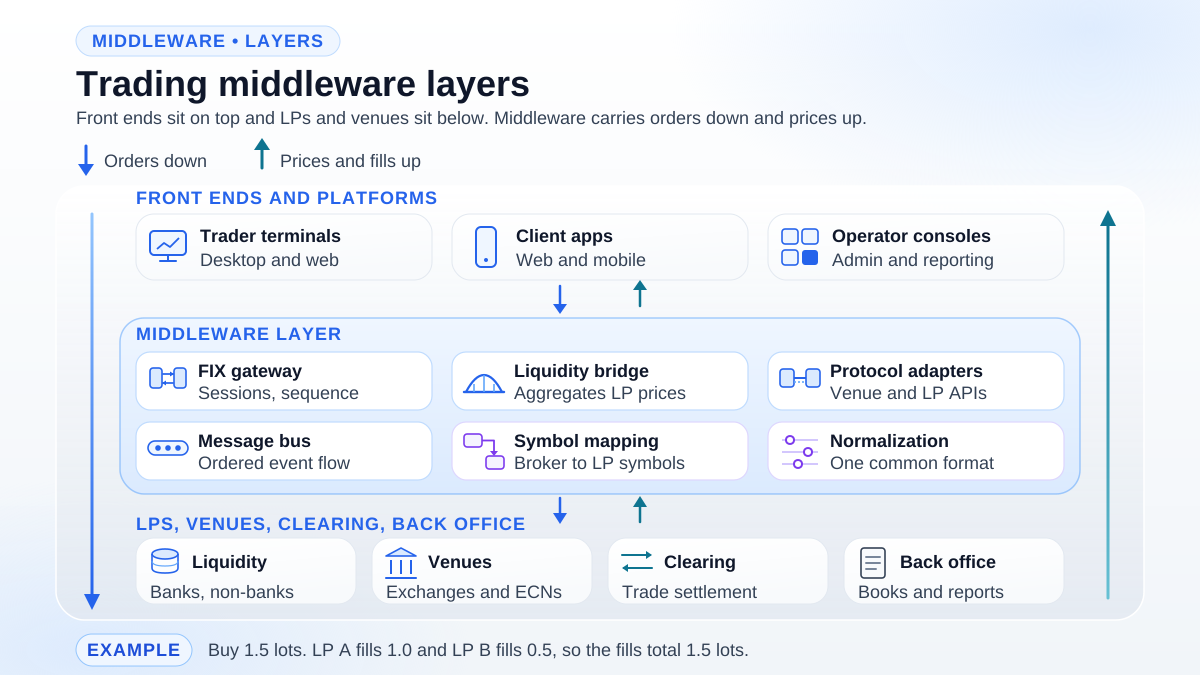
Trading middleware is a layer of software that sits between the systems that create orders and the systems that accept them. A client platform, an order management system or a broker's back office sends instructions into that layer. The middleware carries them to a liquidity provider, an exchange, a bridge or an internal service, and it carries replies back. Its job is to let two systems that speak different languages, or follow different session rules, work together without losing or duplicating an order.
Generic IT middleware connects business applications across an enterprise. Trading middleware uses some of the same techniques, such as message queues and adapters, but its work is tied to market rules: order states, price streams and session sequencing. Many teams use the word loosely for any connector, so define the scope in every requirement.
What the layer does
Six duties recur in most designs. Each one is a place where a fault can change what a client or counterparty sees.
Example (illustrative, not a benchmark): a client order arrives as a REST request with the broker's symbol. The middleware maps the symbol to the counterparty's code, builds a FIX NewOrderSingle, sends it on a session at sequence number 1,042, and maps the ExecutionReport back to the client's order ID. Each step can fail.
- Protocol translation: converts between FIX, REST, WebSocket and proprietary counterparty formats, so each side receives the message it expects.
- Routing: picks a destination for each order using rules such as venue, price, size, account or instrument.
- Normalization: maps prices, timestamps, order states and error codes into one internal model.
- Symbol mapping: links a venue's code for an instrument to the broker's internal identifier, contract size and decimal precision.
- Session management: handles logon, heartbeats, sequence numbers, resend requests and logout for each counterparty connection.
- Buffering: queues messages when a downstream system slows, so a burst does not drop or reorder orders.
Layer table: gateways, FIX engines, bridges, adapters and message buses
Five components usually make up the layer. One product may bundle several, so check which parts a quote covers.
| Component | Role | Example protocols | Typical owner |
|---|---|---|---|
| Gateway | Single entry point for one venue or counterparty, or for a set of client channels. Handles logon, order routing and reply mapping. | FIX 4.4 or 5.0; vendor binary APIs; MetaQuotes Gateway API for integration with other trading systems | Broker technology team, or the vendor that supplies the platform |
| FIX engine | Library or process that runs FIX session and message logic: sequence numbers, resend, heartbeats and validation. | FIX 4.4 session and application messages, or FIXT 1.1 transport with FIX 5.0 and later | Integration team, often on a licensed or open-source library |
| Liquidity bridge | Connects a broker to one or more liquidity providers. Normalizes prices, routes orders and records fills. | FIX, vendor APIs and proprietary price feeds | Broker or vendor on its side; each liquidity provider owns its own side |
| Adapter or connector | Translates between one system's data model and another, often for a specific CRM, back office or data source. | REST, WebSocket, database or file interfaces | Vendor or integrator, with scope set in the contract |
| Message bus | Carries events between internal services through queues or topics, so services can scale and recover without direct links. | Vendor-specific queue or stream protocols and internal message formats | Broker infrastructure or platform team |
Middleware vs platform vs bridge
The three terms overlap in practice. Procurement goes wrong when a quote covers one layer and the buyer assumes it covers all of them.
A trading platform is the software clients and staff use to see prices, place orders and manage accounts. Middleware sits between platforms and counterparties. A bridge is one kind of middleware, usually built to link a broker to liquidity providers. A platform may include a built-in gateway, so the boundaries blur.
The distinction matters when you compare offers. A quote that includes a bridge may cover one counterparty and one protocol version, while routing rules, reconciliation and reporting may need separate work. Ask which layers the price includes, and which counterparties and protocol versions each supports.
MetaQuotes describes MT5 gateways as an integrated way for brokers to hedge client risk by routing to other MetaTrader 5 brokers. It also describes a Gateway API for integration with other trading systems (checked 9 November 2026). These are vendor capabilities. A broker that connects to systems outside that scope still needs its own middleware.
Failure modes and what to test
A happy-path demo shows little about recovery. Test these faults before go-live.
The OnixS FIXT 1.1 reference says that a message with a sequence number lower than expected, without PossDupFlag set, indicates a serious error, and that it is strongly recommended the session be terminated and manual intervention be initiated. Test that your system stops and alerts in that case, rather than continuing silently.
Record the expected result, the observed result and the log evidence for each test. Do not accept a vendor's description of recovery without running the failure yourself.
- Session drops: test logon after a network loss, heartbeat timeouts and reconnection. Confirm that no order is sent twice and no execution report is lost.
- Sequence gaps: when a message arrives with a higher sequence number than expected, the receiver requests a resend. Test a multi-message gap, a resend that mixes administrative and application messages, and a gap-fill reply.
- Mapping errors: test a wrong symbol, contract size or decimal precision, and an unknown instrument. Each should be rejected and alerted, not routed.
- Back-pressure: when a counterparty or downstream service slows, queues grow. Test the queue limit, the message-age alarm and the behavior at the limit, and confirm that orders are delayed or rejected without reordering.
Build or buy the layer
The choice depends on the number of counterparties, how often their interfaces change and who maintains the mapping and recovery logic.
Buying gives faster coverage of common protocols, but you inherit a vendor's dialect and release cycle. Building gives control over routing and mapping, but it adds long-term support for every counterparty version. Either way, budget for counterparty certification and test environments, which often take longer than the coding. The build vs buy guide sets out the full framework.
Orrnn builds RTX5, a trading platform. Its liquidity bridge and FIX 4.4 and 5.0 modules have no published build on the RTX5 roadmap (checked 9 November 2026). This page does not treat them as available. A proposal should name each component and counterparty dialect in scope.
Limitations
This page explains a term. It is not legal, regulatory or investment advice, and it does not assess any vendor, broker or counterparty.
Protocol details come from FIX Trading Community pages and an OnixS vendor reference to FIXT 1.1. Dialects and versions vary by counterparty, so confirm normative wording against the current FIX specification before you design or contract a connection.
Orrnn does not supply liquidity, is not a broker and does not hold a license. Launch and licensing inquiries go to FxTrusts, a separate company.
Frequently asked questions
What is trading middleware?
Trading middleware is the software layer between order-entry systems and the venues or counterparties they trade with. It translates protocols, routes orders, normalizes data, maps symbols, manages sessions and buffers traffic. Generic IT middleware connects business applications. The two share some techniques, but the trading version must follow market rules.
Is a FIX gateway the same as trading middleware?
A FIX gateway is one component of trading middleware. It handles FIX session and message exchange with one counterparty or a set of clients. Full trading middleware usually also covers routing, symbol mapping, normalization and monitoring. Ask a vendor whether its gateway covers those duties or only the message exchange.
What is the difference between middleware and a liquidity bridge?
A liquidity bridge is a kind of trading middleware built to connect a broker to one or more liquidity providers. It usually normalizes prices, routes orders and records fills. Middleware is the wider category, covering client channels and internal services too. Check which counterparties and protocol versions a bridge supports.
What can go wrong with trading middleware?
The common faults are session drops, sequence gaps, mapping errors and back-pressure. A session drop can leave an order in an unknown state. A sequence gap needs a correct resend. A wrong symbol or contract size can route the wrong instrument. Back-pressure can delay or reorder orders when queues fill. Test each fault before go-live, not only the normal path.
Should a broker build or buy its trading middleware?
It depends on the number of counterparties, how often their interfaces change and who will maintain the mapping and recovery logic. Buying speeds up coverage of common protocols but limits control. Building gives control but adds support work. Either way, write acceptance criteria before you select.
Primary sources and further reading
These sources support the definitions used on this page. They do not endorse Orrnn or establish that any product complies with the referenced material.
- FIX Protocol
FIX Trading Community
Checked 9 November 2026. Cited for FIX as a global, open standard developed and maintained by the FIX Trading Community, which the page describes as an application-layer protocol.
- FIX Transport (FIXT) 1.1 specification page
FIX Trading Community
Checked 9 November 2026. Cited to confirm FIXT 1.1 is the FIX transport specification. The page shows a last-updated date of 23 July 2017.
- FIXT 1.1 Message Recovery
OnixS, vendor reference to the FIXT 1.1 specification
Checked 9 November 2026. Cited for ResendRequest triggers, the receiver's gap-fill steps, SeqReset-GapFill, and the advice to terminate the session and start manual intervention on a sequence-number error. This is vendor text, not FIX Trading Community's own, so confirm it against the specification.
- MetaTrader 5 for Brokers
MetaQuotes
Checked 9 November 2026. Cited for the stated purposes of the Gateway, Manager, Server and Report APIs and the gateway hedging description (routing through other MetaTrader 5 brokers). Vendor capability statement.
Related reading
FIX, REST, and WebSocket
Review protocol roles and recovery behavior when migrating interfaces.
Read →Liquidity Bridge: Definition and Evaluation
How a liquidity bridge routes prices and orders, and what to evaluate before go-live.
Read →FIX Protocol
What the FIX protocol covers, its message and session model, and where it fits in order flow.
Read →Build versus buy
A decision framework for building, buying or combining components for a broker platform.
Read →Order Routing for FX and CFD Brokers
Routing rules, risk gates, LP adapters and audit records for FX and CFD order flow.
Read →