Glossary term
What Is an ECN in Forex? ECN Meaning Explained
ECN meaning: an electronic communications network shows orders from many participants and lets them trade. See how it differs from a market maker.
Definition
An ECN, or electronic communications network, is an electronic system that widely disseminates orders to third parties and lets them execute against those orders. The term comes from US equity rules. In forex it is often used loosely for brokers that pass client orders to outside liquidity providers instead of filling them from their own book.
Also known as: ECN, ECN meaning, electronic communications network, electronic communication network, what is an ECN, ECN broker
Key takeaways
- ECN stands for electronic communications network, a term that comes from US equity market rules.
- In forex, ECN is loose marketing language. Two brokers that both say ECN can run very different models.
- An ECN-style broker passes orders to liquidity providers. A market maker fills orders from its own prices and book.
- Before you rely on an ECN label, ask for execution reports, the counterparty for each order, the full cost of a trade and the last look policy.
- Orrnn builds trading software. It does not supply liquidity, operate an ECN or act as a broker.
ECN meaning: where the term comes from
The ECN meaning starts in US equity regulation. Forex firms borrowed the label, and it does not carry the same legal definition.
The ECN meaning starts in US equity markets. Under SEC Regulation NMS, Rule 600(b)(36) defines an electronic communications network, for the purposes of Rule 602(b)(5), as "any electronic system that widely disseminates to third parties orders entered therein by an exchange market maker or OTC market maker, and permits such orders to be executed against in whole or in part", with listed exclusions.
The definition was written for US-listed stocks. It sits inside rules on how orders are displayed and routed across competing venues. It does not define a forex broker, a price or a trading platform.
In retail forex marketing, ECN describes a business model, not a legal status. A firm may call itself an ECN broker when it passes client orders to several liquidity providers, shows prices from more than one source or charges a separate commission. None of these is a regulatory test. The label tells you a claim has been made. The broker's disclosures tell you what it does.
How an ECN matches orders
An ECN shows orders from several participants and matches them under rules set by the venue or the broker.
In its original sense, an ECN is a venue. Participants post limit orders, the system displays them, and an incoming order that meets a resting order at an acceptable price is matched against it. Many venues use price-time priority, where the best price fills first and, at the same price, the earlier order fills first. Check each venue's rulebook.
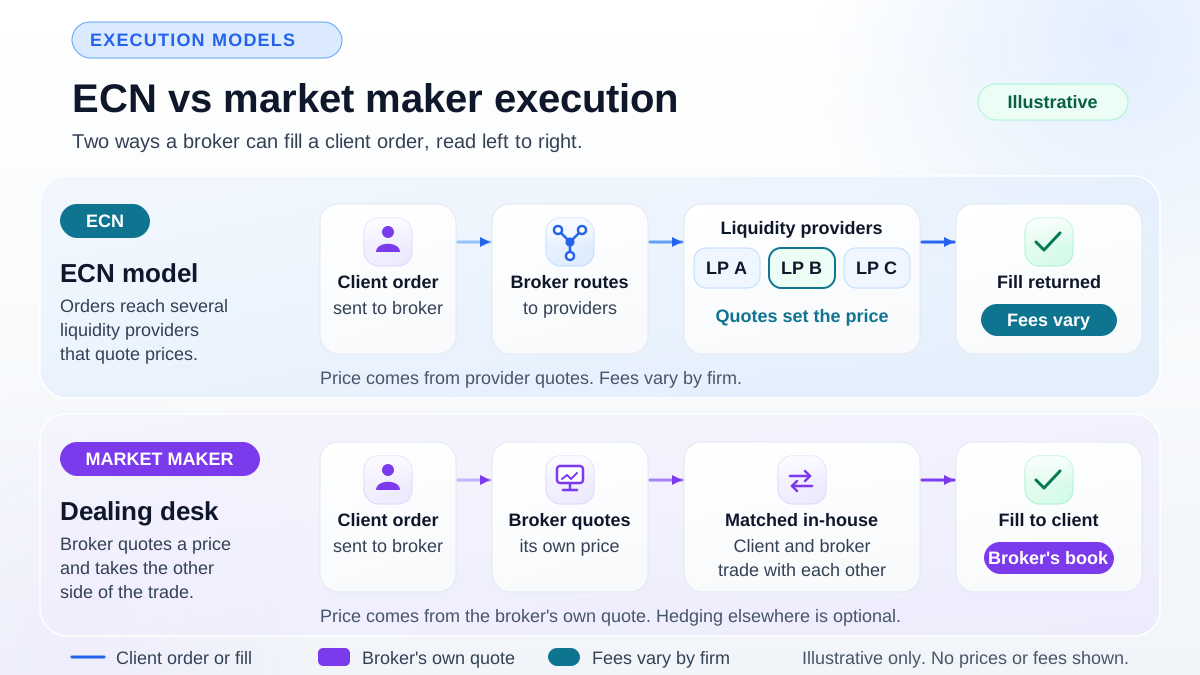
A forex ECN-style broker works differently at the front end. The broker collects client orders and sends them to liquidity providers, which quote prices into the broker's system. Some brokers show the best bid and offer from several providers, add a markup or commission, and route each order to the provider its logic selects. The matching decision then sits in the broker's routing logic, not in an open venue.
An order usually passes four steps: the client sends it, the broker checks it against risk limits, the routing logic selects a provider or venue, and a fill or reject returns with a timestamp. Each step can add delay, a reject or a price change, so the record of each step matters when you review execution.
ECN vs market maker: key differences
A market maker takes the other side of a trade from its own book. An ECN-style model passes the order to others to fill.
| Feature | ECN model (electronic communications network) | Market maker model |
|---|---|---|
| Who fills the order | One or more outside liquidity providers, or other participants on a venue | The market maker's own book, at prices it sets |
| Counterparty | The liquidity provider or participant that matches the order | The market maker itself, which takes the other side |
| Price source | Prices shown from several providers or from a venue's order book | Prices set by the market maker, usually with its own spread |
| Who carries the market risk | Usually the provider that fills the order | The market maker, which may hedge or internalize the position |
| Typical cost | Varies by firm. Check the fee schedule for commission, spread and markups | Varies by firm. Check whether costs appear as spread, commission or both |
ECN broker claims: what to verify
An ECN broker claim should come with evidence. Four checks cover most of the risk.
Last look is a window in which the firm receiving a price request can accept or reject the trade against its quoted price. The FX Global Code covers it in Principle 17 and asks participants to disclose whether, and how, price moves affect that decision. A broker that does not answer the question has not answered it.
The CFTC advises checking an OTC forex dealer's registration and disciplinary history before making initial deposits, using the National Futures Association's BASIC database. Do that check first, because the label does not show who is regulated or what they hold.
Checklist
- Ask for execution reports that show the requested price, the filled price, the time and the liquidity source for each fill.
- Compare the full cost of a round trip: spread, commission, markups and financing charges, not the headline spread alone.
- Ask who the counterparty is for each order and whether the broker ever takes the other side of client trades.
- Ask whether the provider uses last look, how long a price is held before the decision and what happens when the market moves.
How brokers connect to ECN-style venues
A broker reaches outside liquidity through a bridge or connector, often over FIX. Each connection needs its own tests.
A broker that offers ECN-style execution connects to each provider or venue through a liquidity bridge or connector. The bridge takes prices from providers, passes orders out and returns fills and rejects to the trading platform. These links can use FIX, which the FIX Trading Community describes as the global and open standard for exchanging trading information, independent of any particular network or transport.
The protocol version alone does not settle a connection. Each counterparty has its own session rules, message subset and dialect. Test logon, heartbeats, resend requests, sequence gaps, rejects and partial fills against that counterparty's written specification, then record which provider filled each order and at what price.
MetaQuotes says MetaTrader 5 offers solutions for integration with popular liquidity providers, checked 9 November 2026. That is a vendor-stated capability, not an independent test. The RTX5 roadmap lists the liquidity bridge and FIX 4.4 and 5.0 modules as having no published build yet (checked 9 November 2026), so a bridge for live ECN-style flow needs its own scope and acceptance tests. The RTX5 site, rtx5.orrnn.com, has a connectivity page that covers ECN-style liquidity arrangements.
Limitations
This page explains a term. It is not legal, regulatory or investment advice, and it does not assess any broker, venue or liquidity provider. Definitions differ between US equities, EU venue rules and retail forex marketing, so check the rule that applies to your product and market.
The Regulation NMS text covers US equities. The FX Global Code is a set of principles that market participants adopt voluntarily, not a license or regulation. Market practice and vendor documentation change over time.
Orrnn does not operate an ECN, supply liquidity, hold a license or act as a broker. Launch and licensing enquiries are referred to FxTrusts, a separate company.
Frequently asked questions
What is an ECN in forex?
In forex, ECN usually stands for electronic communications network, a term borrowed from US equity markets. Retail brokers use the label for several models, including brokers that pass client orders to outside liquidity providers. It is marketing language, not a legal status, so read the broker's execution disclosures to see how orders are filled and by whom.
Is an ECN broker the same as an ECN?
Not quite. An ECN, in the US equity definition, is an electronic system that disseminates orders to third parties. An ECN broker is a firm that claims to route client orders in an ECN-style way. The broker may be the counterparty or only a router. Verify the claim with execution reports, the counterparty for each order and the full cost of each trade.
Do ECN brokers charge a commission?
Commission arrangements vary by firm and are set out in each broker's fee schedule. Compare the total cost of a round trip at your typical trade size, including spread, commission and markups, rather than the headline spread. Ask for the schedule in writing before you open an account.
What is last look in an ECN?
Last look is a window in which the firm receiving a price request can accept or reject the trade against its quoted price. The FX Global Code covers it in Principle 17. Not every ECN-style provider uses last look, so ask the broker which providers it connects to and whether any of them applies last look.
Does Orrnn operate an ECN?
No. Orrnn is a trading software architecture and engineering provider. It builds RTX5 and does not supply liquidity, operate an ECN or hold a license. The RTX5 liquidity bridge and FIX 4.4 and 5.0 modules have no published build yet, so each counterparty connection needs its own acceptance tests.
Primary sources and further reading
These sources support the definitions used on this page. They do not endorse Orrnn or establish that any product complies with the referenced material.
- 17 CFR 242.600: Definitions (Regulation NMS)
U.S. Securities and Exchange Commission, via the eCFR
Defines electronic communications network in paragraph (b)(36), written for US equity rules. Quoted for paragraph (b)(36), checked on the eCFR on 9 November 2026. The definition is scoped to Rule 602(b)(5) and has listed exclusions.
- FIX Protocol
FIX Trading Community
Describes FIX as the global and open standard for exchanging trading information, independent of network, transport and encoding. Used for the messaging point only.
- Customer Advisory: Eight Things You Should Know Before Trading Forex
U.S. Commodity Futures Trading Commission
Advises checking an OTC forex dealer's registration and disciplinary history before making initial deposits, using NFA BASIC.
- FX Global Code
Global Foreign Exchange Committee (GFXC)
Principle 17 covers last look, where the receiving participant can accept or reject a trade request against its quoted price.
- MetaTrader 5 for brokers
MetaQuotes
Vendor description of MetaTrader 5 solutions for integration with liquidity providers. A vendor-stated capability, not an independent test.
Related reading
SDP Meaning: Single-Dealer Platforms Explained
How a single-dealer platform differs from a multi-dealer platform, and where dealer feeds sit in a broker's stack.
Read →Brokerage Models Compared: A-Book vs B-Book vs Hybrid
How brokers choose between passing orders to the market and taking the other side. Covers the broker model in depth.
Read →Liquidity Bridge: Definition, Routing and Evaluation
What a liquidity bridge does, how it routes prices and orders, and what to test before go-live.
Read →FIX Protocol
What FIX is, how its messages are structured and why each counterparty needs its own session rules.
Read →What Is a Liquidity Provider? A Broker's Guide
Liquidity provider roles, pricing models, last look and due diligence for brokers.
Read →